
Both walking and using a stationary bike are effective ways to improve heart health and burn calories. Walking is simple and weight-bearing, which supports bone health. A stationary bike is lower impact and may burn more calories in less time. The better choice depends on your joints, schedule, fitness goals, and which workout you can do consistently: Stationary Bike vs. Walking
If you want a simple way to get more exercise, walking and using a stationary bike are two great options. Both help you burn calories, strengthen your heart, and support weight loss. They are also easy to fit into a busy day.
The biggest difference is how your body moves. Walking is a natural activity that uses your full body weight. A stationary bike supports your body, which puts less stress on your knees and ankles.
When comparing a stationary bike vs. walking, there is no one best choice for everyone. The right option depends on your goals, your fitness level, and what feels comfortable enough to do on a regular basis.
Both walking and stationary biking offer many of the same health benefits, but they feel very different in practice. This side-by-side comparison shows how they stack up in the areas most people care about.
Stationary bike vs. Walking at a glance
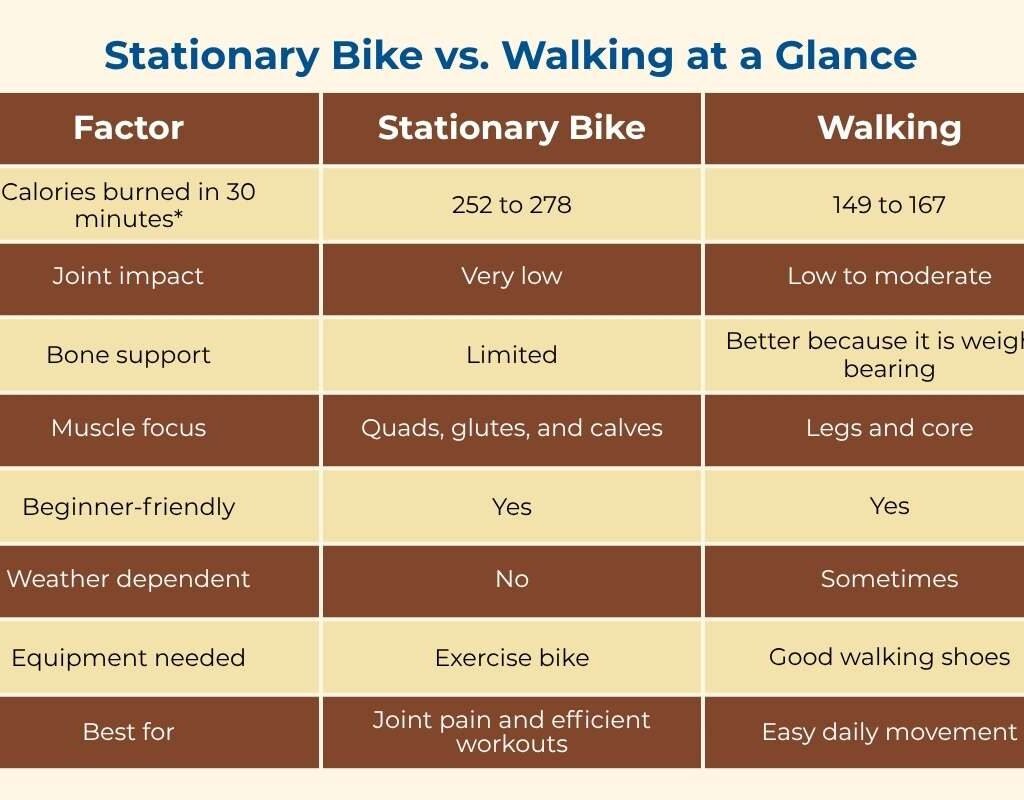
Both walking and stationary biking offer many of the same health benefits, but they feel very different in practice. This side-by-side comparison shows how they stack up in the areas most people care about.
| Factor | Stationary Bike | Walking |
| Calories burned in 30 minutes* | 252 to 278 | 149 to 167 |
| Joint impact | Very low | Low to moderate |
| Bone support | Limited | Better because it is weight-bearing |
| Muscle focus | Quads, glutes, and calves | Legs and core |
| Beginner-friendly | Yes | Yes |
| Weather dependent | No | Sometimes |
| Equipment needed | Exercise bike | Good walking shoes |
| Best for | Joint pain and efficient workouts | Easy daily movement |
Approximate values for a 155-pound person exercising at a moderate pace.
The table gives a quick overview, but the best choice depends on what matters most to you. The sections below explain how each option performs for weight loss, joint health, heart fitness, and more.
Which burns more calories?
If you want to burn more calories in less time, a stationary bike usually comes out ahead. You can raise the resistance and work harder without putting extra stress on your knees and ankles.
A 155-pound person burns about 252 calories in 30 minutes of moderate cycling. The same person burns about 149 to 167 calories during brisk walking, depending on speed.
Still, higher calorie burn does not guarantee better fat loss. What matters most is how much activity you do over time. When comparing a stationary bike vs. walking, the better option is the one you can stick with week after week.
Even a workout that burns fewer calories can lead to great results if you do it consistently.
Which is better for weight loss?

Weight loss happens when you burn more calories than you take in from food and drinks. Exercise can help, but staying consistent matters more than the type of cardio you choose.
A stationary bike can be a good choice if you want structured workouts and higher calorie burn in less time. Walking may work better if you prefer to add movement throughout your day, such as after meals or during work breaks.
Many people find walking easier to maintain because it feels simple and familiar. Others like indoor cycling because they can exercise at home in any weather.
When comparing a stationary bike vs. walking, the best option for weight loss is the one you can keep doing every week.
Which is easier on your joints?
A stationary bike is one of the most joint-friendly ways to do cardio. Your feet stay on the pedals, and the seat supports most of your body weight. This reduces pressure on your knees, hips, and ankles.
Walking is also considered low impact, but each step still sends some force through your joints. For most people, this is not harmful. It can actually help keep your joints moving well.
If you have arthritis, carry extra weight, or are recovering from an injury, a stationary bike may feel more comfortable.
In the stationary bike vs. walking comparison, the bike is usually the better choice for protecting sore joints.
Which is better for heart health?

Walking and stationary biking are both aerobic exercises. That means they make your heart and lungs work harder. Over time, this can improve circulation and lower the risk of high blood pressure, heart disease, and type 2 diabetes.
Health experts recommend at least 150 minutes of moderate aerobic exercise each week. Both activities can help you reach that goal.
A stationary bike can make it easier to do short, harder intervals. Walking is easy to spread throughout the day, even in small sessions.
Both are excellent for heart health if you do them regularly and keep a steady pace.
Which builds more muscle?
Walking and cycling are both good for strengthening your legs, but neither will build large muscles the way weight training does.
A stationary bike works your quadriceps, hamstrings, glutes, and calves. When you increase the resistance, your muscles have to push harder with every pedal stroke.
Walking uses many of the same muscles, but with less resistance. It also engages your core and helps improve balance.
If your goal is to make your legs work harder during cardio, the bike has a small advantage.
Between the two, indoor cycling usually provides a stronger muscle challenge.
Which is better for bone health?
Walking is a weight-bearing exercise. This means your bones support your body every time you take a step. That small amount of stress helps keep bones strong over time.
A stationary bike is not weight-bearing because the seat supports most of your body weight. It is excellent for improving fitness, but it does less to maintain bone density.
If keeping your bones strong is a top priority, walking has a clear advantage.
For this reason, between stationary bike vs. walking, walking offers an important benefit that indoor cycling cannot fully match.
Which one fits your lifestyle best?

The best workout is the one you can keep doing week after week.
Walking is simple and costs very little. All you need is a good pair of shoes and a safe place to walk. You can go outside, walk in a mall, or use a treadmill. It is a great choice if you want a free and natural way to stay active.
A stationary bike is convenient because you can use it at home in any weather. It may be a better option if you have knee or hip pain, want guided workouts, or like short, efficient exercise sessions.
Some people enjoy the freedom of walking. Others prefer the comfort and structure of indoor cycling.
The right choice is the one that fits your body, your schedule, and your personal preferences.
Can you combine both?
Yes, and for many people, this is the best approach.
Using both walking and a stationary bike gives you the benefits of each. You get the joint-friendly cardio of cycling and the bone-strengthening benefits of walking. It also adds variety, which can help prevent boredom.
For example, you might ride the bike for 20 to 30 minutes three times per week and go for a 30 to 45-minute walk on the other days.
Combining both options can improve your fitness while keeping your routine flexible and easier to maintain.
Final verdict
Walking and stationary biking are both excellent ways to improve your health. Walking is simple, supports bone strength, and fits easily into everyday life. A stationary bike is gentle on the joints and can help you burn more calories in less time.
When comparing a stationary bike vs. walking, there is no single winner. The better choice is the one you enjoy and can do on a regular basis.
If you have the time and equipment, combining both can give you the benefits of each and help you stay active for the long term.