Eating disorders are serious mental health conditions marked by persistent disturbances in eating behaviors, thoughts, and emotions that impair physical health and daily functioning. Nearly 9% of people in the U.S., about 31 million, will experience one in their lifetime, yet many still see them as a matter of food, weight, or vanity. They aren’t. They arise from brain function, genetics, emotions, and environment, and affect all ages, genders, and body sizes. A 2026 JAMA Psychiatry study found that 32.1% of U.S. adults with eating disorders had used GLP-1 medications, and 10.1% reported misuse. This guide covers anorexia nervosa, bulimia nervosa, binge eating disorder, and ARFID.
You’ll also learn exactly how neuroscience is revealing the roles of reward processing, appetite regulation, and emotional control in eating behaviors. And why emerging treatments, including GLP-1 medications, are raising important clinical questions.
Table of Contents:
- What Are Eating Disorders and Why Do They Develop?
- What Are the Four Major Types of Eating Disorders?
- How Do Eating Disorders Affect the Brain and Nervous System?
- What Physical and Mental Health Complications Can They Cause?
- How Are Eating Disorders Treated?
- Can GLP-1 Medications Change Eating Behaviors?
- What Does Emerging Neuroscience Mean for Eating Disorder Treatment?
- Conclusion
- FAQ
What Are Eating Disorders and Why Do They Develop?
According to the National Institute of Mental Health (NIMH), eating disorders are serious mental health conditions characterized by severe disturbances in eating behaviors and related thoughts and emotions. They intensely disrupt thoughts, emotions, eating patterns, and daily functioning. A clear clinical boundary separates casual dieting or occasional disordered eating behaviors from a clinically diagnosed eating disorder. This involves persistent, impairing cognitive and behavioral patterns. Crucially, these conditions are complex psychological illnesses rather than lifestyle choices or a simple lack of willpower.
What Causes Eating Disorders?
The development of these mental health conditions is driven by the biopsychosocial model, which demonstrates that no single factor can account for any individual condition. Instead, they arise from an intricate interaction of:
- Genetic predisposition and family history
- Neurobiological factors and brain chemistry
- Psychological vulnerabilities such as chronic anxiety, perfectionism, and emotional distress
- Environmental influences, including trauma, social pressures, and weight stigma
- Cultural expectations and deeply ingrained body image concerns
Who Can Develop an Eating Disorder?
These conditions affect people across all genders, ages, and body sizes. Misconceptions that they are exclusive to adolescent girls or individuals with low body weight often delay vital care. Research emphasizes the critical importance of recognizing symptoms among diverse demographics, including men and older adults.
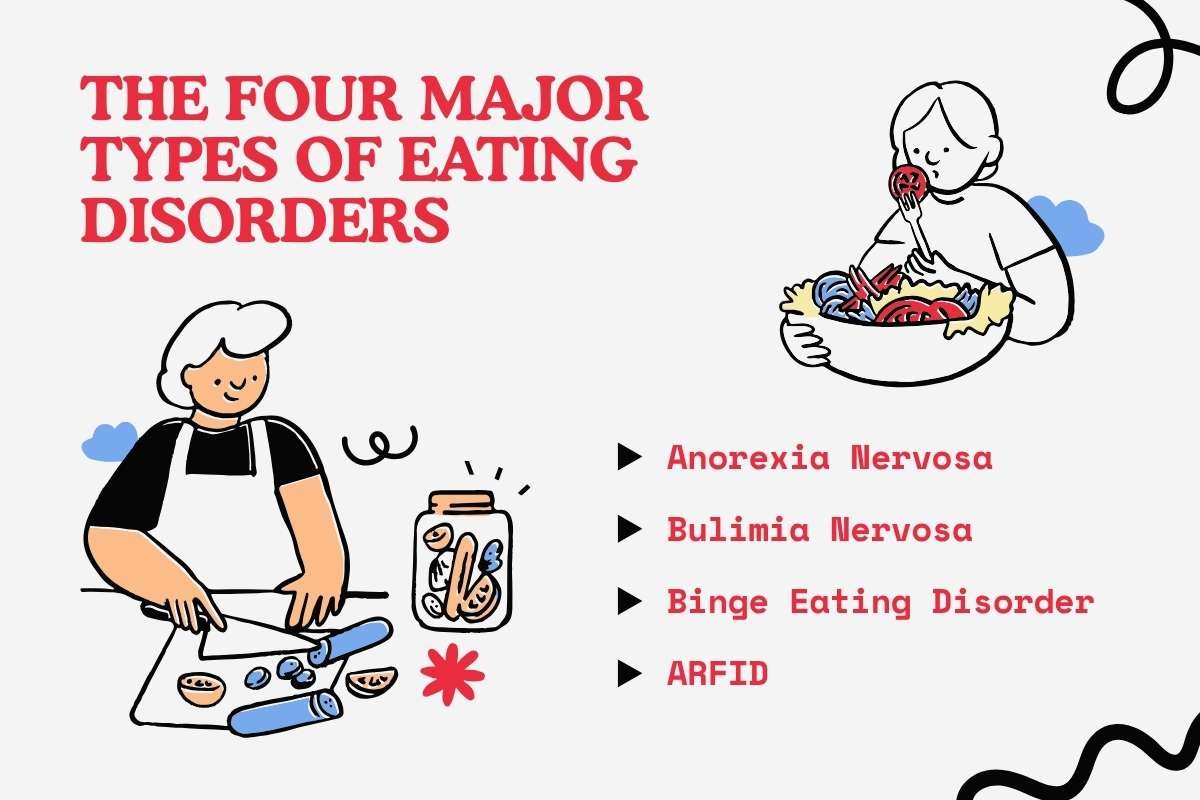
What Are the Four Major Types of Eating Disorders?
Anorexia Nervosa – When Restriction Becomes a Serious Health Risk
Anorexia involves persistent food restriction driven by an intense fear of weight gain and a distorted body image. Serious medical risks, including malnutrition and cardiovascular strain, can occur even at a normal or higher body weight (atypical anorexia).
Bulimia Nervosa – The Cycle of Bingeing and Compensatory Behaviors
Bulimia features recurrent binge episodes followed by compensatory behaviors like vomiting, laxative misuse, fasting, or excessive exercise. Fueled by shame and body-image concerns, it can damage the digestive system, teeth, and heart.
Binge Eating Disorder – When Eating Feels Beyond Your Control
BED involves repeated episodes of eating rapidly or past fullness, accompanied by distress and a sense of lost control. Unlike bulimia, it does not include compensatory behaviors.
ARFID – When Food Avoidance Is Not About Body Image
ARFID stems from sensory sensitivities or a fear of choking or vomiting, leading to nutritional deficits or impaired growth. Unlike anorexia, it is not driven by weight or body shape concerns.
Primary Overview
| Eating Disorder | Defining Pattern | Key Distinction |
| Anorexia Nervosa | Restriction of food intake | Driven by fear of weight gain and distorted body image |
| Bulimia Nervosa | Bingeing and compensatory behaviors | Involves regular purging, fasting, or excessive exercise |
| Binge Eating Disorder (BED) | Recurrent binge eating | Marked by loss of control without compensatory behaviors |
| ARFID | Restrictive or avoidant eating | Sensory/fear-based avoidance, not driven by weight concerns |
Note: These four conditions are not exhaustive. The National Health Service (NHS, 2024) and Beat (2024) also highlight Other Specified Feeding or Eating Disorders (OSFED), Pica, and Rumination Disorder.
How Do Eating Disorders Affect the Brain and Nervous System?
The Brain’s Reward System and Dopamine Signaling
Dopamine regulates motivation, reward learning, and behavioral reinforcement. Altered dopamine signaling may influence how the brain processes food-related rewards, reinforcing restrictive or binge-eating behaviors.
How Appetite Regulation and Hunger Signals Are Affected
The hypothalamus coordinates hunger and satiety by processing peripheral metabolic hormones like ghrelin and leptin. Prolonged restriction or bingeing disrupts these signals, impairing the brain’s ability to accurately sense metabolic needs.
Emotional Regulation, Anxiety, and Cognitive Flexibility
Impaired cognitive control networks and heightened default mode network activity drive rigid thinking and emotional distress. Additionally, altered interoception disrupts internal bodily awareness, making it difficult to process hunger, fullness, or emotional cues.
Can Brain Changes Persist During Recovery?
Research shows neural alterations can persist even after weight restoration, explaining why psychological recovery often lags behind physical healing. Notably, brain imaging findings represent group research observations rather than individual diagnostic tools.
What Physical and Mental Health Complications Can Eating Disorders Cause?

Cardiovascular and Metabolic Complications
Severe starvation or purging alters fluid dynamics, leading to critical electrolyte disturbances (such as hypokalemia) and irregular heart rhythms. Prolonged nutrient deprivation causes low blood pressure, bradycardia, and metabolic shutdown.
Digestive and Gastrointestinal Effects
Chronic restriction impairs gastrointestinal motility, causing severe constipation and delayed gastric emptying (gastroparesis). Meanwhile, recurrent vomiting damages the esophageal lining and dental enamel, whereas laxative misuse disrupts normal bowel function.
Effects on Hormones, Bones, and Brain Function
Malnutrition suppresses the hypothalamic-pituitary-gonadal axis, altering reproductive hormones and triggering amenorrhea. The resulting estrogen deficit severely reduces bone density, accelerating osteoporosis risk. Severe malnutrition associated with eating disorders can be accompanied by changes in brain structure and cognitive functioning.
Mental Health Conditions That Can Occur Alongside
Co-occurring mental health challenges frequently compound clinical severity:
- Depression and generalized anxiety
- Obsessive-compulsive symptoms and perfectionistic traits
- Substance use disorders and self-harm behaviors
- Elevated risk of suicidal ideation and self-directed violence
Behavior-to-Complication Mapping
| Specific Behavior | Primary Health Complication |
| Severe Food Restriction | Bradycardia, bone density loss, amenorrhea |
| Recurrent Self-Induced Vomiting | Electrolyte imbalance, esophageal tears, dental erosion |
| Laxative Misuse | Chronic constipation, cathartic colon, fluid loss |
| Compulsive Binge Eating | Gastrointestinal distress, metabolic strain |
Note: Medical risks vary significantly based on diagnosis, severity, duration, and individual health status.
How Are Eating Disorders Treated?
Eating disorder treatment aims to restore physical health, address harmful eating behaviors, and improve psychological well-being. The approach depends on the diagnosis, symptoms, age, and individual needs.
Evidence-Based Psychotherapy
Cognitive behavioral therapy (CBT), including CBT-ED, helps individuals address unhealthy eating patterns, body-image concerns, and emotional triggers.
Family-Based Treatment
Family-based treatment (FBT) is particularly useful for adolescents with anorexia nervosa. It involves parents or caregivers in supporting nutritional recovery and healthier eating habits.
Nutritional Rehabilitation and Medical Monitoring
Nutritional rehabilitation helps restore adequate food intake and correct deficiencies. Regular medical monitoring tracks vital signs, electrolyte levels, and other health complications.
Why Multidisciplinary Care Matters
Recovery often involves coordinated support from psychiatrists, psychologists, dietitians, physicians, and family members. This approach addresses both the physical and psychological effects of eating disorders.
The key takeaway: Recovery requires more than changing eating habits; it involves psychological care, nutritional support, and medical monitoring.
Read More: The Dangers of Fad Diets and Losing Weight Too Quickly
Can GLP-1 Medications Change Eating Behaviors?
GLP-1 (glucagon-like peptide-1) medications, such as semaglutide and liraglutide, mimic a natural gut hormone that regulates blood sugar, slows stomach emptying, and signals fullness to the brain. They are approved for type 2 diabetes and weight management, but their role in treating eating disorders is still being investigated.
Could GLP-1 Medications Help With Binge Eating Disorder?
A 2025 rapid review and subsequent meta-analyses show that GLP-1 medications can reduce binge-eating frequency, loss-of-control eating, and disinhibited appetite. By enhancing satiety signaling, these drugs may blunt compulsive food urges. However, researchers emphasize that appetite reduction does not automatically equate to solving core cognitive and emotional psychopathology.
Can GLP-1 Medications Worsen Restrictive Eating Behaviors?
Significant safety concerns exist regarding potential misuse. Severe appetite suppression can exacerbate restrictive patterns or trigger relapse in individuals with a history of anorexia nervosa or bulimia nervosa. Because metabolic and neural responses vary widely, these medications pose unique risks depending on an individual’s underlying eating disorder history.
Potential Benefits vs. Clinical Concerns
| Potential Benefit Under Investigation | Major Clinical Concern |
| Reduction in binge-eating frequency | Lack of long-term randomized clinical trials |
| Enhanced satiety and appetite regulation | Excessive suppression leading to severe malnutrition |
| Decreased compulsive food cravings | Potential misuse to fuel restrictive weight-loss goals |
| Cardiometabolic stabilization | Failure to treat psychological triggers (grief, trauma, anxiety) |
What Does Current Evidence Say About Their Safety?
A 2026 multidisciplinary Delphi study highlights the need for careful screening and monitoring when considering GLP-1 medications in people with current or previous eating disorders. Comprehensive eating disorder screening and rigorous psychiatric monitoring are essential before and during initiation to ensure patient safety.
What Does Emerging Neuroscience Mean for Eating Disorder Treatment?

Functional neuroimaging techniques (fMRI) help researchers map brain connectivity, altered reward processing, and executive control networks underlying eating disorders. These imaging studies help clarify why different subtypes exhibit distinct neurological responses to food cues, reward, and anxiety.
Could Biomarkers Help Predict Treatment Response?
Investigational biological and behavioral markers aim to identify which patients might benefit most from targeted interventions. However, reliable neurobiological biomarkers for diagnosing or prescribing treatment are still in experimental stages and not yet used in routine clinical practice.
Precision Psychiatry and Personalized Care
Precision psychiatry seeks to combine genetic profiles, clinical history, psychological evaluations, and neuroimaging data to create individualized treatment strategies. Given the complex nature of these conditions, multidisciplinary care, integrating medical, nutritional, and psychological therapies, remains the gold standard.
What Researchers Still Need to Understand
Key areas of ongoing research include:
- Why neural changes and cognitive rigidity often persist post-weight restoration
- Why individual treatment response rates vary significantly
- Identifying reliable early biological indicators of relapse
- Establishing safe protocols for emerging pharmacological adjuncts
Conclusion
Eating disorders are complex conditions shaped by brain function, genetics, emotions, and environment, not by willpower or vanity. As this guide shows, anorexia nervosa, bulimia nervosa, binge eating disorder, and ARFID each carry distinct patterns and serious physical and mental health risks. Neuroscience is helping explain why reward processing, appetite regulation, and emotional control matter, while emerging options like GLP-1 medications call for caution and close clinical oversight. Recovery is possible, and it works best through multidisciplinary care that treats both body and mind.
Eating disorders are treatable, and professional support matters. If you or someone you know is struggling with food or body image, consider speaking with a qualified healthcare professional today.
Read More: 10 Ways your eating Behavior affects your Emotions
FAQ:
1. Can you have an eating disorder without being underweight?
Yes, eating disorders can affect people of any body size, and weight alone cannot indicate whether someone has one.
2. What causes eating disorders to develop?
It can develop through a combination of genetic, biological, psychological, and environmental factors.
3. Can eating disorders cause long-term health problems?
Yes, they can affect the heart, digestive system, hormones, bones, and brain, sometimes causing serious or lasting complications.
4. Can eating disorders affect men and older adults?
This can affect people of all genders, ages, body sizes, and backgrounds.
5. Are eating disorders linked to anxiety and depression?
Yes, they frequently occur alongside anxiety, depression, obsessive-compulsive symptoms, and other mental health conditions.
Links and Sources:
- https://www.nationaleatingdisorders.org/statistics/#:~:text=9%25%20of%20the%20US%20population%2C%20or%20nearly%2031%20million%20Americans%20will%20have%20an%20eating%20disorder%20in%20their%20lifetime. (Introduction Statistics)
- https://www.nimh.nih.gov/health/publications/eating-disorders
- https://www.nhs.uk/mental-health/feelings-symptoms-behaviours/behaviours/eating-disorders/overview
- https://www.nimh.nih.gov/health/publications/what-are-common-types-of-eating-disorders
- https://www.nationaleatingdisorders.org/health-consequences
- https://oxfordhealth.nhs.uk/camhs/self-care/ed/
- https://pubmed.ncbi.nlm.nih.gov/42742590
- https://pmc.ncbi.nlm.nih.gov/articles/PMC13523834