Can your DNA tell you what to eat? Studies suggest up to 20% of individual variation in response to certain nutrients, like caffeine or saturated fat, may be linked to genetics. This is the core idea behind a nutrigenomics diet: an eating approach that uses insights from gene-nutrient interactions, how genetic variation affects nutrient response, and how nutrients influence gene activity to inform food choices, portions, and patterns. It’s not one fixed meal plan, and research doesn’t yet support DNA tests pinpointing a single “perfect” diet for anyone.
Here’s what you’ll learn: how genes influence nutrient metabolism, key variants worth knowing (like MTHFR or FTO). What genetic testing can realistically reveal versus what it can’t. How to responsibly apply these insights and whether a nutrigenomics diet is actually worth trying based on current evidence.
What Is a Nutrigenomics Diet?
A nutrigenomics diet is an eating approach informed by research into interactions between genetic variation and nutrition. It uses insights from how genes and nutrients influence each other to tailor food choices, portions, and patterns to an individual’s biology. It still respects core principles of healthy eating.
Core concepts
- Nutrigenetics: Studies how genetic differences affect responses to nutrients (for example, why some people’s cholesterol rises more on high–saturated fat diets).
- Nutrigenomics: Studies how nutrients and food compounds influence gene activity and expression (such as how omega-3s or fibre can modulate inflammatory pathways).
- Personalised nutrition: Combines genetics with other personal data like age, health status, labs, lifestyle, and microbiome. This helps to guide nutrition recommendations that are more relevant to the individual.
This distinction improves scientific precision because it clarifies direction: genes → nutrient response (nutrigenetics) versus diet → gene regulation (nutrigenomics), both feeding into personalized nutrition.
What a Nutrigenomics Diet isn’t
- One fixed meal plan. It’s a framework that adapts as your data and goals change.
- A replacement for healthy eating principles like variety, balance, and moderation.
- A guaranteed weight-loss method; genetics inform risk and response, not outcomes alone.
- A diagnostic tool for every food-related problem; many issues stem from environment, behaviour, or medical conditions.
- Proof that your genes determine your health; lifestyle, environment, and access to care remain powerful.
How it fits with established dietary patterns
Regardless of genetic profile, a personalized diet still needs to fit the fundamentals of a healthy diet, including adequate nutrients, variety, balance, and moderation. A nutrigenomics approach typically layers genetic insights into proven patterns. Such as the Mediterranean Diet or DASH Diet. This helps to refine macronutrient targets, sodium tolerance, or fibre goals. For specific conditions, these foundations can be adapted into a diet for diabetes or a Healthy brain diet. Using genotype-informed tweaks while keeping evidence-based food groups and limits intact.
How Do Your Genes Affect the Way You Respond to Food?

Your genes can shape how you respond to food through a simple chain: a genetic variant changes the activity of a protein, enzyme, or receptor. That can alter how a nutrient is absorbed, metabolised, or used, and over time, this may shift dietary needs or disease risk. This is why a Nutrigenomics Diet focuses on patterns and personalisation rather than rigid rules.
Practical examples
- LCT (lactose digestion): Variants near the LCT gene influence whether lactase enzyme production persists into adulthood. People with lactase non-persistence are more likely to experience bloating or diarrhoea after dairy. Others tolerate it well.
- CYP1A2 (caffeine metabolism): Genetic differences can speed up or slow down caffeine breakdown, affecting jitteriness, sleep, and blood pressure responses. Still, caffeine effects also depend on dose, timing, medications, and sleep habits.
- APOE/APOA2 (lipid metabolism): Variants in APOE and APOA2 have been studied for how they relate to blood cholesterol and triglyceride responses to dietary fat and cholesterol. Effects vary by ancestry, overall diet quality, and other genes.
- MTHFR (folate metabolism): Common MTHFR variants can reduce enzyme efficiency and modestly lower folate status or raise homocysteine. This does not mean everyone with a variant needs a special diet. Adequate folate from foods or standard supplements often suffices.
- VDR (vitamin D biology): Variants in the vitamin D receptor can influence how cells respond to vitamin D and may modestly affect blood levels or supplementation response. Sunlight exposure, diet, body weight, and skin tone remain major factors.
Genes can influence nutritional responses. They rarely tell the entire story. Environment, lifestyle, medications, and overall diet quality usually matter more than any single variant.
Which Gene Variants Can Influence Nutrition?
Several common gene variants can nudge how your body handles specific nutrients. But they rarely “determine” requirements on their own. Within a nutrigenomics diet, these variants are used to refine, not replace, standard nutrition guidance.
| Gene/variant | Nutritional area | What research suggests | What it doesn’t mean |
| LCT (e.g., rs4988235) | Lactose digestion | Can influence lactase persistence and dairy tolerance. | Not every digestive symptom is lactose intolerance; other GI issues exist. |
| CYP1A2 (e.g., rs762551) | Caffeine | Variants influence caffeine metabolism speed (fast vs slow). | Genotype doesn’t determine your entire caffeine response; dose, timing, and habits matter. |
| APOE (e.g., ε4) | Lipid metabolism | Variants interact with lipid-related factors and saturated fat response. | It doesn’t prescribe one universal diet; lipid labs and overall pattern matter more. |
| MTHFR (e.g., C677T) | Folate metabolism | Variants can affect folate-related pathways and homocysteine. | A variant alone doesn’t establish a deficiency; testing and diet quality are key. |
| FTO (e.g., rs9939609) | Weight-related traits | Associated with obesity susceptibility and appetite/food preference signals. | It doesn’t mean weight gain is inevitable; activity and diet strongly modify risk. |
| VDR (e.g., FokI, ApaI, TaqI) | Vitamin D | Variants may influence vitamin D–related biology and response to supplementation. | Testing doesn’t replace vitamin D assessment; sun, intake, BMI, and labs still guide care. |
Single-gene vs polygenic traits
Some nutritional traits have relatively straightforward genetic mechanisms (for example, lactase persistence with LCT). While obesity, type 2 diabetes, and cardiovascular disease involve many genes plus environmental and lifestyle factors. That’s why evidence is graded: single-gene effects can be clearer. Whereas polygenic traits show small per-variant effects that add up and interact with diet, activity, sleep, and environment.
In practice, this means a nutrigenomics diet uses genetics to personalise targets (like caffeine limits or saturated fat moderation). But still leans on established dietary patterns and clinical markers for decisions.
What Can a Nutrigenomics Test Actually Tell You?

A nutrigenomics test may provide information about nutrient metabolism, certain food-related traits, genetic predispositions, caffeine metabolism, lactose digestion, some lipid/metabolic pathways, and selected disease-risk associations. However, this is informational, not a substitute for clinical diagnosis or personalised medical advice. Within a nutrigenomics diet, results are best used to refine habits (like caffeine limits or saturated fat targets) alongside labs, symptoms, and established dietary patterns.
Can it tell me…?
| Question | Short answer |
| Which foods are healthiest for me? | Not completely; DNA gives tendencies, not a full meal plan. |
| How do I metabolise caffeine? | Sometimes, variants like CYP1A2 can indicate faster or slower metabolism. |
| Do I have lactose persistence? | Potentially, LCT-related variants can suggest dairy tolerance. |
| Whether I’ll develop diabetes? | No, not by itself. The risk is polygenic and shaped by lifestyle and environment. |
| Whether keto is best for me? | Not reliably; the evidence for genotype-specific “best” diets remains limited. |
| Which supplements do I need? | Not from DNA alone; needs depend on diet, labs, medications, and health status. |
| Whether I’m nutrient deficient? | Usually requires clinical assessment (blood tests), not just genetics. |
| Do genetics affect my weight? | Genetics can contribute, but aren’t destiny. FTO and other variants modify risk, not outcomes. |
Key limitation:
Most nutrition traits are polygenic and context-dependent. Direct-to-consumer tests often cover a small set of variants and may not generalise across populations, so results should be interpreted cautiously and confirmed with a clinician when making health decisions.
Who Should Consider Nutrigenomics?
A nutrigenomics diet may be worth exploring if you’ve tried standard dietary advice without clear results, have a family history of conditions like heart disease or diabetes, or want deeper insight into specific traits like caffeine sensitivity, dairy tolerance, or cholesterol response. It can also appeal to people who enjoy data-driven self-experimentation. However, it’s less useful as a first step for general health improvement, during pregnancy without medical guidance, or as a replacement for treating diagnosed conditions. Those with disordered eating patterns should approach genetic-based diet personalization cautiously, and only alongside a qualified healthcare provider.
How to Build a Nutrigenomics-Informed Diet?
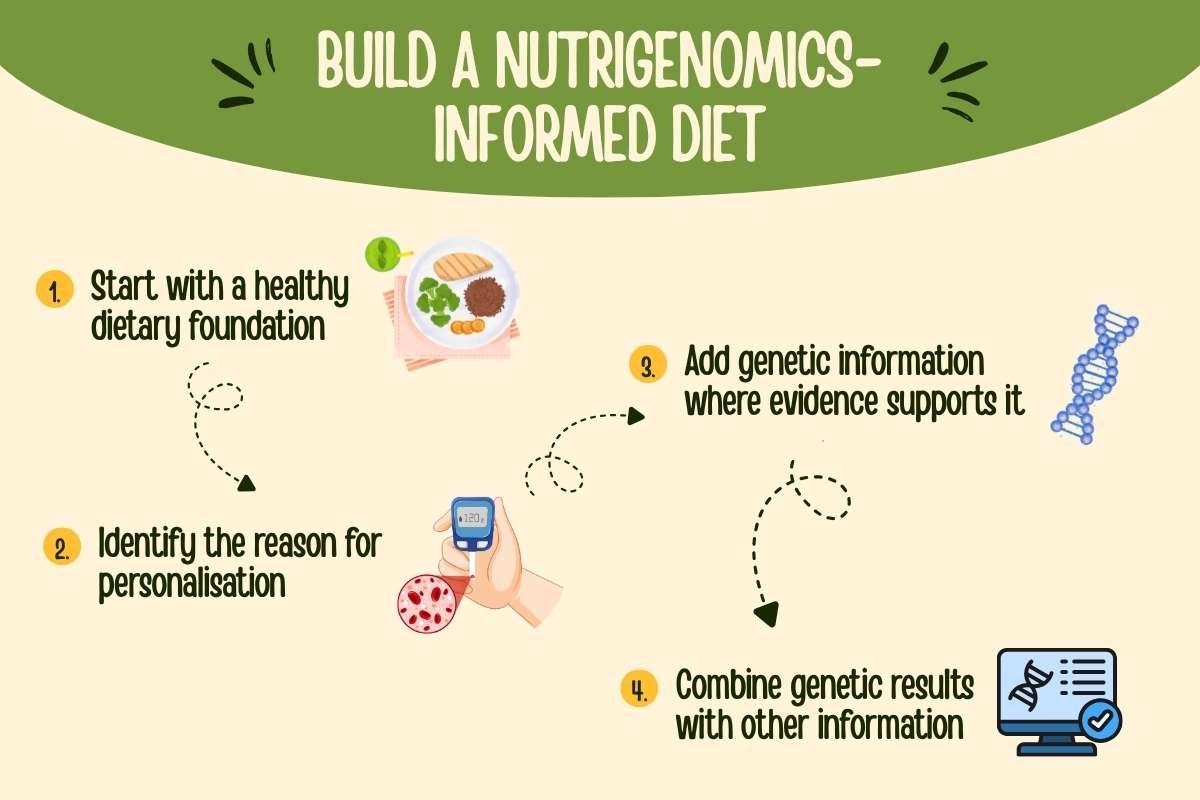
Building a nutrigenomics-informed diet starts with proven eating patterns, then layers genetic insights where evidence supports them. A nutrigenomics diet refines, not replaces, the fundamentals of a healthy diet.
Step 1: Start with a healthy dietary foundation
Don’t begin with genetic testing. Prioritise vegetables and fruit, whole grains, legumes, nuts and seeds, appropriate protein, unsaturated fats, adequate hydration, and minimally processed foods.
Step 2: Identify the reason for personalisation
Clarify your goal: weight management, blood glucose, cholesterol, digestive tolerance, caffeine intake, nutrient adequacy, or athletic performance.
Step 3: Add genetic information where evidence supports it
Use genetics to fine-tune targets (for example, caffeine limits with CYP1A2, dairy tolerance with LCT, saturated fat moderation with APOE), not to override core principles.
Step 4: Combine genetic results with other information
Integrate DNA + biomarkers (labs) + medical history + lifestyle + preferences + an established dietary pattern (Mediterranean, DASH, etc.).
Step 5: Monitor real-world response
A genetic result should not automatically override how someone actually responds to food; adjust based on symptoms, energy, labs, and adherence.
Where this connects to practical food guides
Someone investigating genetic influences on lipid metabolism may also benefit from learning about omega-3 foods and foods that lower cholesterol. Regardless of whether genetic testing is used. Those focused on glucose control can pair genetics with low glycemic index foods and high fibre foods. While gut-related goals align with probiotic and prebiotic foods. For broader goals, see a healthy diet plan for weight loss or a diet for hormone balance to anchor day-to-day choices.
Does Nutrigenomics Really Work? What the Evidence Says
Nutrigenomics is scientifically promising. But the evidence is not strong enough to treat genetic testing as a universal way to prescribe diets. Research supports genuine gene–nutrient interactions, and omics technologies are expanding understanding of how diet interacts with biological systems.
What is promising?
- Studies show detectable gene–diet interactions for specific traits (for example, lipid responses with APOE, CETP, APOB; macronutrient thresholds with TCF7L2; inflammation patterns with APOA2).
- Polygenic analyses suggest a “risk-amplification” model: people with higher genetic risk often benefit most from high-quality dietary patterns.
- Mechanistic work links variants to appetite, adiposity, insulin resistance, and lipid metabolism, supporting biological plausibility.
Where is the evidence weaker?
Complex conditions such as obesity, cardiovascular disease, and diabetes involve multiple genes and environmental factors, making single-variant prescriptions unreliable. Interaction effects are often modest, context-dependent, and difficult to replicate across populations.
The POINTS trial counterpoint
The 2023 POINTS randomised clinical trial classified participants into “carb-responsive” and “fat-responsive” types using multiple genes and tested genotype-matched diets. It found no significant weight-loss advantage for the genotype-tailored groups, challenging commercial claims that DNA alone can pick the “best” diet.
Professional guidance
Consensus reviews from major nutrition bodies conclude that available evidence is insufficient to establish that adding genetic testing to nutrition care improves outcomes beyond standard, high-quality dietary counselling.
Key message: The science supports studying personalised nutrition. It does not yet justify treating every commercial DNA diet recommendation as established medical nutrition therapy.
Conclusion:
Your genes are part of your nutrition story. But they’re not the whole book. A nutrigenomics diet can offer useful clues. How you metabolise caffeine, tolerate dairy, or respond to saturated fat. But it works best as a refinement, not a replacement, for proven eating patterns like Mediterranean or DASH.
Trials like POINTS remind us that genotype-matched diets haven’t outperformed standard, high-quality guidance for weight loss. So treat genetic insights as one input among many. Like, pair them with labs, symptoms, and how your body actually responds to food.
Curious where you might start? Talk to a registered dietitian before making major changes based on DNA results alone.
FAQ:
1. Can a nutrigenomics diet tell me what to eat?
It may offer genetic insights, but DNA alone cannot determine the perfect diet for you.
2. Can a nutrigenomics diet help with weight loss?
It may support personalisation, but there is not enough evidence to prove it works better than standard healthy diets.
3. What should I do with my nutrigenomics results?
Use them as one piece of information and discuss meaningful findings with a qualified professional.
4. Can DNA testing identify my vitamin needs?
It may reveal genetic traits linked to nutrient metabolism, but it cannot reliably diagnose nutrient deficiencies.
5. Is a nutrigenomics diet scientifically proven?
The science is promising, but many practical applications still need stronger evidence.
Links and Sources:
- https://pmc.ncbi.nlm.nih.gov/articles/PMC12816768
- https://www.synlab-sd.com/en/blog/health-and-wellness-en/nutrigenetics-and-nutrigenomics/
- https://pubmed.ncbi.nlm.nih.gov/10343355
- https://link.springer.com/article/10.1186/s41065-026-00648-z
- https://pmc.ncbi.nlm.nih.gov/articles/PMC13239719
- https://gpcardio.org/en/2026-04-24_2026-dietary-guidance-to-improve-cardiovascular-health
- https://academic.oup.com/nutritionreviews/advance-article/doi/10.1093/nutrit/nuaf263/8415611?login=false
- https://www.mdpi.com/2072-6643/18/5/815