
Omega-3 supplements are incredibly popular worldwide. Millions incorporate fish oil into their daily routines for perceived health benefits. The global market for omega-3 products is substantial, valued at approximately USD 8.67 billion in 2024. And projected to reach USD 17.86 billion by 2034. Despite this widespread adoption, a significant portion of the global population, 76%, still doesn’t meet the recommended daily intake of EPA and DHA, highlighting a global public health gap. While often praised for their benefits, there’s a less discussed conversation about the potential risks associated with excessive consumption of these supplements.
This guide explains scientifically proven Fish Oil Side Effects, identifies who should avoid them, and outlines how to take fish oil safely. It’s crucial to consult a qualified professional for personalized guidance. The information provided is for general informational purposes only and should not be considered medical advice.
Understanding Fish Oil Supplements:
Fish oil is extracted from fish tissue and is recognized as a functional food. Due to its rich content of polyunsaturated fatty acids. This can positively impact human health when consumed in sufficient quantities. Omega-3 fatty acids, which cannot be produced by the body. They are essential nutrients that must be obtained through diet. Fish oil contains two primary omega-3 fatty acids: eicosapentaenoic acid (EPA) and docosahexaenoic acid (DHA). These fatty acids are widely distributed throughout the body, including the heart and brain.
What Are Omega-3 Fatty Acids?
Omega-3 fatty acids are essential polyunsaturated fats with multiple double bonds. The three main types are:
- ALA (alpha-linolenic acid): Plant-based, from flaxseed, soybean, and canola oils. The body converts it inefficiently to EPA/DHA.
- EPA (eicosapentaenoic acid): Marine omega-3 from fish; fights inflammation via eicosanoids.
- DHA (docosahexaenoic acid): Marine omega-3 from fish; key in brain, retina, and sperm; curbs inflammation.
Sources: Fatty fish (salmon, mackerel, tuna), shellfish (mussels, oysters), algae oil (vegan-friendly), and supplements (capsules, liquids).
Key Health Benefits of Fish Oil (EPA/DHA Focus)
- Heart Health: Lowers triglycerides, boosts HDL, cuts heart attack risk via anti-inflammatory, antioxidant, and anti-clotting effects.
- Inflammation: Reduces pro-inflammatory signals for better resolution.
- Brain Support: DHA builds brain membranes; links to sharper cognition and lower Alzheimer’s risk.
- Eye Health: Supports retina; may ease dry eyes, mixed results on AMD.
- Prenatal: Aids fetal brain/eye growth, boosts birth weight, cuts preterm risk.
These Are the Top 10 Less-Known Fish Oil Side Effects:
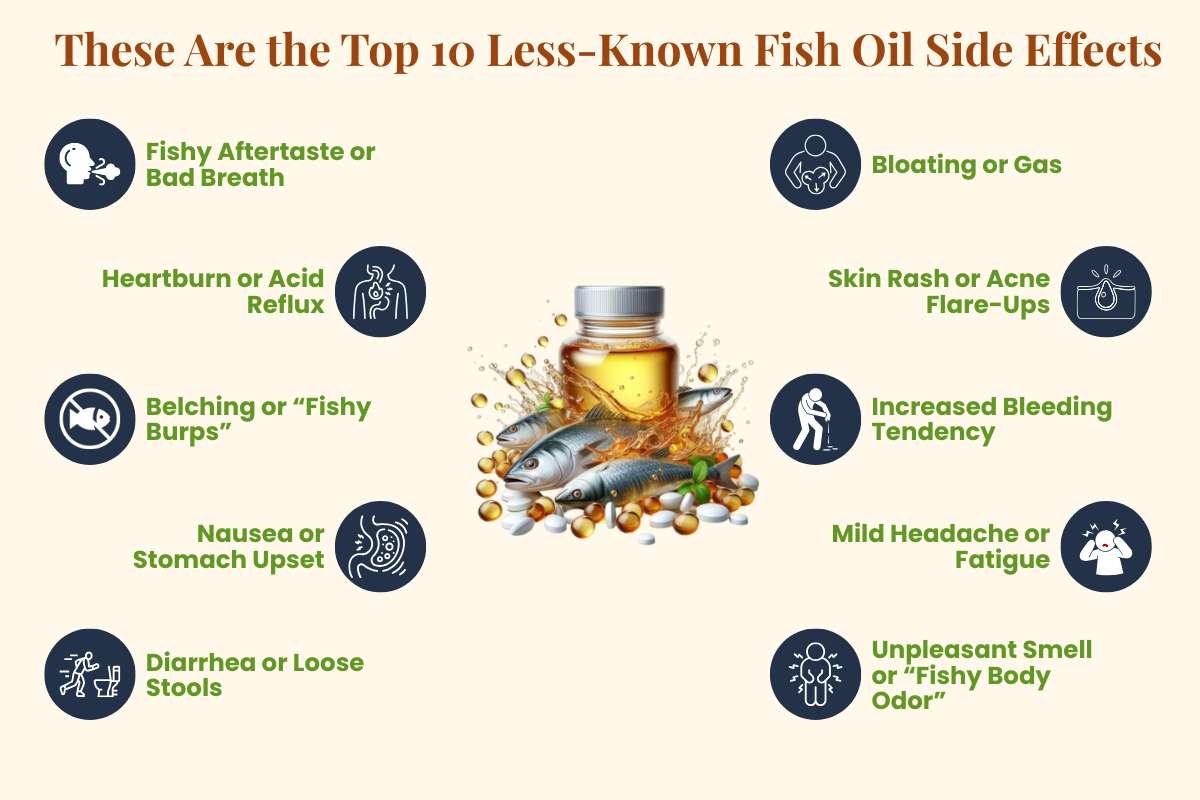
Fish oil supplements offer various health benefits. It can lead to several side effects if consumed in excessive amounts or by individuals with certain predispositions. These effects can range from mild gastrointestinal discomfort to more severe issues. Such as increased bleeding risk or heart arrhythmia. It is always recommended to consult a doctor before starting fish oil supplementation. Especially for those with existing health conditions or on other medications.
1. Fishy Aftertaste or Bad Breath
A common Fish Oil Side Effect is a fishy aftertaste or bad breath. This can also manifest as unpleasant fishy burps. The fish oil, being less dense than stomach fluid, tends to float to the top after the capsule dissolves. When the esophageal valve relaxes during a burp. Small amounts of the oil can travel upward, carrying a fishy taste. Rancid fish oil, which is highly prone to oxidation. It is a major contributor to these unpleasant burps. Taking capsules with meals can help the oil move through the stomach more quickly, potentially reducing this effect. Some fish oil supplements incorporate lemon flavoring to help lessen the fishy aftertaste. But this can sometimes mask rancidity.
2. Heartburn or Acid Reflux
Heartburn and acid reflux are among the common Fish Oil Side Effects. Fish oil, due to its high fat content. This may stimulate acid production in the stomach, leading to heartburn or indigestion. Especially if taken on an empty stomach. Symptoms of acid reflux include heartburn, belching, nausea, stomach discomfort, and bloating. Taking a moderate dose of fish oil with meals can help reduce these symptoms. While some sources suggest fish oil can stimulate acid production. Other research indicates that intraduodenal perfusion of fish oil. It can significantly reduce gastrin-stimulated gastric acid secretion.
3. Belching or “Fishy Burps.”
Belching, often accompanied by a fishy taste, is a frequently reported Fish Oil Side Effect. This phenomenon occurs because fish oil is less dense than stomach fluid. And floats it to the top after the capsule dissolves. When an individual burps, this oil comes up, causing a fishy taste. Rancid or oxidized fish oil is a significant cause of these malodorous burps.
4. Nausea or Stomach Upset
Nausea and general stomach upset are potential Fish Oil Side Effects. Particularly with higher doses or when taken on an empty stomach. These gastrointestinal issues can also include abdominal pain, constipation, and bloating. To minimize these symptoms, it is advisable to take fish oil supplements with meals.
5. Diarrhea or Loose Stools
Diarrhea is a common Fish Oil Side Effect. Especially when taking high doses of omega-3 supplements. Research from 2019 noted that individuals taking 3 to 4 grams (3,000 to 4,000 milligrams) of EPA and DHA reported diarrhea and other digestive issues. It is not necessarily the fish oil itself. But the intake of omega-3s, that can cause loose bowels. Taking supplements with meals and reducing the dosage can help alleviate diarrhea.
6. Bloating or Gas
Bloating and gas are also frequently associated with Fish Oil Side Effects. These symptoms are part of the broader gastrointestinal disturbances that can occur with omega-3 supplementation. Taking fish oil capsules with food can help mitigate these effects.
7. Skin Rash or Acne Flare-Ups
While less common, some people may experience skin reactions like rashes or acne flare-ups as Fish Oil Side Effects. Allergic reactions to fish oil, particularly in individuals with existing fish or shellfish allergies, can manifest as rashes, hives, or itching. Some reports suggest that fish oil supplementation can worsen acne, especially if the supplement is low quality, oxidized, or taken in very high doses. However, other studies indicate that omega-3 fatty acids in fish oil may actually help reduce the severity of acne. Flushing and pruritus (itching) secondary to prescription fish oil ingestion have also been observed.
8. Increased Bleeding Tendency
High doses of fish oil can increase the risk of bleeding because omega-3 fatty acids have anticoagulant properties. This means they can prevent blood from clotting. This Fish Oil Side Effect may be beneficial for heart health by thinning the blood. But it can be problematic for those with existing bleeding disorders or who are taking blood thinners like warfarin. Some doctors may advise discontinuing fish oil before surgery due to its potential to prolong clotting times. While some research suggests that omega-3 polyunsaturated fatty acids are not associated with an increased bleeding risk, particularly in patients not on other antiplatelet or anticoagulant medications, high doses of purified EPA may pose additional bleeding risk.
9. Mild Headache or Fatigue
Headaches are listed as possible Fish Oil Side Effects. Although they are not a common occurrence. Some studies even suggest that omega-3s can alleviate headaches, particularly for migraine sufferers. Fatigue is not explicitly mentioned as a direct Fish Oil Side Effect in the provided texts.
10. Unpleasant Smell or “Fishy Body Odor.”
An unpleasant smell or “fishy body odor” can be one of the fish oil side effects. It can appear in sweat, breath, and urine. This can occur in individuals with trimethylaminuria. It is also known as fish odor syndrome. This is a rare genetic disorder where the body cannot properly break down the chemical trimethylamine. When trimethylamine builds up in the body. It is released through bodily fluids, causing a strong fishy smell.
Who Should Be Careful Taking Fish Oil?
Certain individuals should exercise caution when taking fish oil due to potential Fish Oil Side Effects or interactions with existing conditions and medications. Consulting a doctor before starting supplementation is crucial for these groups.
1. Pregnant Individuals:
While omega-3s are vital for fetal development. But pregnant women should avoid highly oxidized fish oil and high mercury-containing fish. Some experts also warn that unless a deficiency is diagnosed, taking omega-3 supplements might put the pregnancy at risk. However, quality fish oil is generally considered safe during pregnancy when taken as directed. The World Health Organization (WHO) recommends 300 mg of combined EPA and DHA daily for pregnant women.
2. People Taking Anticoagulants:
Fish oil has mild blood-thinning properties. It can increase the risk of bleeding when taken with anticoagulants like warfarin. Although some studies suggest doses below 3 grams daily are safe. Consultation with a doctor is necessary to monitor for potential additive anticoagulant effects.
3. Diabetes Patients:
High doses of fish oil might make blood sugar control more difficult for individuals with diabetes. While some research suggests fish oil can lower triglycerides and increase HDL cholesterol. The overall evidence for its benefit in managing blood sugar or reducing diabetes risk is insufficient or conflicting. Fish oil should be used with caution in these patients.
4. People with Seafood Allergies:
Individuals with fish or shellfish allergies have a low risk of allergic reaction to pure fish oil. But severe reactions have been reported. Fish oil supplements are not always regulated, and some may contain trace amounts of fish proteins. This makes consultation with an allergist important.
5. Individuals Preparing for Surgery:
Concerns about the theoretical bleeding risk from fish oil. It has led to recommendations for patients to stop taking it before surgery. Though newer data suggest no increased risk with typical doses.
6. Children & Elderly Populations:
Children under 18 should only take fish oil supplements under a doctor’s supervision. While generally safe for older adults, the recommended daily intake of EPA and DHA should not exceed 250 mg for the elderly. Unless a doctor advises a higher dose for specific conditions. Such as high triglycerides or rheumatoid arthritis. For children, the recommended combined EPA and DHA dosage varies by age. Spanning from around 100 mg for a 4-year-old to 200 mg for an 8-year-old. Exceeding 3 grams of omega-3s can have side effects in children.
Safe Fish Oil Dosage Guidelines: How Much Is Too Much?

Generally, a minimum of 250–500 milligrams (mg) of combined EPA and DHA daily. This is recommended for healthy adults, which can be obtained from food or supplements. The American Heart Association suggests 1 gram per day of EPA plus DHA for those who may benefit from supplements. The FDA considers doses up to 5 grams (5,000 mg) per day of EPA and DHA safe. Though higher intakes may increase the risk of Fish Oil Side Effects.
Potential Side Effects of Excessive Fish Oil Intake
Consuming too much fish oil can lead to these various adverse effects.
Digestive Issues: Common side effects include acid reflux, heartburn, nausea, belching, stomach discomfort, bloating, and diarrhea, especially with doses of 3–4 grams (3,000–4,000 mg) of EPA and DHA.
Bleeding Risk: High doses of fish oil, particularly over 3 grams daily, may increase the chance of bleeding due to its blood-thinning effect.
Low Blood Pressure: Excessive intake can cause low blood pressure, which is a concern for individuals already having low blood pressure or taking blood pressure-lowering medications.
Fishy Odor: Some individuals with trimethylaminuria may experience a fishy smell in their breath, sweat, and urine after taking fish oil supplements.
Atrial Fibrillation: Very high doses, such as 4,000 mg daily, have been linked to a slightly increased risk of atrial fibrillation in individuals with or at risk of cardiovascular disease.
Vitamin A Toxicity: Certain fish oils, like cod liver oil, contain high levels of vitamin A, and excessive consumption can lead to toxicity, causing symptoms like dizziness, nausea, joint pain, and potentially liver damage.
Dosage and Effects
The effects of fish oil supplementation can vary depending on the intake level, as summarized in the table below:
| Intake Level | Effect |
| Low | Generally safe, with minimal risk of side effects. |
| Moderate | Therapeutic benefits, such as supporting heart health and lowering triglycerides, are especially beneficial for individuals with existing coronary heart disease |
| High | Increased likelihood of side effects like bleeding, acid reflux, headaches, and a fishy smell. Doses exceeding 3 grams per day may increase bleeding risk. |
Practical Ways to Minimize Fish Oil Side Effects:
- Take with meals – Swallow fish oil with or right after a meal (especially one with some fat) to reduce burping, heartburn, and loose stools.
- Split the dosage – Divide your daily amount into smaller doses (e.g., 2× instead of 1 big serving) to ease digestion and lower GI discomfort.
- Refrigerate capsules – Keep bottles in the fridge or freezer so the oil is more solid when swallowed, which can cut down fishy burps and aftertaste.
- Choose purified brands – Pick high‑quality, third‑party tested or certified fish oil (or algae oil) to lower oxidation risk and heavy‑metal exposure.
- Avoid excessive dosing – Stick to recommended doses (often 1–3 g EPA+DHA daily) unless a clinician advises otherwise, to limit bleeding risk, low blood pressure, and diarrhea.
- Check oxidation and freshness – Use opaque, tightly sealed bottles, store in cool/dark places, and replace if the oil smells rancid or smells strongly “fishy” right out of the bottle.
Natural Alternatives to Fish Oil:

For individuals seeking alternatives to fish oil supplements, especially those concerned about Fish Oil Side Effects or following vegetarian or vegan diets, several plant-based sources offer omega-3 fatty acids. These alternatives include fatty fish (for those not strictly vegetarian), algae oil, flaxseed, chia seeds, and walnuts. While many plant sources primarily provide alpha-linolenic acid (ALA), algae oil is unique as it directly supplies eicosapentaenoic acid (EPA) and docosahexaenoic acid (DHA).
Algae Oil
Algae oil is a direct plant-based source of both EPA and DHA, bypassing the inefficient conversion process from ALA. This makes it a highly effective and sustainable alternative to fish oil, particularly for vegetarians and vegans. Algae oil supplements typically provide 400 to 500 mg of combined DHA and EPA, with a general recommendation of 250 mg per day.
Flaxseed
Flaxseed is rich in ALA, providing approximately 6.38 grams of ALA per ounce (28 grams). Flaxseed oil is also a concentrated source, with 7.26 grams of ALA per tablespoon (13.6 grams). Besides ALA, flaxseed offers fiber, protein, magnesium, and manganese. Grinding flaxseeds before consumption is recommended to maximize omega-3 absorption.
Chia Seeds
Chia seeds are another excellent plant-based source of ALA, containing about 4.99 grams of ALA per ounce (28 grams). A tablespoon of chia seeds provides approximately 1.8 grams of ALA and does not require grinding, as they are naturally more stable than flaxseeds. Soaking chia seeds can further improve nutrient absorption.
Walnuts
Walnuts provide approximately 2.54 grams of ALA per ounce (28 grams). They also contain other beneficial nutrients like fiber, potassium, and magnesium.
Conversion differences (ALA vs EPA/DHA):
The human body converts alpha-linolenic acid (ALA) from plant sources into eicosapentaenoic acid (EPA) and, less efficiently, into docosahexaenoic acid (DHA). This conversion is often limited, with ALA to EPA conversion rates typically ranging from 0.5% to 21%, and to DHA from 0% to 9%. Factors like age, genetics, and diet, especially a high intake of omega-6 fatty acids, can further reduce this efficiency. For those looking to avoid Fish Oil Side Effects, relying solely on ALA might not be enough for everyone.
Expert Insight Section:
Most clinical studies indicate that fish oil supplementation is generally safe when consumed within recommended limits. While observational studies have linked higher fish intake to improved health outcomes. Particularly cardiovascular benefits, it’s important to distinguish between omega-3s obtained from food sources and those from supplements.
Peer-reviewed research, including systematic reviews and meta-analyses. Suggests that long-chain omega-3s, such as EPA and DHA. This can reduce the risk of certain cardiovascular endpoints and lower triglyceride levels. However, some large-scale studies have shown inconsistent benefits for primary prevention of cardiovascular events. Especially with lower doses.
There are potential fish oil side effects. Such as gastrointestinal upset and a slightly increased risk of bleeding at high doses. But these are generally mild. Most experts emphasize that dietary intake of fatty fish is preferred, and supplements should be considered under medical supervision. Especially for managing conditions like hypertriglyceridemia.
Conclusion:
Fish oil can be a powerful addition to your wellness routine. But like any supplement, it works best when used wisely. Understanding fish oil side effects, from fishy burps and digestive discomfort to bleeding risk and atrial fibrillation. This empowers you to make smarter choices for your health.
The good news? Most side effects are mild and preventable. Taking fish oil with meals, choosing high-quality brands, and sticking to recommended doses. This can go a long way in keeping problems at bay.
If fish oil does not feel right for your body. Plant-based options like algae oil offer a clean, effective alternative.
Above all, your health is personal. What works for one person may not work for another. Always consult your doctor before starting or adjusting any supplement. Stay informed, stay safe, and let science guide your decisions.
People Also Ask:
1. What are the negative side effects of taking fish oil?
Fish oil is generally safe, but common side effects include a fishy aftertaste, bad breath, heartburn, nausea, and diarrhea. High doses (over per day) may increase bleeding risks, cause bruising, or raise LDL (“bad”) cholesterol. It may also trigger atrial fibrillation in some users.
2. What happens if I take fish oil every day?
While generally safe, getting too much fish oil can increase your risk of bleeding and might affect your immune response. It’s not clear whether fish oil is safe for people who are allergic to seafood. Take fish oil supplements under a doctor’s supervision.
3. Why do I feel weird after taking fish oil?
Fish oil can cause “weird” feelings, often due to high-dose side effects like acid reflux, fishy burps, nausea, or dizziness. It may also cause rare, intense side effects such as anxiety, insomnia, or intense headaches. Solutions include reducing the dose, taking capsules with food, or freezing them to improve digestion.