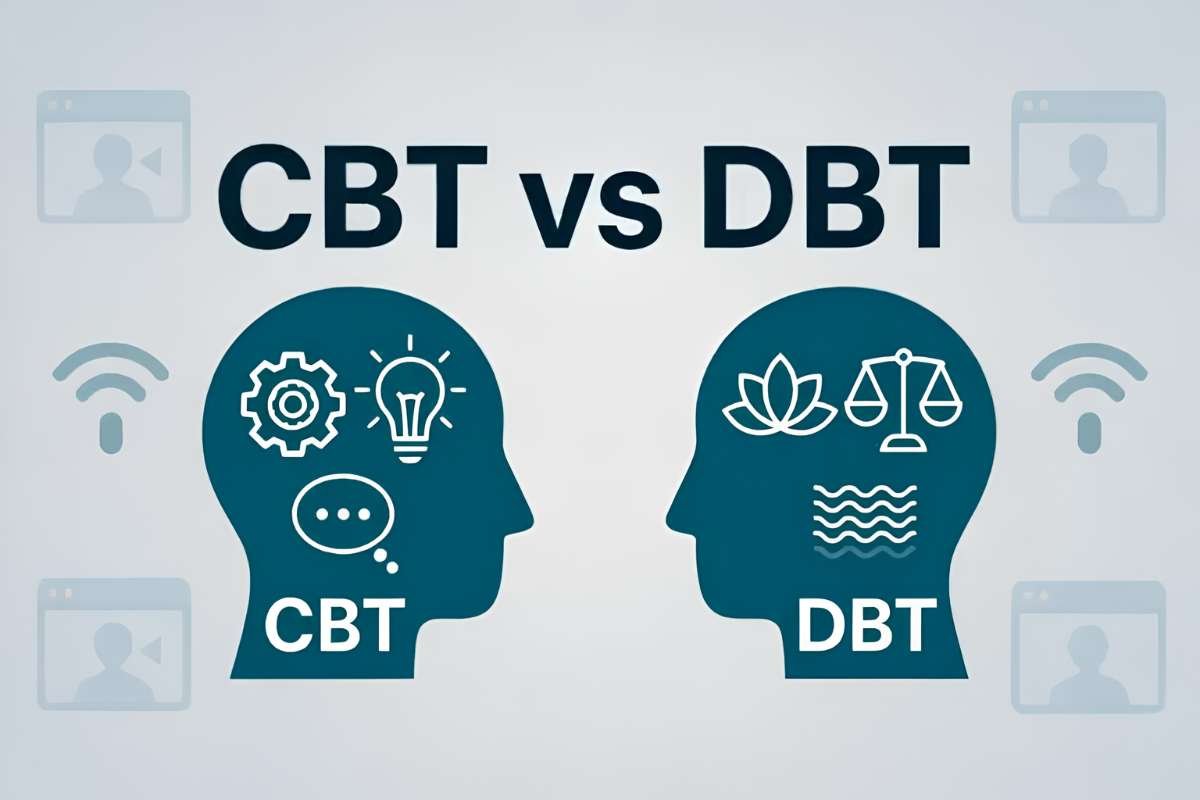
CBT vs DBT depends on whether you need to change negative thought patterns or manage overwhelming emotions. This guide compares their differences, benefits, conditions treated, and how to choose the therapy that best supports your emotional wellness and mental health goals.
CBT and DBT are both evidence-based therapies. But they are for different emotional and psychological needs. If you’re weighing CBT vs DBT for anxiety, depression, intense emotions, or relationship struggles, recognizing their differences is the first step towards finding appropriate support. CBT focuses on changing unhelpful thinking patterns. DBT includes skills of acceptance and emotional regulation for people who struggle with overwhelming emotions. This guide explains both therapies in simple terms and helps you to see where they fit into the bigger picture of emotional well-being and mental health care.
CBT vs DBT: Quick Comparison at a Glance
CBT helps you to change unhelpful thoughts and behaviours, while DBT adds intensive skills for emotion regulation and acceptance. CBT vs DBT depends mainly on whether your biggest struggle is specific symptoms (like anxiety or depression) or intense, unstable emotions and self-harm.
Quick comparison table:
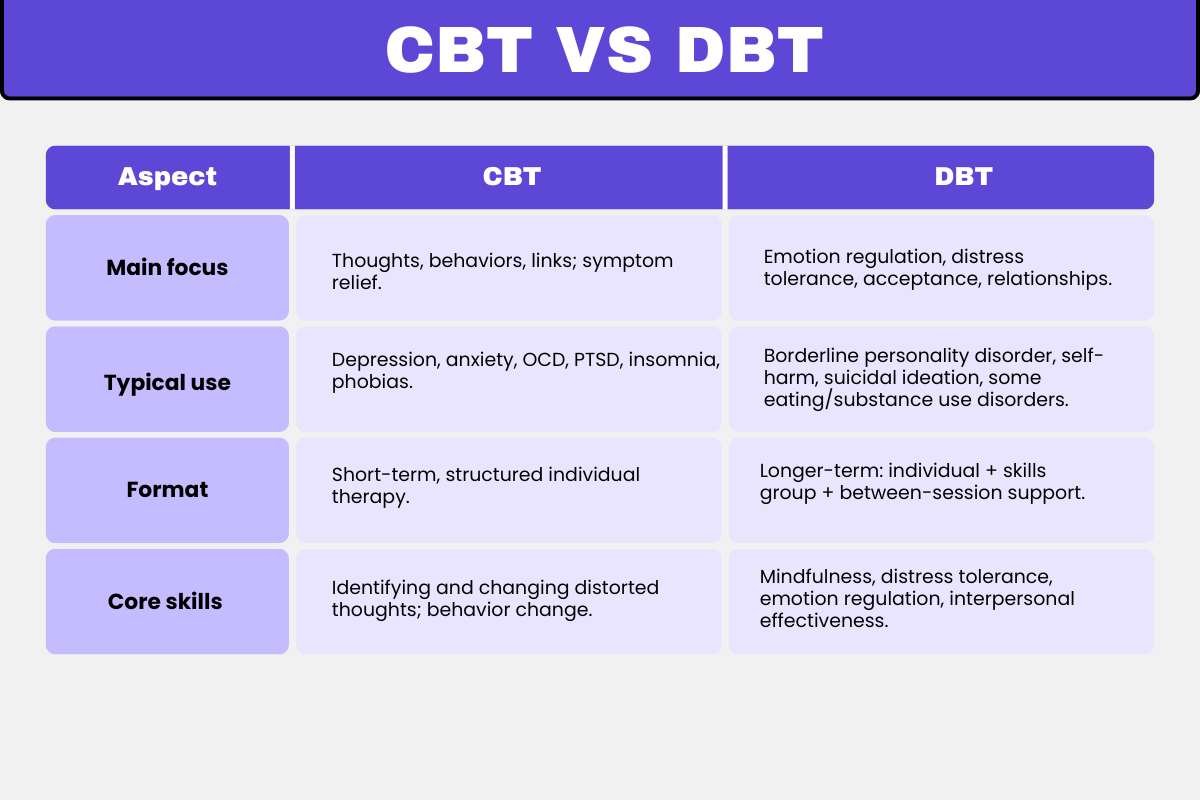
| Aspect | CBT | DBT |
| Main focus | Thoughts, behaviors, links; symptom relief. | Emotion regulation, distress tolerance, acceptance, relationships. |
| Typical use | Depression, anxiety, OCD, PTSD, insomnia, phobias. | Borderline personality disorder, self-harm, suicidal ideation, some eating/substance use disorders. |
| Format | Short-term, structured individual therapy. | Longer-term: individual + skills group + between-session support. |
| Core skills | Identifying and changing distorted thoughts; behavior change. | Mindfulness, distress tolerance, emotion regulation, interpersonal effectiveness. |
Choose CBT if you:
Struggle with specific symptoms (anxiety, depression, OCD, PTSD, insomnia).
I want short-term, practical tools to change thinking and behavior.
Do not experience severe emotional crises or self-harm.
Choose DBT if you:
Experience intense, overwhelming emotions, impulsive behavior, or unstable relationships.
Struggle with BPD traits, recurrent self-harm, or suicidal ideation.
Need comprehensive support, including group skills training and crisis coaching.
Consider both if you:
Have anxiety/depression paired with severe emotional dysregulation.
Have tried CBT but still feel overwhelmed or unsafe.
30-Second Quiz: CBT or DBT?
Choose A or B for each question:
- Primary Challenge: Anxiety or low mood (A) vs. Intense, fast-changing emotions (B)
- Safety & Self-Harm: Rarely self-harm or experience suicidal urges (A) vs. Recurring self-harm or suicidal thoughts (B)
- Relationships: Mostly stable (A) vs. Frequently chaotic or volatile (B)
- Therapy Goal: Fast tools to change thinking/habits (A) vs. Structured coaching for crisis coping and emotion/relationship skills (B)
- Mostly A’s: CBT fits better.
- Mostly B’s: DBT fits better.
- A Mix: Consider a combined approach; discuss with a licensed clinician.
What Makes CBT and DBT Different?
CBT teaches you to notice and change unhelpful thoughts to feel and act differently, while DBT adds acceptance and skills to handle intense emotions and relationships without making things worse.
CBT philosophy
CBT is built on the idea that thoughts, feelings, and behaviors are linked, and that distorted thinking drives distress.
The main technique is cognitive restructuring: spotting automatic thoughts like “I’ll fail” and testing or replacing them with more balanced ones.
DBT philosophy
DBT grew out of CBT for people who understood the tools but still felt emotionally overwhelmed or acted impulsively.
Its core idea is dialectical: you can accept yourself as you are and still work to change.
Acceptance vs change
CBT focuses mostly on change: identify what’s unhelpful and fix it.
DBT balances change with acceptance: validate your pain and urges, then learn skills to respond differently.
Thinking patterns vs emotional regulation
CBT targets thinking patterns that fuel anxiety, depression, or avoidance.
DBT targets emotional regulation, distress tolerance, mindfulness, and interpersonal skills.
Everyday examples
- CBT: You think “I’m a failure,” write it down, look for evidence, and replace it with “I’m struggling right now, but I’ve handled hard things before.”
- DBT: You feel a surge of rage or shame, notice it mindfully, and use a breathing or grounding skill to get through the moment, then choose a safer action instead of lashing out or self-harming.
Why DBT evolved from CBT: many clients with severe emotional swings, self-harm, or unstable relationships needed more than thought work. They needed validation plus concrete emotion and relationship skills.
Read Next: Feeling Numb, Unmotivated, and Exhausted? Emotional Burnout Could Be Why
CBT vs DBT: Side by Side Comparison
| Dimension | CBT | DBT |
| Primary goal | Reduce symptoms by changing unhelpful thoughts and behaviors. | Reduce life-threatening and therapy-interfering behaviors by balancing acceptance and change. |
| Core techniques | Cognitive restructuring, exposure, behavioral experiments, activity scheduling. | Mindfulness, distress tolerance, emotion regulation, interpersonal effectiveness, diary cards, phone coaching. |
| Session structure | Individual, agenda-based (review homework, skills, plan next steps). | Individual therapy + weekly skills group + between-session phone coaching (standard DBT). |
| Homework | Thought records, exposure tasks, behavioral activation logs. | Daily diary cards, skills practice, chain analysis of problem behaviors. |
| Duration | Usually 8–20 sessions (short-term). | Typically 12 months for a full program. |
| Conditions treated | Depression, anxiety disorders, OCD, PTSD, phobias, panic, and insomnia. | Borderline personality disorder, chronic suicidality, self-harm, severe emotion dysregulation; adapted for some eating and substance use disorders. |
| Emotional focus | Change emotions by changing thoughts/behaviors. | Directly regulate intense emotions and tolerate distress while validating pain. |
| Skill-building | Problem-solving, cognitive tools, graded exposure. | Emotion regulation, crisis survival, mindfulness, relationship skills. |
| Therapist involvement | Weekly individual sessions; limited between-session contact. | Weekly individual + group; therapists consult in a team; phone coaching available. |
| Group sessions | Not standard (some CBT groups exist but not core). | Core component: weekly skills training group. |
| Progress tracking | Symptom scales (e.g., PHQ-9, GAD-7), thought/behavior logs. | Diary cards tracking urges, self-harm, skills use, mood, and target behaviors. |
| Cost considerations | Lower total cost due to shorter duration; widely available. | Higher total cost (longer, multi-modal); often specialized programs. |
| Research support | Very strong evidence across many disorders (hundreds of RCTs). | Strong evidence for BPD, self-harm, Suicidality, and emotion dysregulation. |
Which therapy addresses your biggest challenge?
- Overthinking → CBT (targets rumination and worry with cognitive tools).
- Panic → CBT (exposure and panic-specific CBT have the strongest evidence).
- Emotional outbursts → DBT (emotion regulation and distress tolerance).
- Self-harm → DBT (designed for recurrent self-injury and Suicidality).
- Relationship conflicts → DBT (interpersonal effectiveness and validation).
- Chronic stress → CBT (problem-solving, pacing, cognitive tools) or DBT if emotions feel unmanageable.
- Perfectionism → CBT (cognitive restructuring of “all-or-nothing” rules).
- Impulsivity → DBT (urge surfing, crisis skills, chain analysis).
If your main problems are specific symptoms like anxiety or depression. Then CBT is often the first‑line. If intense emotions, self‑harm, or chaotic relationships dominate, DBT is usually a better fit.
Which Therapy Is Better for Different Mental Health Conditions?

When comparing CBT vs DBT, CBT is usually first-line when symptoms are driven mainly by distorted thoughts and avoidance, while DBT is stronger when intense, unstable emotions and impulsive behaviors dominate, often alongside relationship chaos or self-harm.
“DBT is the most comprehensive therapy for emotion dysregulation, especially with self-harm, suicidality, or borderline personality disorder.” — Academic review of DBT and emotion regulation.
- Anxiety: CBT targets worry cycles and safety behaviors with exposure and cognitive tools, directly reducing fear responses.
- Depression: CBT challenges negative thinking and inactivity, lifting mood by changing thought–behavior loops.
- PTSD: CBT (e.g., trauma-focused CBT) processes traumatic memories and reduces avoidance; DBT helps when PTSD co-occurs with severe emotion swings or self-harm.
- OCD: CBT with exposure and response prevention directly breaks obsessions–compulsions; DBT is not first-line unless emotional crises are prominent.
- Borderline Personality Disorder: DBT is the gold standard, reducing self-harm, Suicidality, and hospitalizations by teaching emotion and relationship skills.
- ADHD: CBT improves organization and negative self-talk; DBT skills can help with emotional impulsivity and distress tolerance.
- Eating disorders: CBT-E targets rigid food/weight rules; DBT helps when bingeing/purging is driven by emotional dysregulation.
- Substance use: CBT changes triggers and coping thoughts; DBT adds skills for crisis moments and self-destructive urges.
- Emotional dysregulation: DBT directly trains emotion awareness, regulation, and distress tolerance, which CBT alone may not fully address.
Improving Emotional Wellness and Mental Health often involves combining therapy with healthy sleep, movement, and stress-management habits alongside evidence-based treatment.
Can CBT and DBT Work Together?

Yes. CBT and DBT are often combined when someone has both clear symptom patterns (anxiety, depression, OCD) and intense emotional reactivity or self-harm.
How they’re combined
- Integrated plans: Therapists use DBT skills (mindfulness, distress tolerance, emotion regulation) alongside CBT tools like thought records, exposure, and behavioral activation.
- Sequential treatment: DBT first to reduce crises and self-harm, then CBT (e.g., trauma-focused CBT or exposure) once emotions are more manageable.
Practical examples
- PTSD + BPD: Start with DBT skills and individual sessions; add CBT-based trauma work (e.g., prolonged exposure) while continuing DBT support.
- Anxiety/depression + self-harm: Use DBT diary cards and crisis skills, then layer in CBT exposure and cognitive restructuring as urges drop.
Benefits
- Fewer crises and ER visits while still directly treating core symptoms.
- Addresses both distorted thinking and emotional storms in one plan.
Limitations
- Requires a clinician trained in both; poorly coordinated blending can feel confusing.
- Often longer or more intensive than standard CBT alone.
Research and clinical reviews support integrated or sequential CBT + DBT for overlapping conditions (e.g., BPD with PTSD, eating disorders, substance use), rather than treating this as a strict CBT vs DBT choice.
Read Next:
- Are Your Emotional Reactions Normal? Understanding Emotional Dysregulation in Adults
- The Gut-Brain Axis and Emotional Wellness: What Most People Don’t Know
Conclusion
It’s not about better; it’s about what’s right for your main struggles right now. Thinking traps and avoidance, or intense emotions, self-harm, and relationship chaos. CBT provides you with structured tools to challenge unhelpful thoughts and change behavior. DBT adds validation, emotion regulation, distress tolerance, and relationship skills when life feels like one crisis after another. If you see yourself in both, it’s common and evidence-informed to combine or sequence them with a licensed clinician, so you can reduce symptoms and build emotional stability over time versus forcing a strict CBT vs DBT either/or choice.
So when you look at your own patterns, what one thing- thought spirals, emotional storms, self-harm urges, or relationship volatility – seems most urgent to work on first?
FAQ:
1. Who is DBT not recommended for?
Dialectical Behavior Therapy (DBT) is generally not recommended for individuals with severe cognitive or intellectual limitations, active unmanaged psychosis, or those who are unwilling or unable to commit to its intense structure, homework, and skills practice.
2. Why is CBT invalidating?
Cognitive Behavioral Therapy (CBT) can feel invalidating because it focuses heavily on changing “irrational” thoughts.
3. Which is more effective, DBT or CBT?
Neither DBT nor CBT is universally “better”; rather, DBT is a specialized subset of CBT designed for intense emotional dysregulation, while standard CBT is broadly effective for general anxiety and depression.
4. Why do some therapists not like CBT?
Some therapists dislike Cognitive Behavioral Therapy (CBT) because they view it as overly mechanical, invalidating of deep emotions, or overly focused on the individual instead of systemic and environmental problems.
5. Why is DBT controversial?
Dialectical Behavior Therapy (DBT) is controversial due to its strict rules, lack of deep trauma processing, and rigid Western focus.