
Emotional wellness and mental health are connected, but they mean different things. But many people use the terms interchangeably, and this confuses what each actually covers. Emotional wellness refers to your ability to understand, express, and manage your emotions. Mental health is a broader term that encompasses a wide range of psychological, emotional, and social functioning, including cognition, behavior, and relationships.
In this article, emotional well-being is defined not as always feeling positive, and mental health is defined not as the absence of mental illness. It is normal to have difficult emotions. Ongoing difficulties with emotions can interfere with functioning, and mental health conditions can make regulating emotions more difficult. We compare both below.
Emotional Wellness vs. Mental Health: What’s the Difference?
Emotional health is the ability to recognize, acknowledge, and express positive and negative feelings in healthy ways. Being aware of your feelings, managing your emotions, dealing with everyday challenges, and building resilience and adaptability. It’s important to note that being emotionally healthy doesn’t mean you’re happy or calm all the time. “Emotional and mental wellness is not about being positive all of the time. It’s about awareness, managing difficult feelings, and recognizing when you need support,” says the University of Rochester.
Mental health is so much more. It includes thoughts, feelings, behavior, relationships, decision-making, coping, general functioning, and psychological well-being. Mental health, as defined by the Substance Abuse and Mental Health Services Administration (SAMHSA), is our emotional, psychological, and social well-being. It affects how we think, feel, and act; how we handle stress, relate to others, and make choices. According to the American Psychological Association, mental health is characterized by mental health, appropriate functioning, relative freedom from disabling anxiety or other symptoms, good relationship skills, and the ability to cope with the normal stresses of life.
| Emotional Wellness | Mental Health |
| Focuses heavily on emotional awareness and regulation | Encompasses broader psychological functioning |
| How you recognize and manage feelings | How you think, feel, behave, and function. |
| Includes resilience and coping | Includes psychological well-being and mental-health conditions |
| One component of overall well-being | Broader construct |
In short, emotional wellness can be viewed as one important component of overall mental well-being, not a synonym for mental health. Understanding this distinction helps clarify why emotional well-being and mental health are related but not interchangeable.
How Emotional Wellness and Mental Health Influence Each Other?

There are two ways in which emotional wellness and mental health influence one another. First, improved emotional well-being leads to better mental health. Recognizing emotions early helps you regulate reactions, choose healthier ways to cope, and maintain better behavior and functioning. With time, difficulty managing emotions can contribute to:
- Rumination and persistent negative thinking
- Avoidance of people, tasks, or feelings
- Interpersonal conflict and strained relationships
- Chronic stress and burnout
- Impaired concentration and decision-making
- Sleep disruption and fatigue
- Unhealthy coping behaviors (e.g., substance use, emotional eating)
Mental health conditions like anxiety or depression alter thoughts and behaviors, reducing coping capacity and impairing emotional regulation. Driven by interacting biological, psychological, and social factors, this creates a feedback loop in which worsening emotional distress further hinders daily functioning.
BMJ evidence highlights that emotional distress and physical health interact through interconnected sleep, inflammation, activity, and social pathways rather than direct emotion-to-disease causation. Strengthening emotional skills buffers stress to support mental health, while treating mental health conditions improves emotional regulation, demonstrating how these distinct domains continuously reinforce each other.
Early Emotion Recognition → Better Regulation & Healthy Coping → Better Behavior & Functioning → Improved Mental Health → (Unmanaged) → Rumination / Avoidance / Conflict / Burnout / Impaired Decisions / Sleep Disruption / Unhealthy Coping.
Why is Emotional Regulation the Bridge Between Them?
Emotional regulation is the ability to turn emotions into useful information instead of knee-jerk reactions. This involves figuring out what you’re feeling, spotting your emotional triggers, taking a pause before responding, picking the right response, and bouncing back after emotional upsets. These skills fall somewhere between psychological wellness and mental health. Good regulation supports well-being, and poor regulation can strain well-being.
It’s normal to have strong feelings every once in a while. Emotional dysregulation means you have a consistent pattern of emotional reactions that are too strong, last too long, or are inappropriate for the situation. These reactions can significantly impact your emotional wellness and mental health, causing problems in your relationships, work, sleep, and daily functioning. This may show up as overreactions to small things, quick mood swings, inability to calm down, acting on impulse in the moment, avoidance when overwhelmed, and difficulty with relationships. Causes are multifactorial: early life experiences, brain chemistry, chronic stress, or sleep loss. Along with conditions such as ADHD, anxiety, depression, or trauma-related disorders, all of which can play a role.
A simple chain shows why regulation matters:
Trigger → emotion → thought → reaction → consequence.
Example (unregulated): Work criticism → anxiety → “I’m failing” → withdrawal → increased stress and isolation.
Example (regulated): Work criticism → anxiety → identify the feeling → evaluate the thought (“Is this true?”) → ask for clarification → move forward with a plan.
What Can Strengthen Emotional and Mental Health?
Rather than a long checklist, think in terms of mechanisms that support both emotional wellness and mental health.
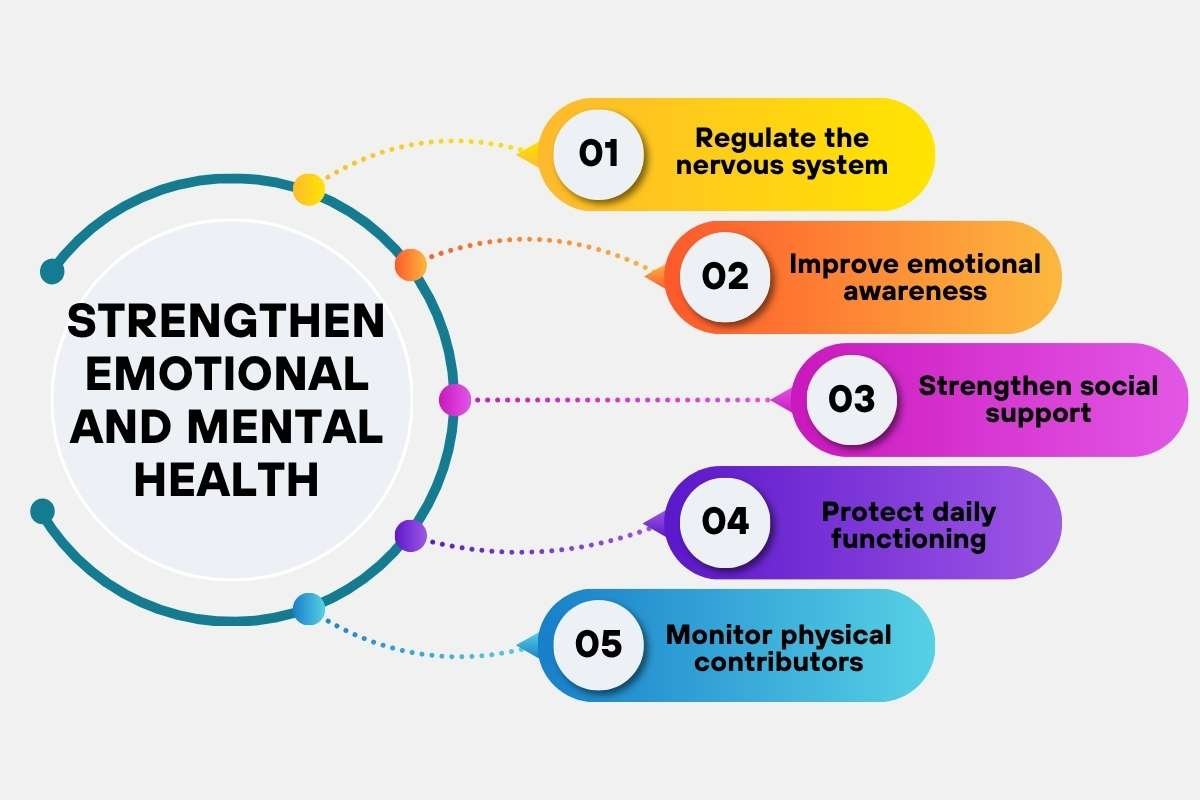
1. Regulate the nervous system
Use slow breathing (e.g., box or 4–7–8), mindfulness or body scans, gentle movement or yoga, and consistent, adequate sleep to shift the body toward calm and improve resilience.
2. Improve emotional awareness
Name emotions as they arise, journal briefly about triggers and patterns, and link thoughts to feelings so you can spot unhelpful loops early.
3. Strengthen social support
Invest in meaningful relationships, practice clear communication, ask for help when overwhelmed, and stay connected to community or peer groups.
4. Protect daily functioning
Keep healthy routines, set boundaries around time and energy, break work into manageable goals, and maintain a sustainable work–life balance.
5. Monitor physical contributors
- Sleep quality and regularity
- Exercise or daily movement
- Nutrition and hydration
- Chronic stress load and recovery time
These strategies support wellness. They are not substitutes for professional treatment when a mental-health condition is present. If symptoms persist or impair functioning, evidence-based care (therapy, medication, or both) remains essential. Used together, these mechanisms create a stable foundation for emotional wellness and mental health.
Building Emotional Wellness as Part of Long-Term Mental Health:

Emotional wellness is not a one-time achievement; it is a repeatable practice that supports long-term mental health. A useful framework is: Awareness → Regulation → Connection → Recovery → Support. You notice what you feel, choose how to respond, stay connected to others, allow time to recover, and seek help when needed.
This matters across life stages. Emotional wellness and mental health can shift during major biological and life transitions. Menopause and perimenopause are one example where mood, sleep, stress, and other factors interact, sometimes increasing the risk of anxiety, low mood, or irritability. For more on navigating this phase.
Heart Rate Variability adds a biological component. HRV is a quantitative index of autonomic nervous system regulation. Higher HRV is generally associated with better emotional regulation and stress resilience, and lower HRV is observed in a variety of mental health conditions. It is not a stand-alone measure of mental health or emotional well-being but can be used alongside self-report and clinical assessment.
Conclusion
Emotional wellness and mental health are related but different. Emotional wellness is the ability to understand and manage your emotions. Whereas mental health is a broader picture of how you think, feel, behave, and function. Making this distinction a daily practice builds awareness, regulation, connection, recovery, and support. Strong emotional skills are a buffer against stress and help with coping, and managing mental health issues makes regulation easier.
Start small. Identify one feeling today. Pause before you respond. Connect with someone you trust. If the difficulties continue, or begin to interfere with your work, sleep, or relationships, consider seeking professional help. Repeated choices over time reinforce emotional well-being and mental health.
FAQ:
1. What is mental health and emotional wellness?
Mental and emotional well-being means your ability to handle thoughts, manage feelings, and cope with everyday stress.
2. What are 5 ways to improve mental health?
Five effective ways to improve mental health include getting regular exercise, prioritizing quality sleep, building strong social connections, practicing mindfulness or deep breathing, and eating a balanced, nutritious diet.
3. How can I improve my emotional wellness?
To improve emotional well-being, practice daily self-care like regular exercise, mindfulness, and healthy sleep habits.
4. What is an example of emotional wellness?
An example of emotional wellness is pausing to take deep breaths and acknowledging your frustration instead of reacting with anger when a stressful event happens.
5. What are four types of mental health?
Mental health and wellness are often grouped into four key dimensions: emotional, psychological, cognitive, and social health.
Links and Sources:
- https://pmc.ncbi.nlm.nih.gov/articles/PMC10911315
- https://www.onepeloton.com/blog/mental-vs-emotional-health
- https://freemedicaljournals.com/blog/compare-and-contrast-mental-health-and-emotional-health/
- https://www.who.int/news-room/fact-sheets/detail/mental-health-strengthening-our-response
- https://psychiatry.ucsf.edu/sites/psych.ucsf.edu/files/EMOTION%20REGULATION%20SKILLS%20MANUAL.pdf
- https://medicine.yale.edu/news-article/emotion-regulation-is-the-linchpin-for-mental-health