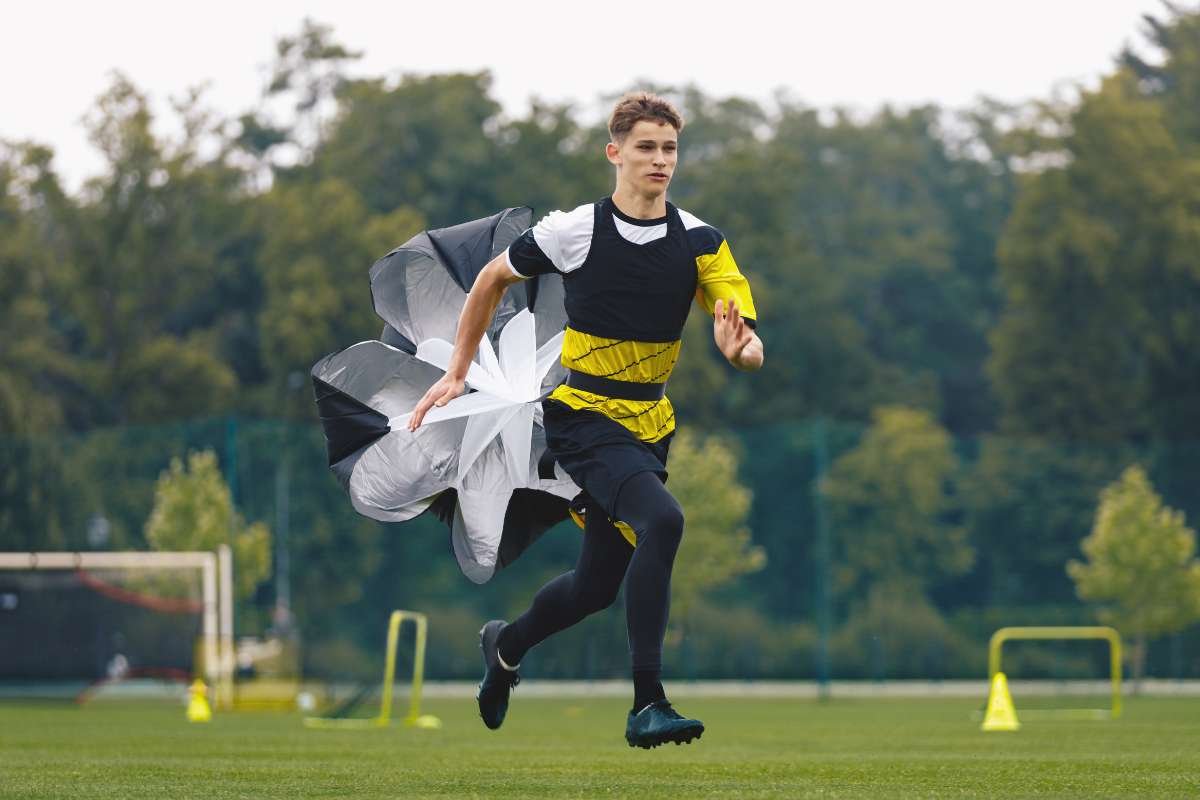
You are speeding across a field with a parachute flying behind you. You look like a superhero on a budget, but you also feel the burn in your legs, lungs, and soul. That moment sums up the fun and madness of parachute sprint training.
This workout makes you laugh at yourself while pushing your limits. It adds resistance without slowing you down completely. It feels silly at first, but after a few runs, something shifts. Your strides feel stronger, your core feels tighter, and your confidence jumps a little higher.
Think of it as giving your sprinting power a friendly slap on the back, saying, “Wake up, champ.” It challenges your speed most directly. It also makes training feel less boring because the parachute turns every run into a mini-adventure. And if you train outdoors, you also entertain half the neighbourhood.
This guide breaks down the best ways to use parachute sprint training, the benefits, drills, and interesting facts to keep you excited for your next session.
10 Powerful Parachute Sprint Training Drills
Below are ten drills that help you build speed, strength, balance, and better movement. Each explanation is easy to follow, even if you are a beginner.
1. Straight-Line Speed Run
This is the simplest and most common drill. You run straight ahead as fast as you can while the parachute opens behind you. The open chute pulls you back and makes every step harder. This extra pull forces your legs to work stronger than usual. It also trains your body to push harder during the first few steps of a sprint, which improves your overall speed. The drill builds clean, raw sprint power and makes your running muscles stronger.
2. High-Knee Acceleration Run
In this drill, you lift your knees high while sprinting. The parachute adds pressure from behind and makes each lift tougher. This strengthens your hip flexors, thighs, and lower abs. High knees also improve your running form because they train your body to keep an upright posture and create a smoother stride. When you mix this with resistance, the drill becomes great for athletes who want to fix posture, improve rhythm, and gain better leg drive.
3. 20-Meter Boost Sprint

You begin with a slow jog and then suddenly switch to a full sprint for 20 meters. The parachute sprint training resists this quick burst, which trains you to react faster and explode forward with more force. This drill is excellent for sports where quick acceleration matters, like football, cricket, rugby, or track. It sharpens your sprint starts and teaches your legs to respond instantly when you push off.
4. Zig-Zag Resistance Run
In this drill, you sprint in a zig-zag or side-to-side pattern. The parachute follows your movement and pulls you in different directions. This pull challenges your balance and control. Your legs learn to shift weight fast, which builds better footwork and agility. It is a great drill for athletes who need strong direction changes, such as basketball players or football players.
5. Half-Speed to Full-Speed Switch
You start the run at half speed, stay steady for a few meters, and then shift into full speed. The parachute makes this speed change harder, so your muscles must activate with more force. This boosts your acceleration and improves your ability to control your pace. The drill teaches your body how to shift gears smoothly, which is helpful in real sports situations where speed changes often.
6. Uphill Resistance Sprint

This drill doubles the challenge. You run up a slope while the parachute adds even more resistance behind you. The incline forces your glutes, hamstrings, and calves to work harder. The parachute makes your legs push even more. This combination builds strong lower-body muscles, improves stamina, and sharpens your forward drive. It is one of the toughest and most effective drills.
7. Countdown Sprint Sets
You run in a pattern of decreasing distances: 50 meters, then 40, 30, 20, and finally 10 meters. Each sprint feels different because the resistance challenges your body in unique ways. The longer sprints improve stamina and build strength, while the shorter sprints improve pure power and sharp acceleration. This drill creates a balanced mix of endurance and explosive speed.
8. Partner Release Sprint
In this drill, a partner holds your parachute from behind while you lean forward and prepare to sprint. Your partner releases the chute suddenly, and you launch forward at full power. This movement trains your body to react fast and push hard right from the start. It builds strong acceleration and helps you improve your first step, which is important in many sports.
9. Controlled Stride Sprints

Instead of running with quick, short steps, you focus on taking long, smooth, and controlled strides. The parachute helps stretch each step by adding resistance, so your body learns to maintain proper form even under pressure. This drill improves stride length, balance, and overall running efficiency. It also teaches your legs to stay strong during long, powerful movements.
10. Double-Chute Burst Run
This is an advanced drill. You attach two parachutes instead of one. The resistance becomes much stronger, and the run feels similar to moving through heavy wind. This drill pushes your strength and power to their highest level. Only attempt this once you are fully comfortable with basic parachute sprint training, because the extra pull is intense and needs proper technique and strength to handle safely.
Read Next:
- Resisted Sprint Training: The Secret Weapon for Explosive Speed
- Want Speed and Strength? Try These Best Sprinting Workouts Proven by Science
Why Parachute Sprint Training Works So Well?
Here is why this method gets real results:
- It forces your legs to generate more power.
- It increases acceleration strength.
- It improves balance during speed.
- It makes your core muscles more stable.
- It keeps training fun and fresh.
Athletes from football, cricket, running, rugby, and athletics use it because it builds the kind of strength that shows up in real-world performance.
Interesting Facts
- Resistance running improves sprint acceleration by up to 10%.
- Parachute running increases stride length and step frequency.
- Sprinters who train with resistance gear build stronger glutes and hamstrings.
- Wind-based resistance leads to more muscle activation during speed work.
Conclusion
Training should make you feel strong, confident, and a little entertained. That is exactly what parachute sprint training does. It pushes your limits with simple moves. It toughens your legs and sharpens your speed. And it gives you a training moment that feels both challenging and funny in the best way.
The parachute behind you becomes a symbol of the weight you want to overcome. Every sprint becomes a reminder that strength builds step by step. So tie one on, start running, let the wind pull that chute open, and enjoy becoming the fastest version of yourself.