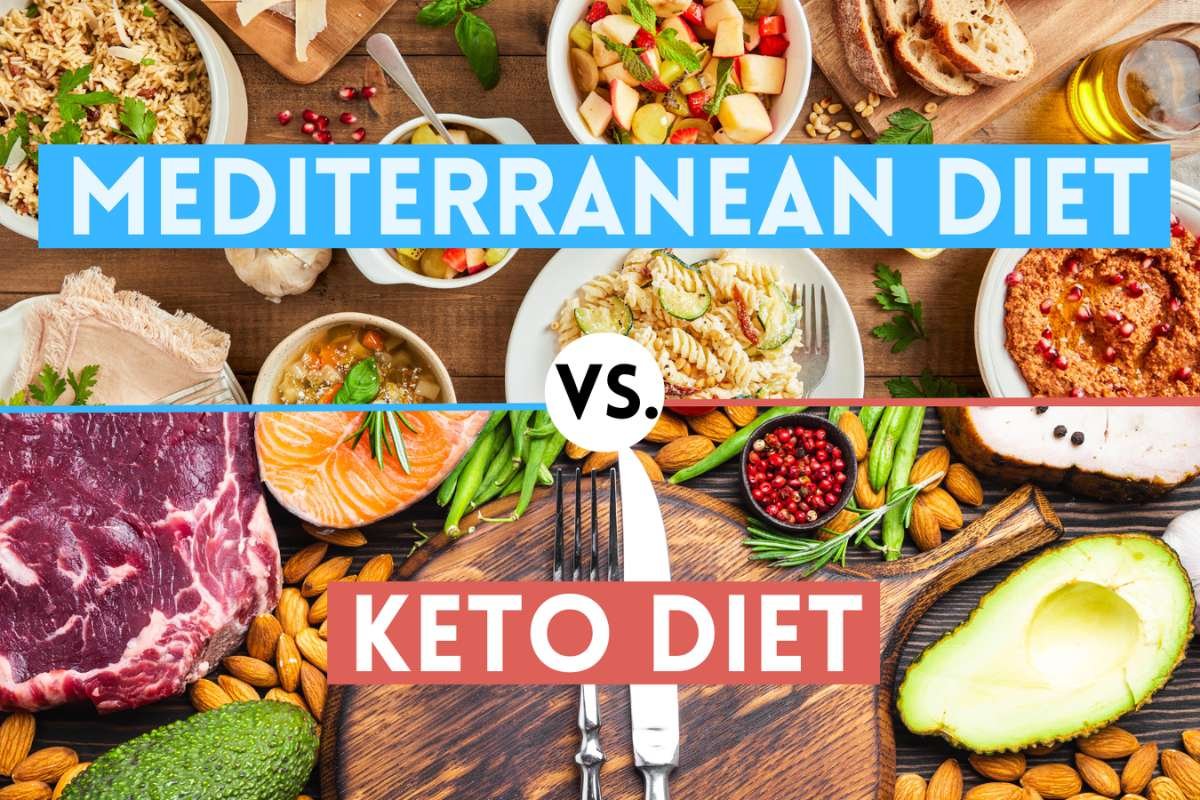
Which diet actually works better for your health: cutting carbs or eating more olive oil? In the PREDIMED trial, a Mediterranean diet cut major cardiovascular events by roughly 30% in high-risk adults. Keto-style diets often produce faster early weight loss. Keto vs Mediterranean Diet is a close contest. The better fit depends on your health goals, dietary needs, food preferences, and ability to sustain the pattern. Keto restricts carbs to trigger ketosis, while the Mediterranean approach centers on vegetables, legumes, fish, nuts, and olive oil.
Below, you’ll see how each compares for weight loss, blood sugar, heart health, liver health, nutrition, and long-term sustainability so that you can choose confidently.
Table of Contents
Keto vs Mediterranean Diet: What’s the Difference?
The keto diet is a very-low-carb, high-fat eating pattern that aims to put your body into ketosis, while the Mediterranean diet is a plant-forward, flexible pattern centered on whole foods, olive oil, fish, and moderate carbs.
Keto in a nutshell
Keto typically limits carbohydrates to about 20–50 g per day to trigger ketosis, where the body burns fat and produces ketones for energy. Common foods include eggs, fish, meat, cheese, oils, avocado, nuts, seeds, and non-starchy vegetables. Grains, legumes, most fruit, starchy vegetables, and added sugars are usually restricted because they can exceed the daily carb limit.
Mediterranean Diet in a nutshell
The Mediterranean diet emphasizes vegetables, fruit, whole grains, beans and legumes, nuts and seeds, and olive oil as the main fat. It includes regular fish and seafood, moderate dairy and poultry, and limited processed meat, added sugar, and highly processed foods. Unlike keto, it does not restrict carbs but focuses on high-fibre, nutrient-dense, mostly low–glycemic–index sources.
Keto vs Mediterranean Diet at a glance
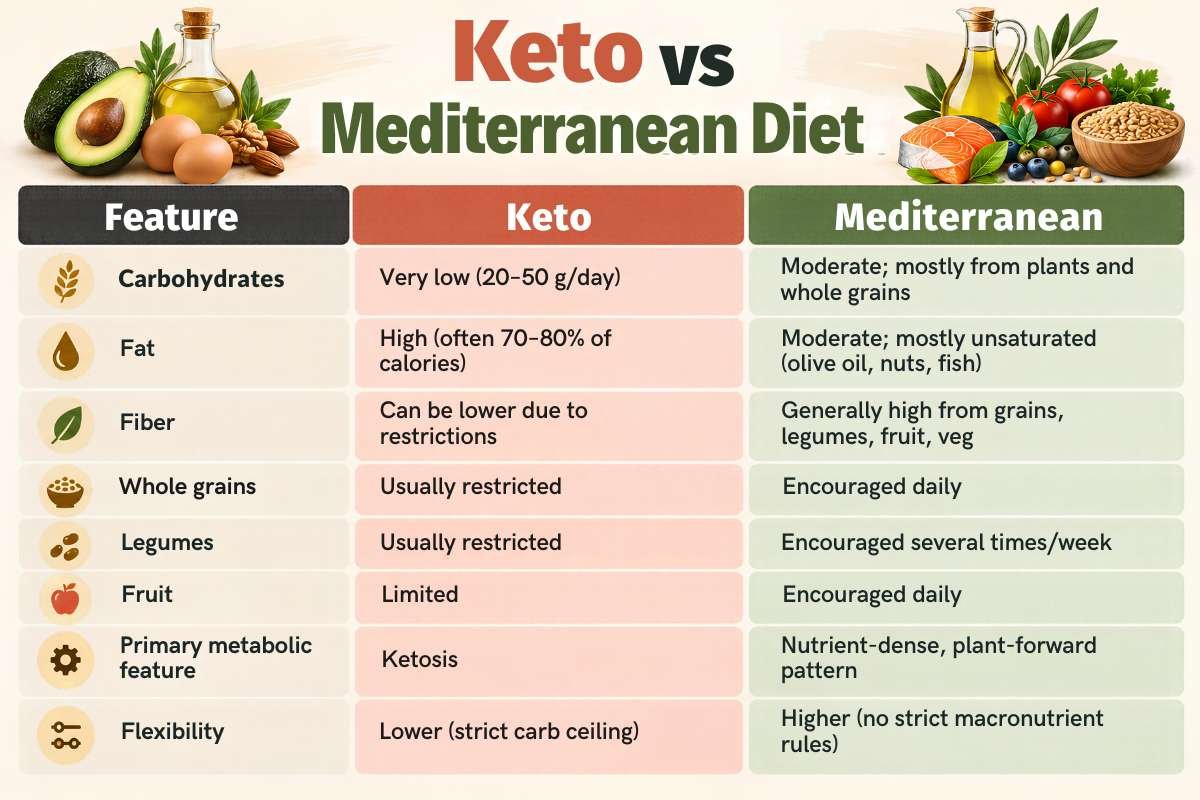
When comparing Keto vs Mediterranean Diet, the biggest differences are carb level, food variety, and long-term flexibility.
| Feature | Keto | Mediterranean |
| Carbohydrates | Very low (20–50 g/day) | Moderate; mostly from plants and whole grains |
| Fat | High (often 70–80% of calories) | Moderate; mostly unsaturated (olive oil, nuts, fish) |
| Fiber | Can be lower due to restrictions | Generally high from grains, legumes, fruit, veg |
| Whole grains | Usually restricted | Encouraged daily |
| Legumes | Usually restricted | Encouraged several times/week |
| Fruit | Limited | Encouraged daily |
| Primary metabolic feature | Ketosis | Nutrient-dense, plant-forward pattern |
| Flexibility | Lower (strict carb ceiling) | Higher (no strict macronutrient rules) |
How Do Keto vs Mediterranean Diet Compare for Weight Loss?
Does keto cause faster initial weight loss?
Yes, at first, for two simple reasons:
- Water: Cutting carbs empties your glycogen stores, and glycogen holds water. The scale drops quickly.
- Appetite: Keto often reduces hunger, so people naturally eat fewer calories.
But early scale weight isn’t all fat. In a study of 268 adults, keto reached 5% weight loss in one month, while the Mediterranean group took three. Both groups lost fat, but the Mediterranean group lost more from the waist and in fat mass.
What about long-term weight maintenance?
Fast results matter less if you can’t keep them.
- Adherence: Keto is strict, so it’s harder to follow for years.
- Weight gain can occur when a restrictive diet is discontinued, particularly if previous eating patterns return without maintaining an appropriate energy balance.
- Flexibility: Mediterranean eating fits most cuisines and food preferences.
That’s an important factor in the Keto vs Mediterranean Diet comparison: the eating pattern you can sustain consistently may matter more than short-term results.
What Does the Evidence Show for Blood Sugar and Metabolic Health?

What the newer 2026 trial adds
A small, tightly controlled 2026 Cell Metabolism trial in adults with obesity, prediabetes, and fatty liver found similar 10% weight loss across diets. But the very‑low‑carb keto group showed greater improvements in hepatic insulin sensitivity, liver fat, and several glucose measures. Results should not be generalized beyond this high‑risk, closely supervised setting. For personalized guidance, see a diet for diabetes plan with your clinician.
Which Diet Better Supports Heart, Brain, and Gut Health?
For heart health, the Mediterranean diet has stronger, longer-term evidence, while keto shows mixed cardiovascular effects that depend heavily on food quality and fat type.
Heart health
- LDL cholesterol: LDL can increase on some ketogenic diets, particularly depending on the types and amounts of dietary fat consumed. The Stanford trial found LDL increased during its ketogenic phase.
- Triglycerides: Both can lower triglycerides; keto typically produces a larger short-term drop.
- Blood pressure: Both may reduce systolic/diastolic pressure. The Mediterranean shows modest, sustained effects in large trials.
- Saturated vs unsaturated fat: Keto can be high in saturated fat if based on butter, cheese, and processed meats; Mediterranean emphasizes unsaturated fats from olive oil, nuts, and fish. Choosing saturated fat vs unsaturated fat wisely matters more than the diet label.
- Fiber: Mediterranean is generally higher in fiber from whole grains, legumes, fruit, and vegetables; keto can be lower unless carefully planned. Higher fiber supports foods that lower cholesterol and gut health.
- Food quality: A well-formulated keto plan can include fish, avocado, nuts, and non-starchy vegetables, but overall cardiovascular evidence remains limited and mixed compared with the robust data behind the Mediterranean diet.
Brain and gut health
Mediterranean eating has a larger body of human observational and clinical research related to cognitive health, while evidence for ketogenic diets beyond their established therapeutic role in epilepsy remains more limited. Keto is established for epilepsy, but its wider cognitive benefits are still preliminary. For gut health, the Mediterranean diet’s legumes, whole grains, and fruit feed beneficial microbes. Keto can work too, but strict versions may cut fiber unless carefully planned.
What About Liver Health and Fatty Liver?
Liver health matters because excess liver fat (steatosis) drives insulin resistance and is tightly linked to obesity, prediabetes, type 2 diabetes, and cardiovascular risk. This cluster of conditions is now termed MASLD (metabolic dysfunction–associated steatotic liver disease).
What the 2026 keto vs Mediterranean trial found
In a 2026 randomized pilot study of adults with overweight/obesity and MASLD, a ketogenic very‑low‑energy diet (VLED) cut liver fat by 77% versus 14% on a Mediterranean diet at 12 weeks, with 13% vs 4% weight loss. 69% of the VLED group normalized liver fat versus none in the Mediterranean diet group.
Why you shouldn’t interpret this as “keto wins”
This small pilot (about 25 people) used a supervised, calorie-restricted diet, not typical keto. The keto group also received semaglutide, and follow-up was short. Results apply only to people with MASLD who are overweight or obese, so treat them as promising but preliminary and seek medical guidance.
How to Choose Between Keto vs Mediterranean for Your Goals

Use your primary goal to guide the choice between these patterns, since both can work when well-planned and sustained.
| If your priority is… | Evidence to consider |
| Rapid initial weight change | Keto can produce substantial early weight loss, partly from water and glycogen shifts. |
| Long-term weight management | Consider adherence, flexibility, and sustainability; Mediterranean eating shows strong maintenance data. |
| Blood sugar control | Both can help; effects vary by population, carb level, and food quality. |
| Heart health | Weigh stronger long-term Mediterranean evidence and how keto fat choices affect LDL. |
| Liver fat/MASLD | Emerging 2026 data support very‑low‑carb, supervised programs in selected patients. |
| High fiber intake | The Mediterranean has an inherent advantage from whole grains, legumes, fruit, and vegetables. |
| Food flexibility | Mediterranean patterns are generally easier to maintain socially and long-term. |
| Ketosis-specific goals | Keto is required to achieve and maintain nutritional ketosis. |
Conclusion:
There’s no single best choice in the keto vs Mediterranean diet debate. Keto can produce faster initial scale-weight changes, partly because of changes in glycogen and water, while the Mediterranean diet has a larger body of long-term evidence for cardiovascular health and is generally less restrictive, which may make it easier for some people to sustain.
The best choice is the one that matches your goal and fits your daily life. If you have diabetes, fatty liver, or heart disease, keto is best tried under medical supervision.
Your next step: Pick the one goal that matters most to you right now, then talk to your doctor or dietitian about which approach fits it best.
FAQ:
1. Is keto better than the Mediterranean diet for weight loss?
Both can support weight loss. Keto may produce faster initial changes, while long-term results depend heavily on adherence, energy intake, and the ability to maintain the eating pattern.
2. Can the Mediterranean diet help with fatty liver?
Yes. Mediterranean-style eating has been studied for metabolic and liver health, although the degree of liver-fat improvement can vary by intervention and population.
3. Which diet has more fiber in keto vs Mediterranean diet?
The Mediterranean diet generally provides more fiber because it emphasizes legumes, whole grains, fruits, and a wide variety of vegetables.
4. Can you combine keto and Mediterranean eating?
Some people adopt a lower-carbohydrate Mediterranean-style pattern, but a diet does not need to produce ketosis to retain many Mediterranean principles.
5. Is the Mediterranean diet low carb?
Not usually. It can be moderate in carbohydrates while emphasizing their quality, particularly vegetables, legumes, fruits, and whole grains.
Links and Sources:
- https://www.ncbi.nlm.nih.gov/books/NBK557733
- https://www.healthdirect.gov.au/amp/article/ketogenic-diet
- https://www.ccjm.org/content/ccjom/68/9/761.full.pdf
- https://jamanetwork.com/journals/jamanetworkopen/fullarticle/2810826
- https://med.stanford.edu/news/all-news/2022/070/keto-mediterranean-diet-diabetes.html
- https://link.springer.com/article/10.1186/s12872-026-06189-7
- https://www.health.harvard.edu/heart-health/keto-diet-is-not-healthy-and-may-harm-the-heart
- https://www.ncbi.nlm.nih.gov/books/NBK541033
- https://nutritionsource.hsph.harvard.edu/healthy-weight/diet-reviews/mediterranean-diet/