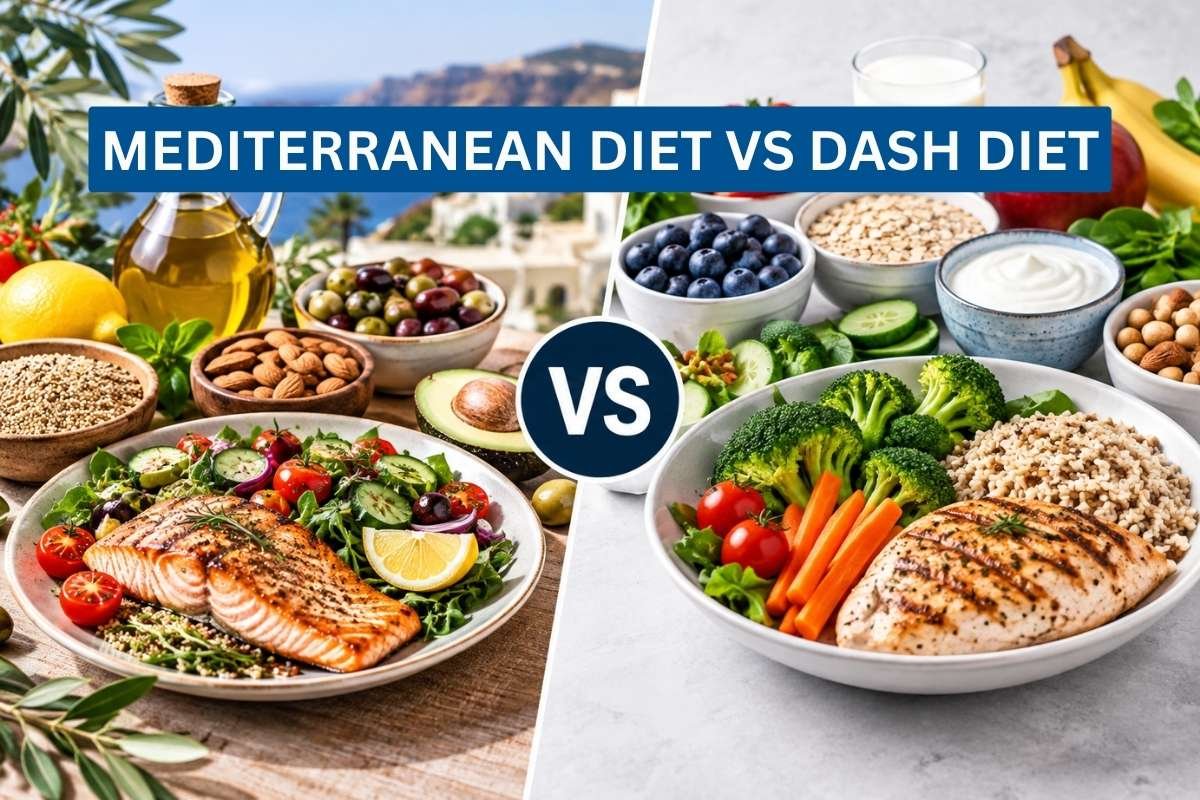
Mediterranean and DASH diets share many healthy foods. But they prioritize different things. The Mediterranean is an overall pattern built on plants, olive oil, nuts, fish, and minimally processed foods. DASH was designed for blood pressure, with sodium limits, potassium-rich foods, and set food-group targets. In the original DASH trial, the combination diet lowered systolic blood pressure by 5.5 mmHg more than the control diet. Among participants with hypertension, the reduction was 11.4 mmHg. In the Mediterranean diet vs DASH diet debate, both have strong evidence. The results vary by outcome, sodium intake, and study population.
This guide compares them across eight health outcomes and shows how to interpret the differences instead of naming a winner.
Table of Contents
Mediterranean Diet vs DASH Diet: What Is the Difference?
The Mediterranean Diet and DASH Diet are both evidence-based eating patterns that emphasize whole, minimally processed foods, but they differ in purpose and structure. The Mediterranean Diet is a cultural, plant-forward pattern centered on olive oil and fish, while the DASH Diet is a clinically designed plan focused on lowering blood pressure through sodium reduction and structured food-group targets.
What Is the Mediterranean Diet?
The Mediterranean Diet is a plant-forward eating pattern centered on olive oil, vegetables, fruits, legumes, whole grains, nuts, seeds, and fish, with moderate poultry/dairy and limited red/processed meat.
What Is the DASH Diet?
The DASH Diet is a clinically designed plan to lower blood pressure that emphasizes fruits, vegetables, whole grains, legumes, nuts/seeds, low-fat dairy, and lean protein while reducing sodium, saturated fat, and added sugars.
What Do They Have in Common?
| Similarity | Mediterranean | DASH |
| Vegetables | High emphasis | High emphasis |
| Fruit | High emphasis | High emphasis |
| Whole grains | High emphasis | High emphasis |
| Legumes | High emphasis | High emphasis |
| Nuts/seeds | High emphasis | High emphasis |
| Red/processed meat | Limited | Limited |
| Added sugar | Limited | Limited |
| Saturated fat | Limited | Limited |
The major differences are straightforward. Mediterranean → dietary pattern + healthy fats + olive oil + fish. DASH → sodium reduction + structured food groups + blood-pressure focus. When choosing between the Mediterranean Diet vs DASH Diet, pick the pattern that best fits your goals and lifestyle. Both align with a healthy dietary pattern built around minimally processed foods, nutrient density, variety, and long-term adherence.
Mediterranean vs DASH: The 8 Health Outcomes That Matter
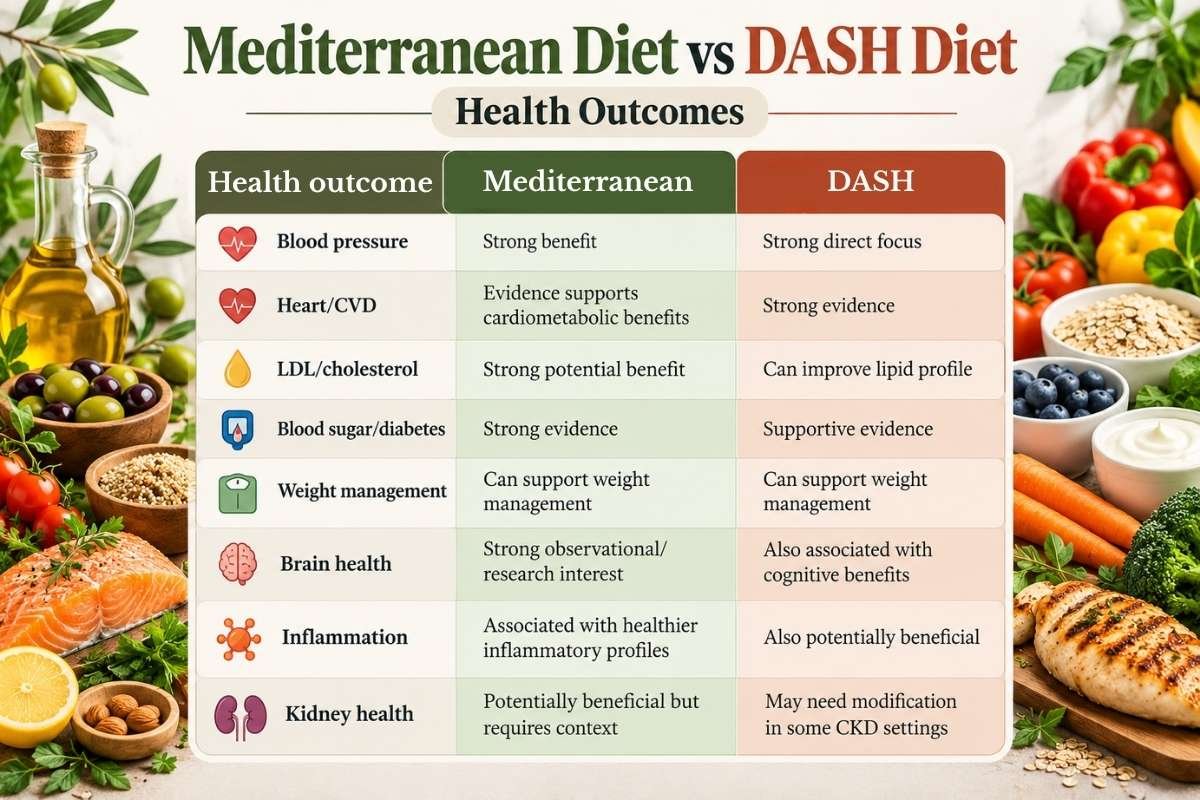
| Health outcome | Mediterranean | DASH | What the evidence means |
| Blood pressure | Strong benefit | Strong direct focus | Sodium and overall food quality matter |
| Heart/CVD | Evidence supports cardiometabolic benefits | Strong evidence | Both support cardiovascular health through somewhat different dietary emphases. |
| LDL/cholesterol | Strong potential benefit | Can improve lipid profile | Fat quality and overall dietary pattern matter |
| Blood sugar/diabetes | Strong evidence | Supportive evidence | Fiber-rich, minimally processed foods are central |
| Weight management | Can support weight management | Can support weight management | Neither automatically causes weight loss without overall energy balance |
| Brain health | Strong observational/research interest | Also associated with cognitive benefits | Shared plant-rich components matter |
| Inflammation | Associated with healthier inflammatory profiles | Also potentially beneficial | Avoid presenting inflammation as a single-diet outcome |
| Kidney health | Potentially beneficial but requires context | May need modification in some CKD settings | Medical kidney restrictions can change the picture |
When weighing Mediterranean Diet vs DASH Diet, remember that both patterns improve key markers, but individual results vary. Evidence that a diet improves a particular marker does not necessarily mean it prevents or treats a disease in every person.
How the Mediterranean and DASH Diets Compare for Heart and Metabolic Health
Blood Pressure
DASH was developed to help lower blood pressure, and sodium reduction is an important part of the approach. NHLBI sets a 2,300 mg daily limit, and 1,500 mg lowers blood pressure even further. Mediterranean eating supports blood pressure through overall food quality instead.
Is DASH better than Mediterranean for blood pressure?
DASH has the more hypertension-focused design, but the evidence doesn’t justify a winner-takes-all answer. A 2024 randomized trial of 240 adults with high-normal blood pressure or grade 1 hypertension paired both diets with salt restriction. Both improved cardiometabolic measures, and the Mediterranean group had the greater blood pressure drop. That result applies to that trial’s conditions.
Cholesterol and Heart Health
In the same trial, total and LDL cholesterol fell in both diet groups. The Mediterranean pattern leans on olive oil, nuts, seeds, and fish, which are foods that lower cholesterol and are rich omega-3 foods. DASH limits saturated fat to 6% of calories and adds nutrient-rich foods. In the Mediterranean Diet vs DASH Diet comparison, the main difference is how each handles saturated fat vs unsaturated fat.
Blood Sugar and Diabetes
Both patterns rely on fiber-rich, minimally processed carbohydrates: whole grains, legumes, fruit and vegetables. High-fibre foods and low glycemic index foods support insulin sensitivity and glycemic control. In the trial, fasting glucose and HbA1c fell in all diet groups. Neither diet replaces diabetes treatment, so pair any diet for diabetes with your clinician’s advice.
Where the Diets Differ Most: Sodium, Fats, Fiber, Dairy and Protein
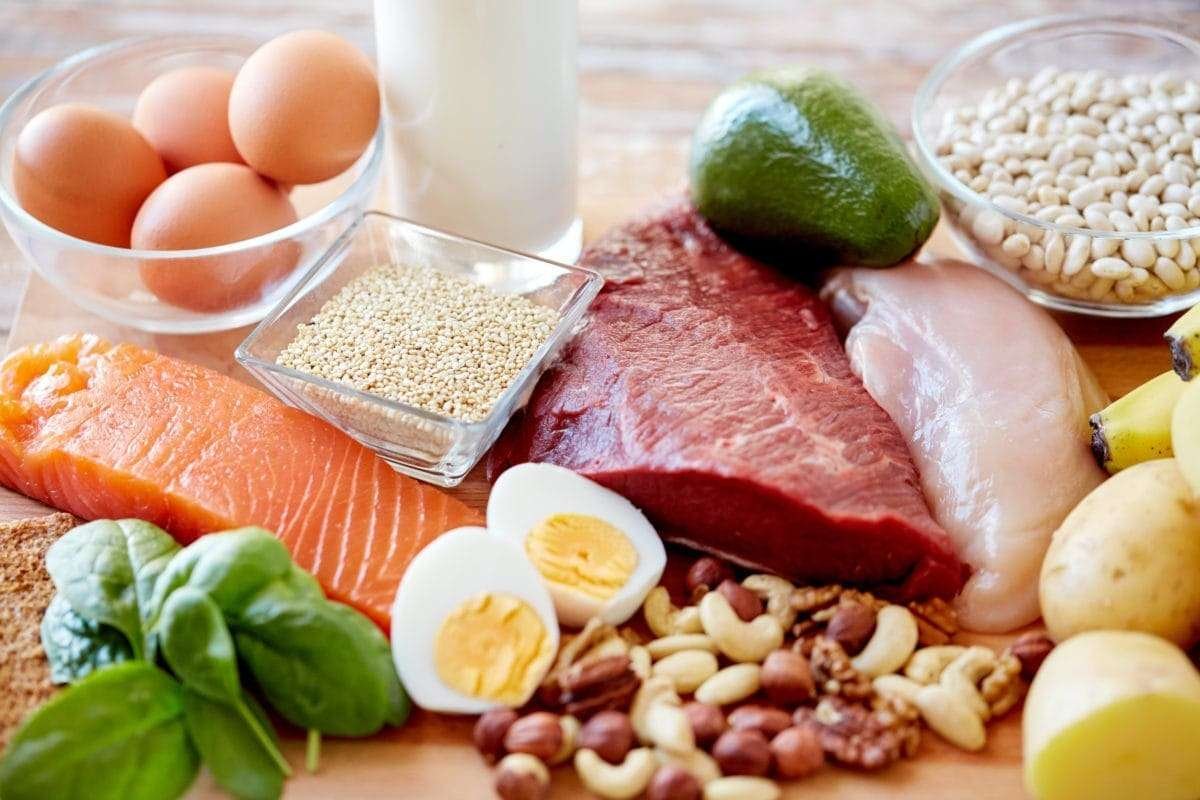
| Dietary feature | Mediterranean | DASH |
| Sodium | Emphasizes minimally processed foods; no strict universal target | Explicit sodium target (typically ≤2,300 mg/day; lower option ≤1,500 mg) |
| Main fat pattern | Olive oil, nuts, seeds, fish (unsaturated-fat forward) | Lower saturated fat; traditionally more low-fat dairy |
| Dairy | Moderate, often yogurt/cheese | More explicitly incorporated, usually low-fat (2–3 servings/day) |
| Fish | Prominent | Included as lean protein |
| Fiber | High | High |
| Protein | Legumes, fish, nuts, poultry | Legumes, fish, poultry, low-fat dairy |
| Red meat | Limited | Limited |
Why Sodium Changes the Comparison
“Mediterranean” doesn’t automatically mean “high sodium.” But sodium isn’t as defining a feature of the pattern as it is for DASH. DASH sets explicit daily sodium limits (2,300 mg or 1,500 mg) to drive blood-pressure benefits. Whereas Mediterranean-style eating reduces sodium mainly by favoring fresh, minimally processed foods.
Why Fat Quality Matters
It’s not “low-fat vs high-fat” but which fats you choose. Mediterranean eating swaps saturated fat for unsaturated fats from olive oil, nuts, seeds, and fish. DASH cuts saturated fat and uses low-fat dairy. See Saturated Fat vs Unsaturated Fat for more.
What Does a Mediterranean Diet vs DASH Diet Plate Actually Look Like?
Mediterranean Plate
- ½ vegetables/fruit
- whole grain
- legumes or fish/poultry
- olive oil
- nuts/seeds
- herbs/spices
DASH Plate
- vegetables
- fruit
- whole grain
- lean protein/legumes
- low-fat dairy
- nuts/seeds
- minimal added sodium
Breakfast
- Mediterranean: Greek yogurt with berries, walnuts, and whole-grain toast drizzled with olive oil.
- DASH: Low-fat yogurt with banana, unsalted almonds, and oatmeal made with low-fat milk.
Lunch
- Mediterranean: Lentil and vegetable salad over farro with olive oil–lemon dressing and herbs.
- DASH: Turkey and veggie wrap on a whole-wheat tortilla with low-fat yogurt–herb sauce and fruit.
Dinner
- Mediterranean: Baked salmon, quinoa, and roasted vegetables with olive oil and lemon.
- DASH: Grilled chicken, brown rice, steamed broccoli, and a side of low-fat milk or yogurt.
Can You Follow Either Diet With Indian or Other Cultural Foods?
Yes. Both are principle-based, not cuisine-locked. Use staples like dal, chana, rajma, sabzi, whole-grain rotis, and curd to eat more plants and fiber. Choose healthier fats and cut sodium. For the Mediterranean diet vs DASH diet, as a simple starting framework, you can build a plate around roughly half vegetables and fruit, with the remaining space divided between whole grains and a protein-rich food.
Can You Combine the Mediterranean and DASH Diets?
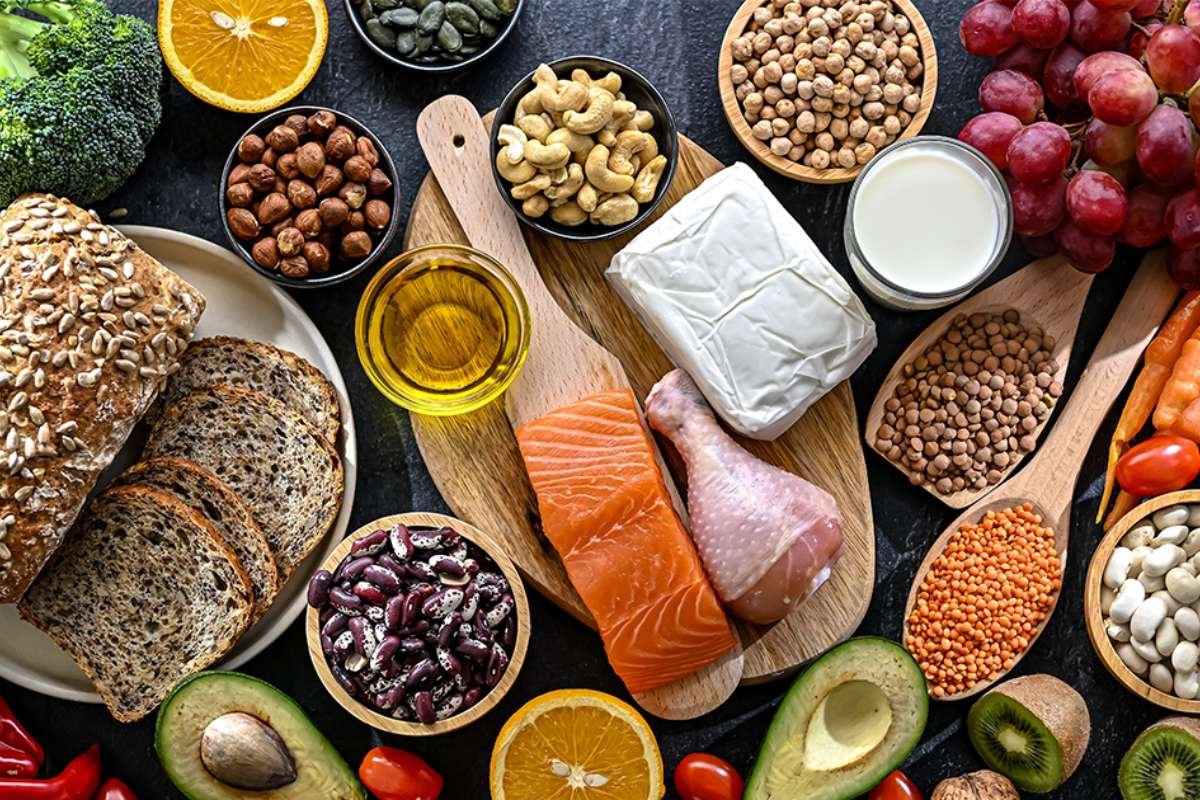
Yes. The two patterns overlap considerably. Both emphasize vegetables, fruits, whole grains, legumes, nuts/seeds, and lean proteins while limiting red/processed meat and added sugars. The MIND diet is a separate dietary pattern that incorporates elements of both Mediterranean and DASH approaches and was developed specifically around brain-health research. Combining principles doesn’t mean randomly mixing every recommendation. You can adopt Mediterranean-style fats and fish while keeping DASH-style sodium targets if blood-pressure management is your goal.
The existence of the MIND pattern also gives a natural bridge to Diet for Brain Health, though current trials show modest cognitive effects and more research is needed. When weighing Mediterranean Diet vs DASH Diet, think in terms of shared foundations. Such as plant-forward foods, minimally processed choices, and sustainable habits. Then layer in specific targets (sodium, fat quality, dairy) based on your health priorities.
Conclusion:
In the Mediterranean Diet vs DASH Diet comparison, there’s no universal winner. Both are plant-rich, low in processed foods, and backed by strong evidence. DASH gives you clear sodium and food-group targets, which suits blood pressure goals. The Mediterranean pattern offers flexible, healthy-fat eating that’s easy to sustain. You can also blend them: Mediterranean-style fats with DASH-style sodium limits.
Your next step: Pick one goal, such as lower blood pressure or easier long-term eating, and try one swap from the matching diet this week. Check with your doctor first if you have a medical condition.
FAQ:
1. Is the Mediterranean Diet better than the DASH Diet?
Both are well-studied healthy eating patterns. The more appropriate choice depends on the health goal, dietary preferences, and medical needs.
2. Can you combine the Mediterranean diet vs DASH diet?
Yes. Their shared emphasis on vegetables, fruits, whole grains, legumes, nuts, and minimally processed foods makes their principles compatible.
3. Which diet is better for weight loss?
Neither diet guarantees weight loss. Weight change depends on overall energy intake, food choices, activity, adherence, and other individual factors.
4. Which diet is better for cholesterol?
Both can support healthier lipid profiles. The Mediterranean pattern places particular emphasis on unsaturated fats from foods such as olive oil, nuts, and fish.
5. Is the Mediterranean Diet good for kidney disease?
People with CKD should not increase potassium-rich foods or make major dietary changes without guidance from their healthcare professional or renal dietitian.
Links and Sources:
- https://pubmed.ncbi.nlm.nih.gov/9099655/#:~:text=Among%20the%20133,Hg%20(P%3D0.003). (Introduction Statistics)
- https://www.nia.nih.gov/health/alzheimers-and-dementia/what-do-we-know-about-diet-and-prevention-alzheimers-disease
- https://medlineplus.gov/ency/patientinstructions/000770.htm
- https://www.health.harvard.edu/diet-and-nutrition/a-guide-to-the-dash-diet
- https://bmjopen.bmj.com/content/5/8/e008222
- https://www.nhlbi.nih.gov/news/2024/mediterranean-diet-linked-reduced-associated-risk-premature-death