Ever grabbed a pickle jar mid-cramp because your calf felt like it was trying to escape your leg? Don’t worry, you’re not crazy. Pickle juice for cramps has gone from locker room folklore to something researchers at universities now study seriously.
Athletes have sworn by this trick for decades, passing it down like a secret handshake. Coaches kept jars on the sideline long before anyone proved why it helped. Turns out the science is catching up to the tradition.
This article breaks down what the research actually shows, how pickle juice may calm a cramp, how much you need, and who should be careful with it. We’ll also cover the newer data on people with liver disease, since that’s where some of the strongest trial evidence now lives. By the end, you’ll know exactly when to reach for the jar and when to skip it.
Does Pickle Juice for Cramps Actually Stop Muscle Spasms?
Short answer: it looks that way, and not just anecdotally. A 2010 study in Medicine & Science in Sports & Exercise found that a few sips of pickle juice inhibited electrically induced muscle cramps in healthy men. That’s a controlled lab result.
More recently, a randomized trial called PICCLES tested this on people with cirrhosis, a group that suffers frequent, severe cramps. Patients who sipped pickle brine at cramp onset saw a bigger drop in cramp severity than those who drank tap water, a difference researchers called statistically significant.
So pickle juice for cramps isn’t just an old wives’ tale. It has actual data behind it now, from two very different groups of people.
Why Does Pickle Juice Work So Fast?
Here’s where it gets weird. Cramp relief happens in under a minute, way too fast for your body to absorb sodium from your stomach. So sodium probably isn’t the real hero here.
Researchers now point to your throat instead of your bloodstream. As one liver specialist put it, the acid in the brine triggers nerves in the back of the throat, which then turns the cramp off. Your mouth and throat send a signal straight to your nervous system.
Think of it like a reset button for the overactive nerve causing your muscle to seize. This nerve reflex theory explains why relief feels almost instant.
| Theory | What It Claims | Does Evidence Support It? |
| Electrolyte replacement | Sodium restores balance and stops cramping | Weak; absorption takes too long |
| Neural reflex (oropharyngeal) | Acidic brine triggers a nerve response in the throat | Strong, matches speed of relief |
| Placebo effect | Belief alone drives the result | Unlikely, effect beats placebo in trials |
How Much Pickle Juice Do You Actually Need?
Small amounts work because this is a nerve trigger, not a nutrient refill. Most research uses tiny doses on purpose.
Doctors involved in liver-cramp research noted that just one tablespoon of pickle juice has been shown to stop experimentally induced cramps pretty effectively in earlier studies. A tablespoon or two, sipped right when the cramp starts, seems to be the sweet spot.
Timing matters more than quantity. Drink it after the cramp has faded and you’ve basically missed the window. Pickle juice for cramps works best as an in-the-moment fix.
Read More: Juicing: Good or Bad? The Truth Doctors Want You to Know
Is Pickle Juice Safe for Everyone?

Mostly yes, but not for everyone. Pickle brine is loaded with sodium, so if you’re watching blood pressure or kidney health, talk to your doctor first.
People with cirrhosis were studied specifically because cramps hit them so hard, and the trial reported no serious side effects during the 28-day period. Still, that group was medically supervised the whole time. Random self-dosing at home is a different situation.
Pregnant women, people on sodium-restricted diets, and anyone with kidney issues should check with a provider before making this a habit. For healthy athletes dealing with occasional exercise cramps, small sips are generally considered low risk.
What Causes Muscle Cramps in the First Place?
For a long time, everyone blamed dehydration and low electrolytes. That explanation is losing ground fast. Research shows that when most people are actually cramping, their blood electrolyte and hydration levels are normal.
The newer theory points to the nervous system instead. Overactive alpha motor neurons in your brain stem and spinal cord may fire too much, causing the muscle to lock up. That lines up neatly with why a nerve-triggering drink like pickle juice can interrupt the cycle so quickly.
This shift matters because it changes how you should treat a cramp. Chugging water alone may not be enough if the real problem sits in your nerves, not your fluid levels.
Pickle Juice for Cramps vs Other Cramp Remedies
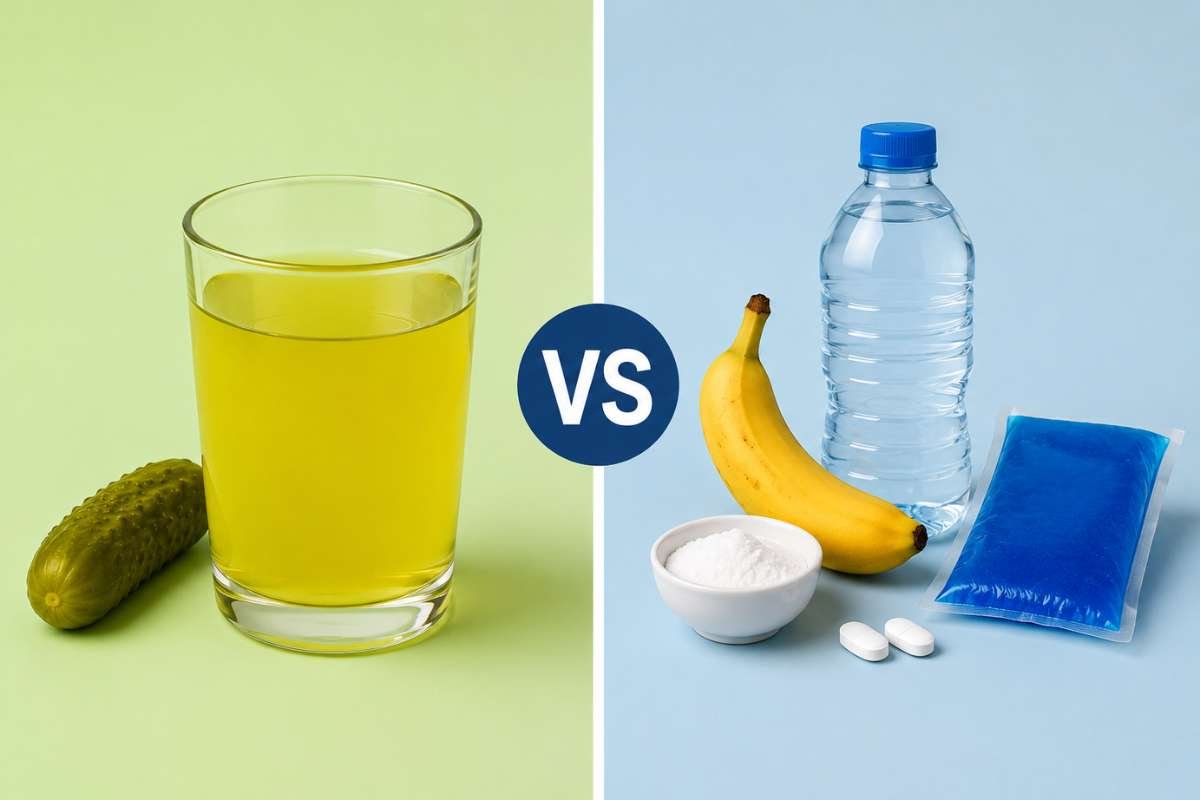
Not every remedy is created equal. Some target electrolytes, others target nerves, and a few just distract your brain for a moment.
- Pickle Juice: Fast nerve-based relief, backed by trial data
- Sports Drinks: Slower, sodium-based, better for prevention than active cramps
- Yellow Mustard: Similar acidic, nerve-triggering theory as pickle juice
- Stretching: Mechanical relief, works but takes longer and needs mobility
- Water Alone: Helpful for hydration, weak for active cramp relief
Both mustard and pickle juice keep showing up together in research because they share that acidic, throat-triggering mechanism. If you’re out of pickles, a small squeeze of mustard is worth trying.
Read More: Benefits of Drinking Pickle Juice: From Cramps to Hydration
The Bottom Line
Pickle juice for cramps has real trial data behind it, from healthy athletes to people with serious liver disease. The mechanism looks more like a nerve reset than an electrolyte refill, which explains the fast relief people report.
Keep a small bottle of brine in your gym bag or fridge for the next time a cramp hits. Sip a tablespoon or two right when it starts, not after. If you’re managing a health condition, check with your doctor first, then give this old-school fix a real shot.
FAQs
1. Does pickle juice work for menstrual cramps?
There’s no strong research on this specific use yet, so results are mostly anecdotal rather than proven.
2. Can you drink pickle juice every day?
Occasional use is fine for most healthy people, but daily drinking may push your sodium intake too high.
3. Is pickle juice better than a banana for cramps?
Bananas address potassium levels over time, while pickle juice targets the nerve response during an active cramp.
4. How fast does pickle juice stop a cramp?
Many users and some lab studies report relief within 30 to 90 seconds of sipping.
5. Can kids drink pickle juice for cramps?
There’s limited pediatric research, so check with a pediatrician before giving it to children.
Sources: