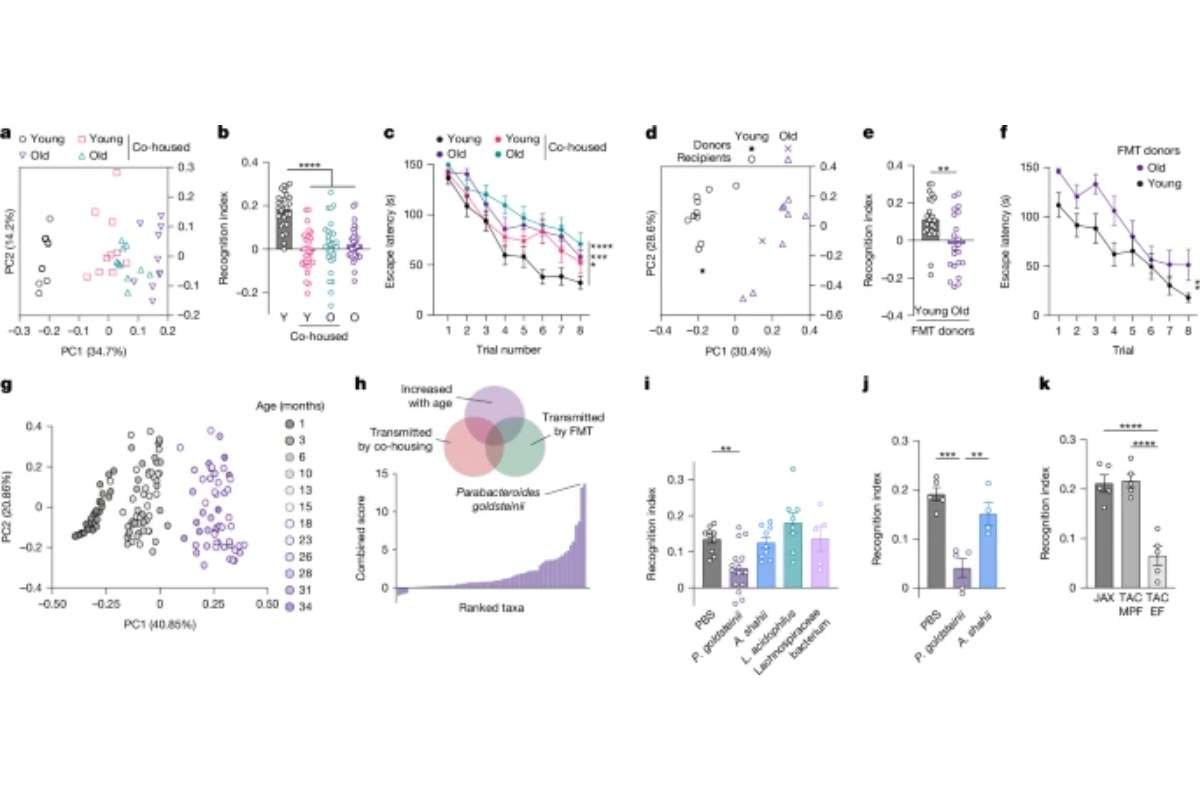
Scientists report that age-related changes in gut bacteria can impair memory by disrupting signals between the intestines and brain, according to a new mouse study that identifies inflammatory pathways and potential treatment targets. showing how the Gut Microbiome Linked To Memory Loss may play a role in aging-related cognitive decline.
Study Links Gut Microbes to Age-Related Memory Decline
Researchers have identified a biological pathway connecting gut microbes to declining memory in aging mice, suggesting the microbiome may play a direct role in cognitive decline.
The study shows that certain intestinal bacteria accumulate with age and weaken communication between the gut and the brain. That disruption affects the hippocampus, a brain region critical for forming memories.
Scientists found that young mice exposed to gut microbes from older mice developed memory deficits similar to those seen in aged animals. The findings suggest age-related microbiome changes alone can influence cognitive performance.
“Our results show that signals originating in the gut can shape how the brain processes memory,” the researchers wrote. They said the pathway links intestinal metabolites, immune responses, and neural signaling that ultimately affects brain function.
Bacterial Metabolites Trigger Inflammation and Weaken Brain Signals
The research identified a bacterial species, Parabacteroides goldsteinii, which becomes more abundant with age and contributes to cognitive decline in mice. offering further evidence of how the Gut Microbiome Linked To Memory Loss may influence brain health
This bacterium produces medium-chain fatty acids, small molecules that activate a receptor known as GPR84 on immune cells. Activation of that receptor triggers inflammation in peripheral tissues.
The inflammatory response disrupts vagal nerve signaling between the gut and the brain. As a result, sensory information reaching the brain weakens, leading to reduced activity in hippocampal neurons involved in memory encoding.
“We found that these metabolites impair neuronal activation in the hippocampus,” the researchers reported. “This results in a loss of memory formation.”
Experiments showed that administering these fatty acids to mice reduced their performance in object recognition and spatial learning tasks.
Additional tests found that the metabolites did not enter the brain directly. Instead, they acted through immune cells outside the brain, demonstrating how peripheral inflammation can affect cognition.
Experimental Treatments Restore Memory in Mice
The study also tested several interventions that restored memory performance in older mice. offering further insight into how the Gut Microbiome Linked To Memory Loss might be targeted for treatment.
One strategy used bacteriophages—viruses that infect bacteria—to alter microbial activity in the gut. A phage treatment reduced levels of harmful fatty acids and improved cognitive performance.
Researchers also tested drugs that block the GPR84 receptor, preventing inflammatory signaling. Mice receiving the inhibitor regained normal memory function and showed improved neuronal activity in the hippocampus.
Another approach involved stimulating sensory nerves that carry signals from the gut to the brain. Activating those neurons restored communication along the gut–brain pathway and improved memory in animals with aged microbiomes.
In separate experiments, scientists found that gut hormones that activate the vagus nerve could also restore cognitive performance.
“These findings suggest that stimulating gut–brain communication may counteract age-related memory decline,” the researchers said.
Findings Suggest New Targets for Brain Aging Research
The work highlights how signals originating outside the brain may influence cognitive aging.
Scientists have long studied how changes within the brain contribute to memory loss, but the new research suggests that the gut and immune system may play a major role.
The researchers said inflammation triggered by microbiome metabolites could weaken the sensory pathways that relay internal body signals to the brain.
Although the experiments were conducted in mice, the findings point to possible strategies for preventing or slowing memory decline.
Future research will need to determine whether similar gut–brain mechanisms contribute to aging-related cognitive decline in humans. and confirm whether the Gut Microbiome Linked To Memory Loss plays a comparable role in people.