
All athletes desire that explosive burst—an ability to speed up quickly, faster than their competition. Traditional sprinting only gets you so far. For a real elevation in performance, athletes and coaches are looking for the research-supported method of Resisted Sprint Training. This style of training focuses on running against resistance; be it a sled, parachute, or resistance band, the goal is to develop strength, power, and acceleration at the same time.
What Is Resisted Sprint Training?
Resisted Sprint Training is a specialized form of sprint exercise where athletes perform sprints while facing external resistance. This resistance can come from equipment such as weighted sleds, resistance bands, vests, or even partner towing. The idea is simple: make your sprinting muscles work harder than usual, so when the resistance is removed, your natural sprint feels lighter and faster.
This concept mirrors strength training principles. When you lift heavier weights, your muscles adapt by becoming stronger. Similarly, by sprinting against resistance, you teach your muscles to produce greater force during each stride — leading to quicker starts, stronger strides, and enhanced top speed over time.
The Science Behind the Speed
When you perform Resisted Sprint Training, several biomechanical and physiological adaptations occur:
- Increased Force Production: The resistance forces your muscles — particularly the glutes, hamstrings, and quads — to contract more powerfully.
- Improved Neural Activation: It enhances communication between your brain and muscles, improving coordination and reaction time.
- Enhanced Acceleration Mechanics: Resistance improves stride length and frequency, key factors in explosive starts.
- Greater Muscular Endurance: Continuous resistance conditions your fast-twitch fibers, helping maintain power over repeated sprints.
Studies have shown that athletes who incorporate this form of training consistently experience significant improvements in acceleration (0–30m) — a game-changing advantage in sports like football, soccer, rugby, and track events.
Types of Resisted Sprint Training
There’s no one-size-fits-all approach. Depending on your sport and goals, you can choose from various methods of Resisted Sprint Training:
1. Sled Sprints:

- Athletes attach a weighted sled to their waist and sprint over short distances.
- Ideal for improving leg drive and acceleration.
- Keep the load moderate (10–30% of body weight) to maintain proper sprint mechanics.
2. Parachute Sprints:
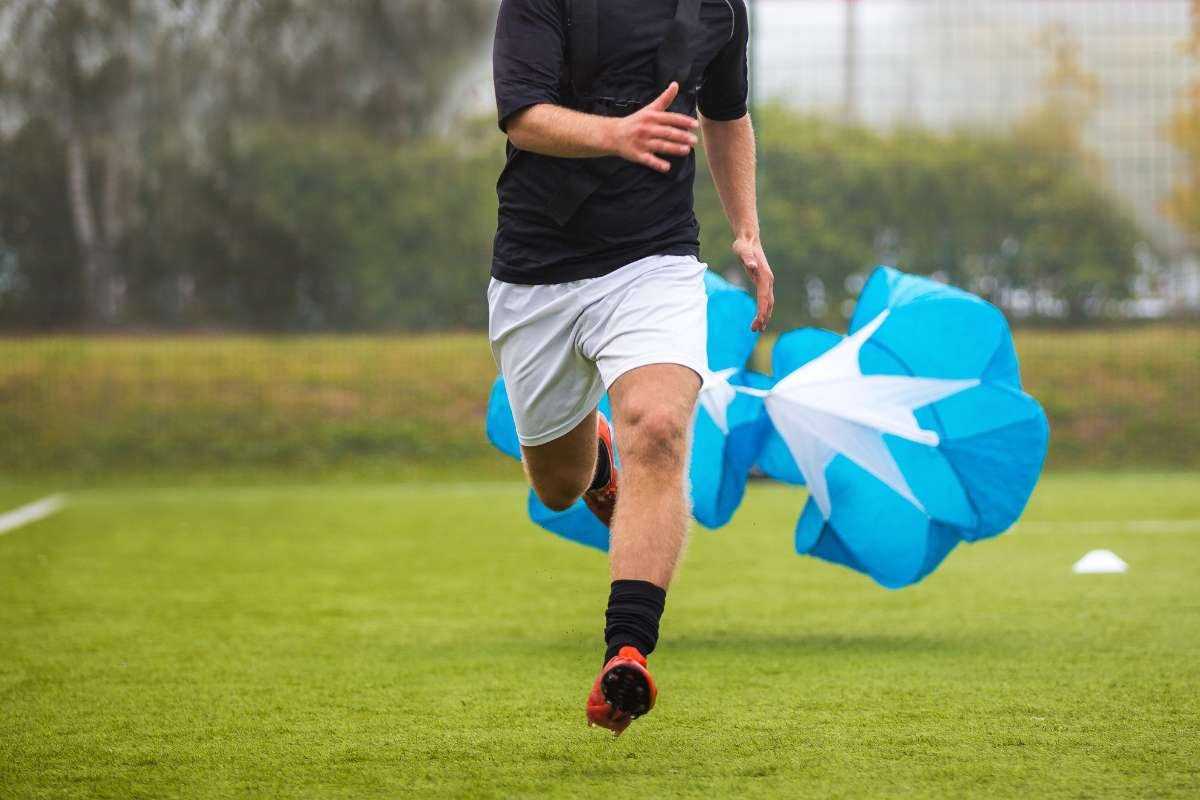
- A lightweight parachute is attached to the athlete’s back, creating drag during the sprint.
- Great for developing top-end speed and running against air resistance.
3. Resistance Band Sprints:
- A training partner or anchor point holds a resistance band while you sprint forward.
- Perfect for short, high-intensity bursts and developing explosive starts.
4. Weighted Vest Runs:
- Adds overall body load, challenging your cardiovascular system and leg strength.
- Best used sparingly to prevent overstrain or poor sprint mechanics.
- Each type offers unique benefits, and combining them strategically can yield well-rounded performance improvements.
Key Benefits of Resisted Sprint Training
1. Enhanced Acceleration:
Resistance strengthens your ability to overcome inertia, allowing for faster take-offs — crucial in sports that require quick bursts of speed.
2. Improved Sprint Mechanics:
The added resistance promotes optimal forward body lean and stronger ground contact — essential elements for efficient sprinting form.
3. Increased Power Output:
Stronger muscle contractions lead to higher propulsion forces, directly translating to faster unresisted sprint speeds.
4. Injury Prevention:
Strengthening the posterior chain (glutes, hamstrings, lower back) reduces the risk of common sprint-related injuries like hamstring pulls.
5. Sport-Specific Transfer:
Athletes in team sports (football, basketball, soccer) can mimic real-game resistance — like pushing against opponents — improving functional speed and strength.
How to Incorporate Resisted Sprint Training into Your Routine
Integrating Resisted Sprint Training into your schedule doesn’t require a full overhaul — just smart programming:
- Frequency: 1–2 sessions per week is ideal for beginners.
- Volume: Keep sprints short (10–30 meters) to maintain intensity and technique.
- Rest: Allow full recovery (1–3 minutes) between sprints for maximum power output.
- Progression: Start with lighter resistance and gradually increase as form and strength improve.
- Balance: Combine resisted sessions with unresisted sprints to ensure speed translation.
Example Weekly Plan:
- Day 1: Sled sprints (6 × 20m) + unresisted sprints (4 × 30m)
- Day 2: Strength training (squats, lunges, power cleans)
- Day 3: Parachute sprints (8 × 30m)
- Day 4: Recovery and mobility work
Common Mistakes to Avoid
- Overloading the Sled: Too much resistance can alter sprint mechanics, reducing training effectiveness.
- Skipping Warm-up: Failing to prepare your muscles increases the risk of strain or injury.
- Neglecting Technique: Focus on posture, arm drive, and stride form throughout each sprint.
- Ignoring Recovery: Sprinting under load is demanding — adequate rest and nutrition are non-negotiable.
Expert Tips for Maximum Results
- Use video analysis to check and correct sprint mechanics.
- Pair resisted sprints with plyometric drills (like box jumps or bounding) for explosive power gains.
- Include core training — a strong core stabilizes your movements and enhances running efficiency.
- Track your sprint times over weeks to measure progress and adjust resistance levels.
Who Can Benefit from Resisted Sprint Training?
.jpg)
- Track Athletes: Improve acceleration phases and speed endurance.
- Football & Soccer Players: Boost explosive starts and agility.
- Basketball Players: Enhance first-step quickness and transition speed.
- Rugby Players: Strengthen lower body for tackling and scrummaging.
- Fitness Enthusiasts: Add variety to workouts while developing strength and power.
Whether you’re a sprinter aiming to shave milliseconds off your time or a team-sport athlete looking to dominate the field, Resisted Sprint Training delivers measurable, performance-based results.
Also Read:
- Reclaiming Strength and Agility: The Role of Sports Med Physical Therapy in Athletic Wellness
- 5 Ways to Increase Adductor Strength
Conclusion
Speed is not simply a result of genetics or natural ability. It is based on how you train. Resisted Sprint Training is a new, evidence-based method to develop explosive performance by uniting strength and speed training. If done correctly, resisted sprint training will increase acceleration and sprint mechanics while enhancing resiliency and confidence on the field.
When you head to the track or turf next time, don’t simply sprint. Sprint with a purpose, sprint with resistance, and sprint toward optimal performance.