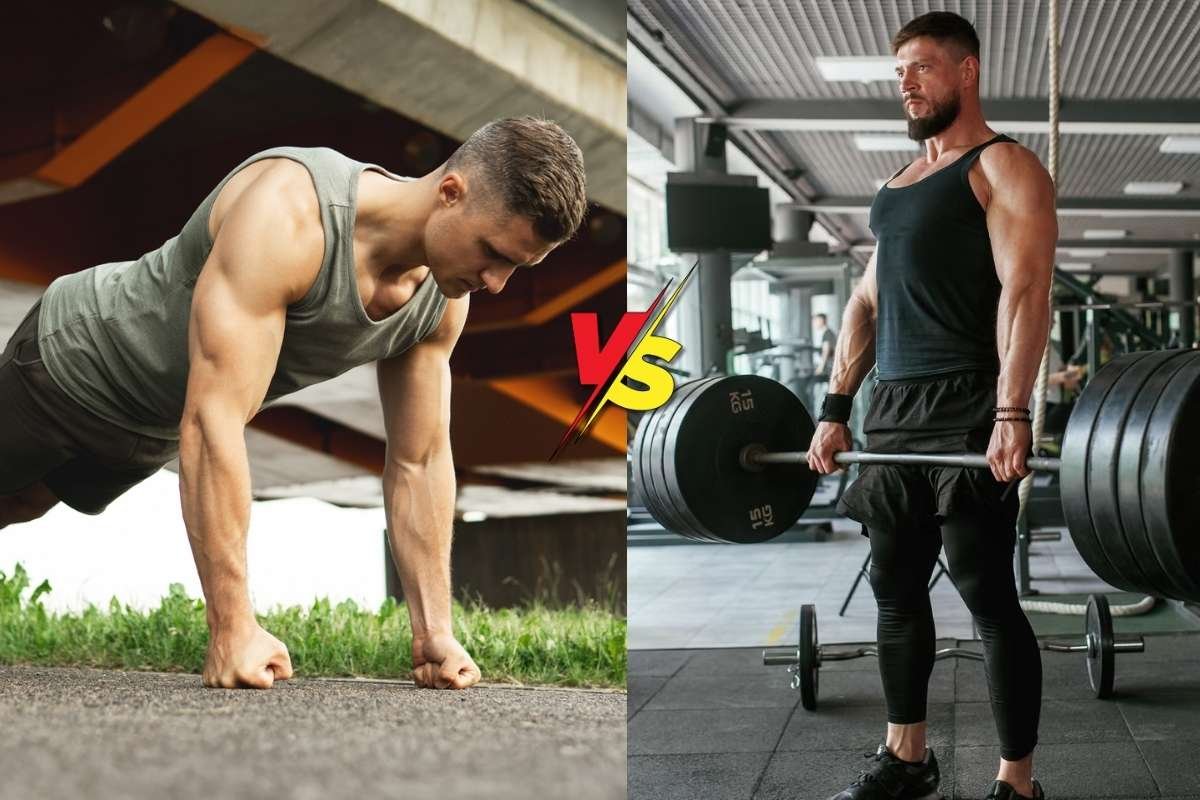
Both bodyweight exercises vs weightlifting build strength, muscle, and fitness. Bodyweight workouts are simple, portable, and beginner-friendly. Weightlifting offers precise progression and often builds muscle faster. The best choice depends on your goals, equipment, and experience. Many people get the best results by combining both methods in one balanced training routine.
Getting stronger does not have to be complicated. Some people use push-ups, squats, and pull-ups to build strength. Others lift dumbbells, barbells, or use gym machines.
Both methods can help you gain muscle, burn calories, and improve your health. The biggest difference is how you add resistance and how easily you can make your workouts harder over time.
When comparing bodyweight exercises vs weightlifting, there is no single best choice for everyone.
The right option depends on your goals, your budget, any past injuries, and what type of training you enjoy enough to do week after week.
What are bodyweight exercises?
Bodyweight exercises use your own body to create resistance. You do not need heavy equipment to get a good workout.
Common bodyweight exercises include:
- Push-ups
- Squats
- Lunges
- Pull-ups
- Planks
- Dips
These movements work several muscles at the same time. They can help you build strength, improve balance, and move better in daily life.
In the bodyweight exercises vs weightlifting comparison, bodyweight training stands out because it is simple and easy to start.
You can make these exercises harder by doing more repetitions, slowing down each movement, adding pauses, or trying advanced versions like pistol squats or one-arm push-ups.
What is weightlifting?
Weightlifting means using outside resistance to make your muscles work harder.
Common equipment includes:
- Dumbbells
- Barbells
- Kettlebells
- Weight machines
You can increase the weight little by little as you get stronger. This makes it easy to keep making progress.
Weightlifting can help you build muscle, gain strength, lower body fat, and support strong bones.
In the bodyweight exercises vs weightlifting discussion, weightlifting gives you more control over how hard each exercise feels.
It also makes it easier to train specific muscles and follow a clear plan for building size, strength, and athletic performance over time.
Bodyweight training vs weightlifting: key differences at a glance
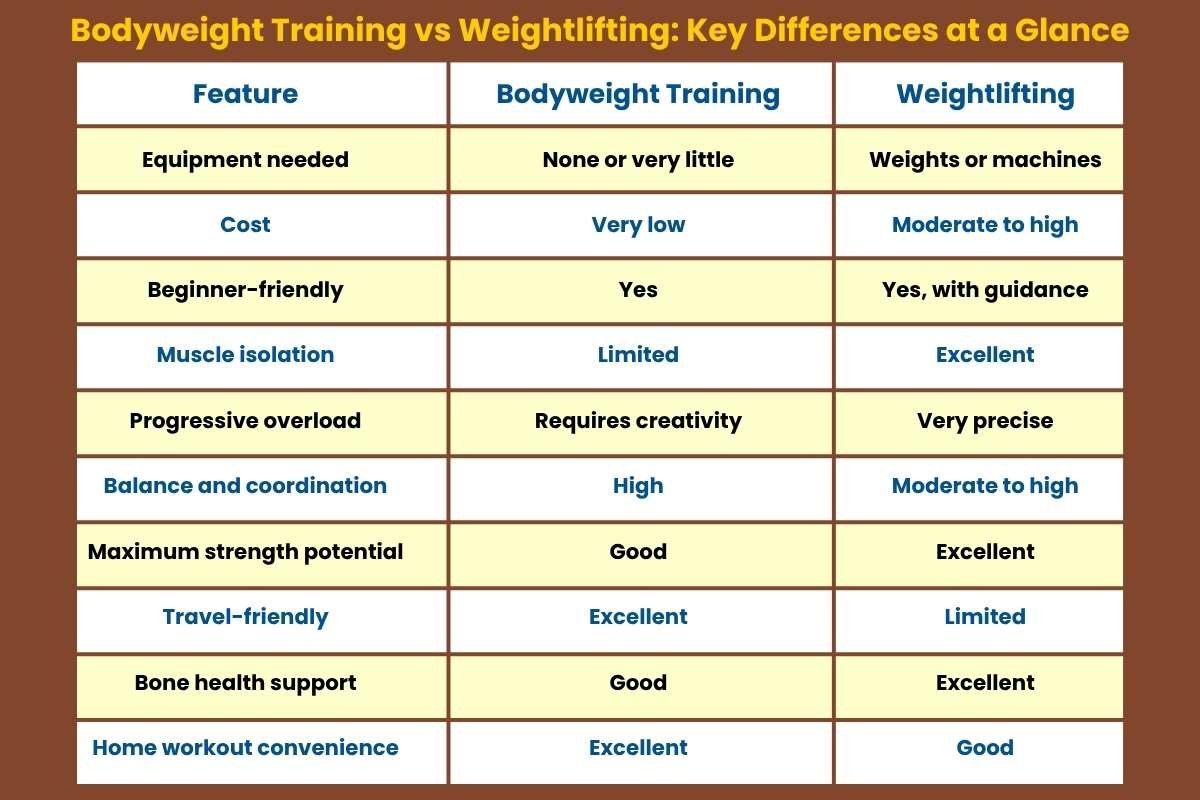
Both training methods can help you get stronger, but they differ in cost, convenience, and how easily you can increase the challenge over time. The table below highlights the main differences side by side.
| Feature | Bodyweight Training | Weightlifting |
| Equipment needed | None or very little | Weights or machines |
| Cost | Very low | Moderate to high |
| Beginner-friendly | Yes | Yes, with guidance |
| Muscle isolation | Limited | Excellent |
| Progressive overload | Requires creativity | Very precise |
| Balance and coordination | High | Moderate to high |
| Maximum strength potential | Good | Excellent |
| Travel-friendly | Excellent | Limited |
| Bone health support | Good | Excellent |
| Home workout convenience | Excellent | Good |
In the bodyweight exercises vs weightlifting comparison, both methods can help adults meet the common recommendation of doing strength training at least two times per week. The better choice depends on your goals, budget, and access to equipment.
Which builds more muscle?
Both bodyweight training and weightlifting can help you build muscle. The key is to challenge your muscles and make your workouts harder over time.
You need to work close to your limit. That means the last few reps should feel difficult.
In bodyweight exercises vs weightlifting, weightlifting usually makes muscle growth easier. You can add a small amount of weight as you get stronger.
Bodyweight exercises can also build a lot of muscle. Pull-ups, dips, handstand push-ups, and pistol squats are all very effective.
For most people, weights offer a simpler and more consistent way to keep gaining muscle over time.
Which is better for strength and fat loss?
Strength is your ability to produce force. Fat loss happens when you burn more calories than you eat over time.
Both bodyweight training and weightlifting can help you get stronger and lose fat.
Bodyweight exercises are excellent for building relative strength, which is how well you move your own body. Weightlifting also builds absolute strength, which is the total amount of force you can produce.
In bodyweight exercises vs weightlifting, weights usually lead to greater maximum strength because you can increase resistance in small steps.
For fat loss, neither method has a clear advantage. Both burn calories and help preserve muscle. The best choice is the one you can do consistently while following a healthy eating plan.
Safety and injury risk
Both bodyweight training and weightlifting are safe when done correctly. The most important factors are good form, gradual progress, and enough recovery between workouts.
Bodyweight exercises are often easier for beginners because they use natural movements such as pushing, pulling, and squatting. Weightlifting can also be very safe, but it requires closer attention to technique, especially as the weights get heavier.
In bodyweight exercises vs weightlifting, injuries are usually caused by poor form, doing too much too soon, or not allowing the body enough time to recover. Starting with basic exercises and focusing on proper technique can greatly lower your risk.
Who should choose each training style?
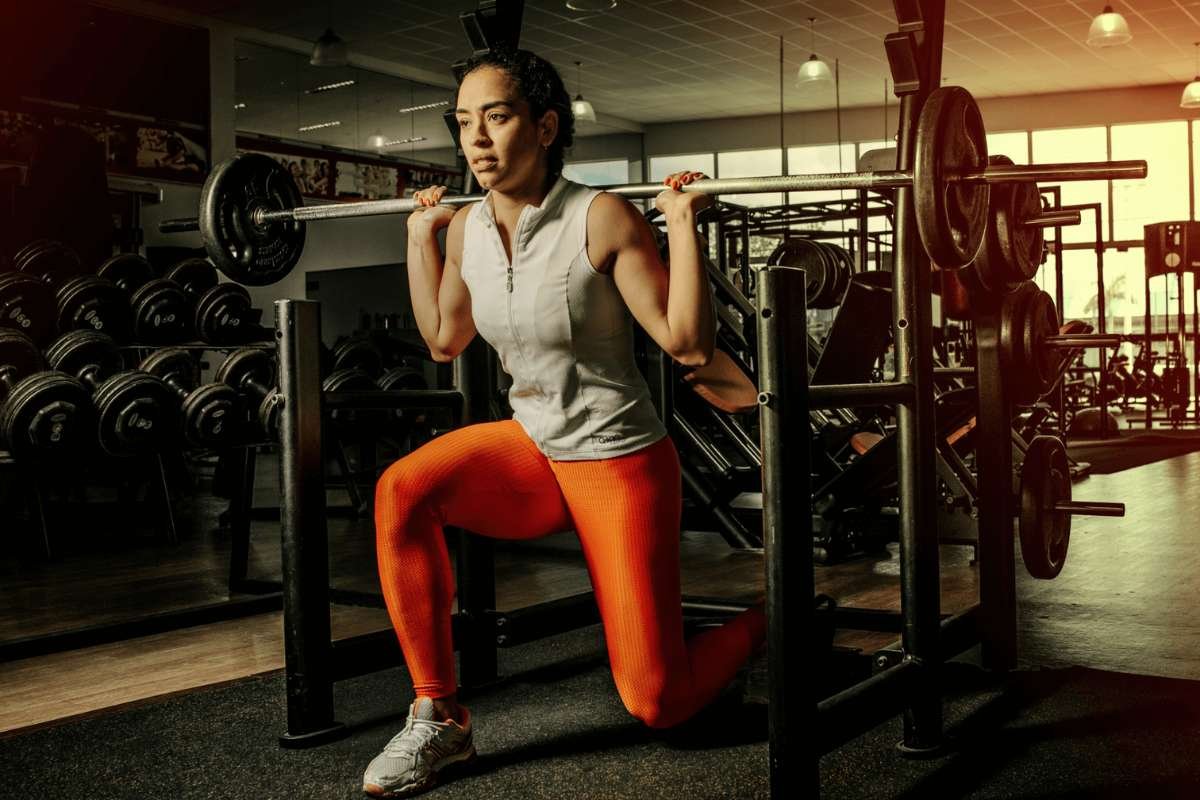
Both training methods can deliver excellent results, but they tend to suit different goals and lifestyles.
Bodyweight training may be best for
Bodyweight training is a strong choice for beginners because it is simple and easy to learn. It is also ideal for travelers and people who work out at home, since most exercises require little or no equipment.
This style is a good fit for those on a limited budget and for anyone who prefers quick, straightforward workouts. In bodyweight exercises vs weightlifting, bodyweight training stands out for its convenience and flexibility.
Weightlifting may be best for
Weightlifting is often the better option for people who want to build as much muscle and strength as possible. It is also useful for athletes who need to improve performance and for experienced trainees who want precise progress.
This approach suits people who enjoy structured workout plans and want to target specific muscle groups more easily. In bodyweight exercises vs weightlifting, weightlifting offers more control as your goals become more advanced.
Final verdict
Both bodyweight training and weightlifting are effective ways to get stronger, build muscle, and improve your health.
Bodyweight training is simple, portable, and easy to do almost anywhere. Weightlifting gives you more precise control over resistance and often makes it easier to build maximum strength and muscle size.
In bodyweight exercises vs weightlifting, the best choice is the one that fits your goals and keeps you training consistently.
Many people get the best results by combining both methods. For example, you can do push-ups and pull-ups along with dumbbell or barbell exercises.
What matters most is staying consistent over time.