Consider a fully formed creature that has a voice, a spine, and a heartbeat, but it’s still small enough to fit comfortably on your thumbnail. Some of these biological marvels are only 7 millimeters long, making them the smallest amphibians in the world.
Beyond their “cute” appeal, these small vertebrates offer important evolutionary insights into the boundaries of bone development and body size. Their conservation is a top priority because scientists study them to learn how life flourishes in micro-habitats. Learn about the record-breaking species, their distinctive survival strategies, and the secret rainforest floors they inhabit in this guide.
What Defines the “Smallest Amphibians in the World”?
To classify the smallest amphibians in the world, herpetologists primarily use Snout-to-Vent Length (SVL). Measuring from the tip of the snout to the cloacal opening. Unlike “total length,” SVL excludes the tail. This can be easily lost or vary in length. It provides a consistent standard for scientific comparison.
Qualifying as a “miniature” typically requires an average adult SVL of under 20 millimeters. To claim a world record, measurements must be verified through peer-reviewed studies of multiple adult specimens to distinguish them from juveniles.
While the class Amphibia includes three orders. They include Anura (frogs/toads), Caudata (salamanders), and Gymnophiona (caecilians). The tiniest species are almost exclusively frogs. Their compact, tail-less body plan allows for extreme skeletal reduction. It enables them to occupy “micro-niches” on the rainforest floor that larger vertebrates cannot reach.
Top 10 Smallest Amphibians in the World That Are Tinier Than A Coin:
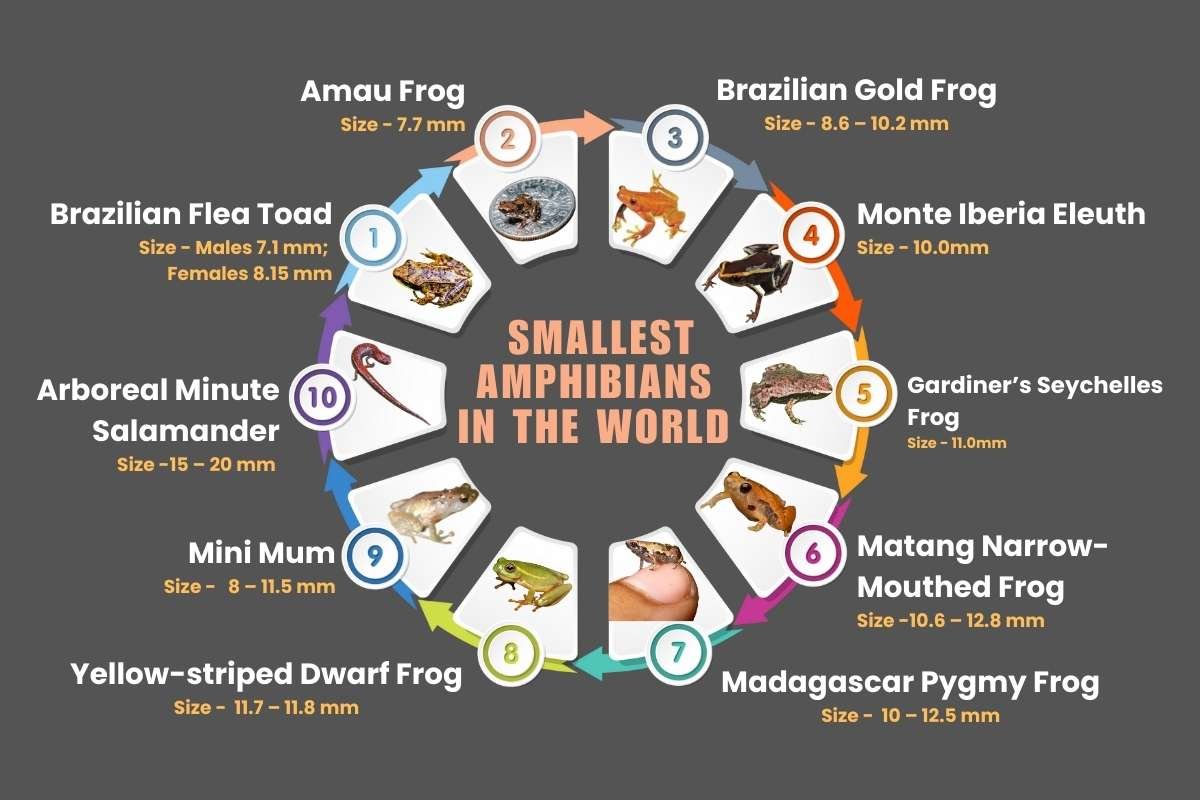
These biological wonders range from the obscure leaf litter of Papua New Guinea to the misty cloud forests of Brazil. They show that the most intricate designs found in nature can be found in packages no bigger than a typical housefly.
| Rank | Common Name | Scientific Name | Size (Average Adult) |
| 1 | Brazilian Flea Toad | Brachycephalus pulex | 7.1 mm |
| 2 | Amau Frog | Paedophryne amauensis | 7.7 mm |
| 3 | Brazilian Gold Frog | Brachycephalus didactylus | 8.6 mm |
| 4 | Monte Iberia Eleuth | Eleutherodactylus iberia | 10.0 mm |
| 5 | Mini Mum | Mini mum | 10.5 mm |
| 6 | Matang Narrow-Mouthed Frog | Microhyla nepenthicola | 10.6 mm |
| 7 | Gardiner’s Seychelles Frog | Sechellophryne gardineri | 11.0 mm |
| 8 | Yellow-striped Dwarf Frog | Eleutherodactylus limbatus | 11.7 mm |
| 9 | Madagascar Pygmy Frog | Stumpffia pygmaea | 12.0 mm |
| 10 | Arboreal Minute Salamander | Thorius arboreus | 15.0 mm |
1. Brazilian Flea Toad
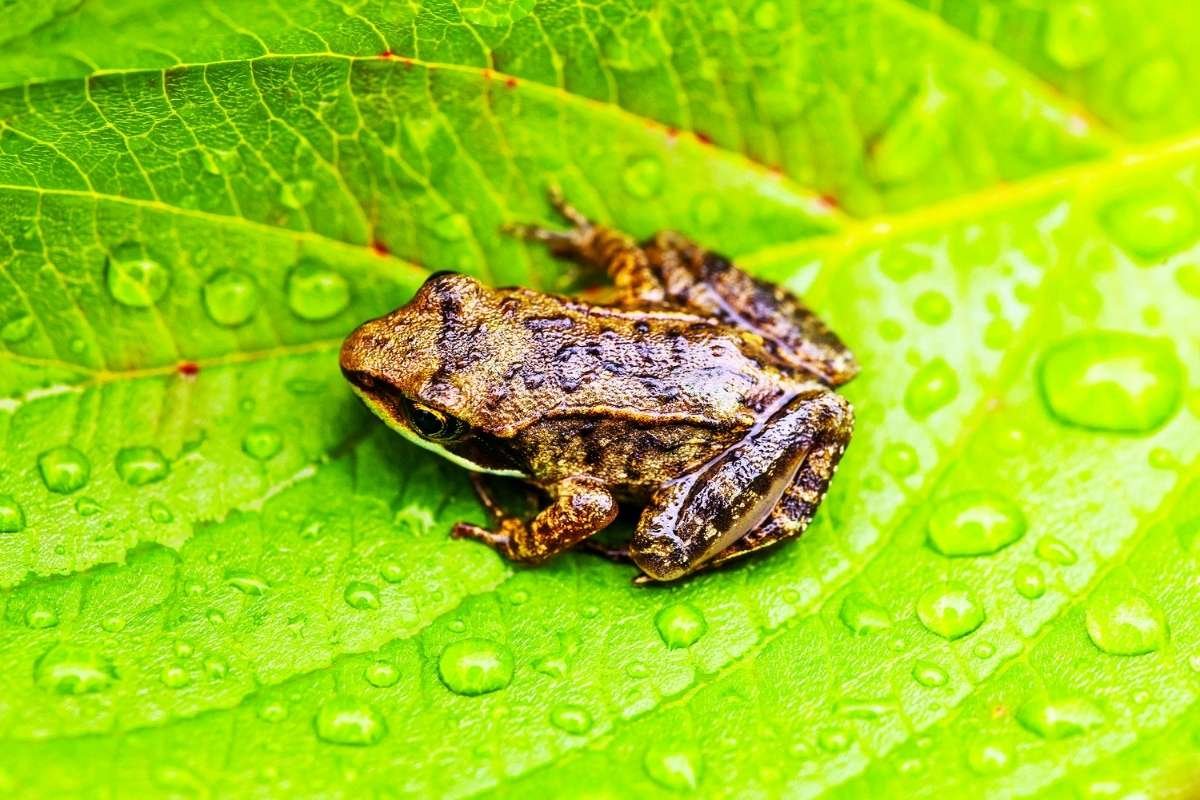
- Scientific Name: Brachycephalus pulex
- Native Regions: Southern Bahia, Brazil (Serra Bonita Reserve)
- Size: Males average7.1 mm; Females 8.15 mm
- Weight: Estimated < 0.1 grams
- Habitat: Dense leaf litter in the montane Atlantic Forest.
- Conservation Status: Endangered (IUCN)
Despite the name “toad,” this is actually a tiny frog that has fascinated researchers for years. It was recently titled to be one of the smallest amphibians in the world after researchers confirmed its adult size is significantly smaller than its closest rivals. To reach this incredibly tiny size, it has evolved by losing several bones in its hands and feet, leaving it with fewer digits than most other frogs.
2. Amau Frog
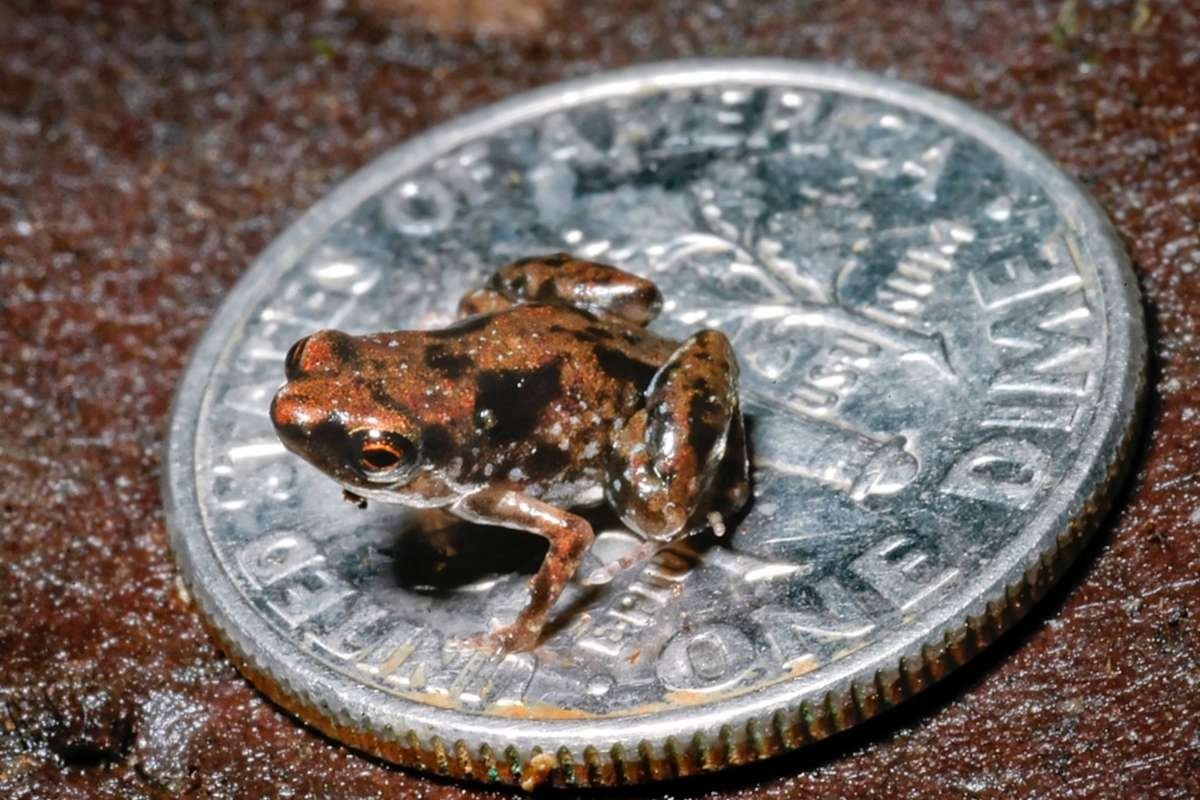
- Scientific Name: Paedophryne amauensis
- Native Regions: Central Province, Papua New Guinea
- Size: Average 7.7 mm
- Weight: 0.13 grams
- Habitat: Tropical rainforest leaf litter.
- Conservation Status: Not evaluated (likely stable in its remote range)
Found in the leaf litter of Papua New Guinea, this species held the top spot for years. It is incredibly difficult to find because its high-pitched call sounds more like an insect than a frog. Because it is so small, it has a very high surface-area-to-volume ratio, meaning it must live in extremely humid environments to avoid drying out.
3. Brazilian Gold Frog (Izecksohn’s Toad)
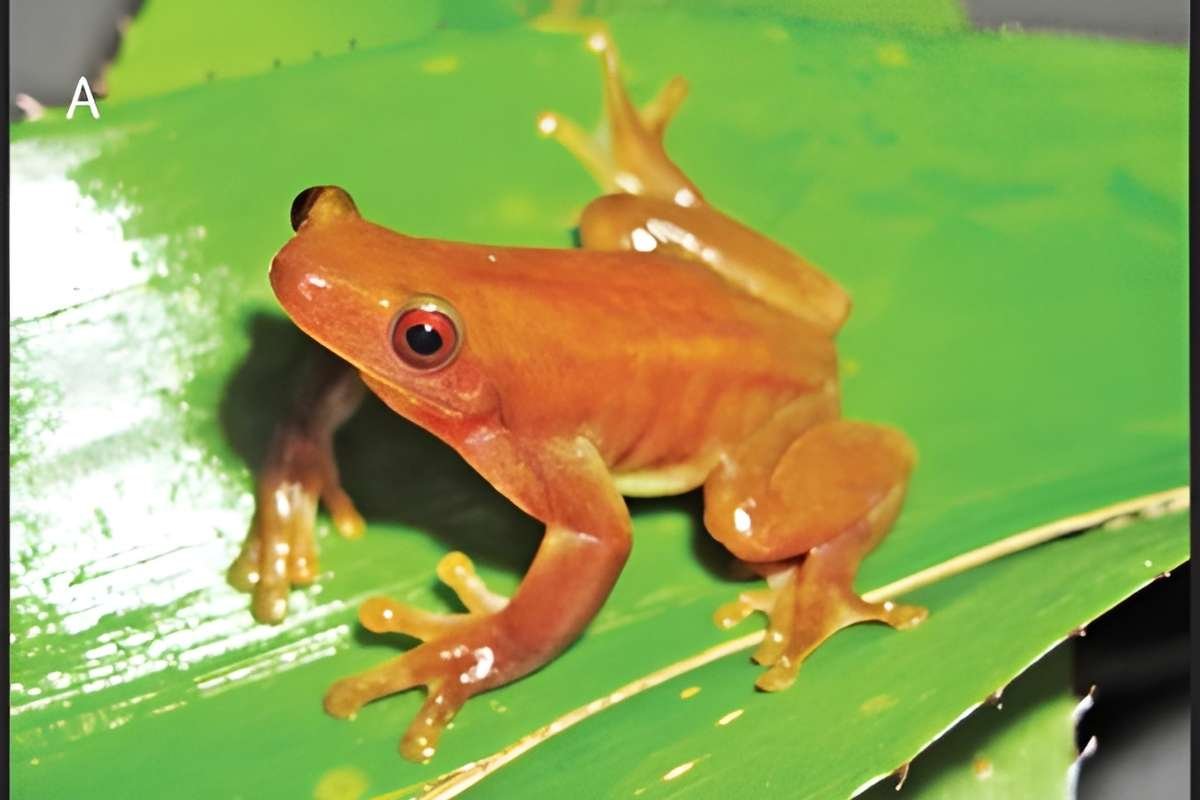
- Scientific Name: Brachycephalus didactylus
- Native Regions: Rio de Janeiro and Espírito Santo, Brazil
- Size: 8.6 – 10.2 mm
- Weight: 0.15 grams
- Habitat: High-altitude cloud forests.
- Conservation Status: Least Concern
Found in the lush Atlantic Forest, this “three-toed” frog is a master of the forest floor. Its bright coloration can sometimes serve as a warning to predators, but its primary defense is its size. It is simply too small for many larger predators to even notice as a meal.
4. Monte Iberia Eleuth
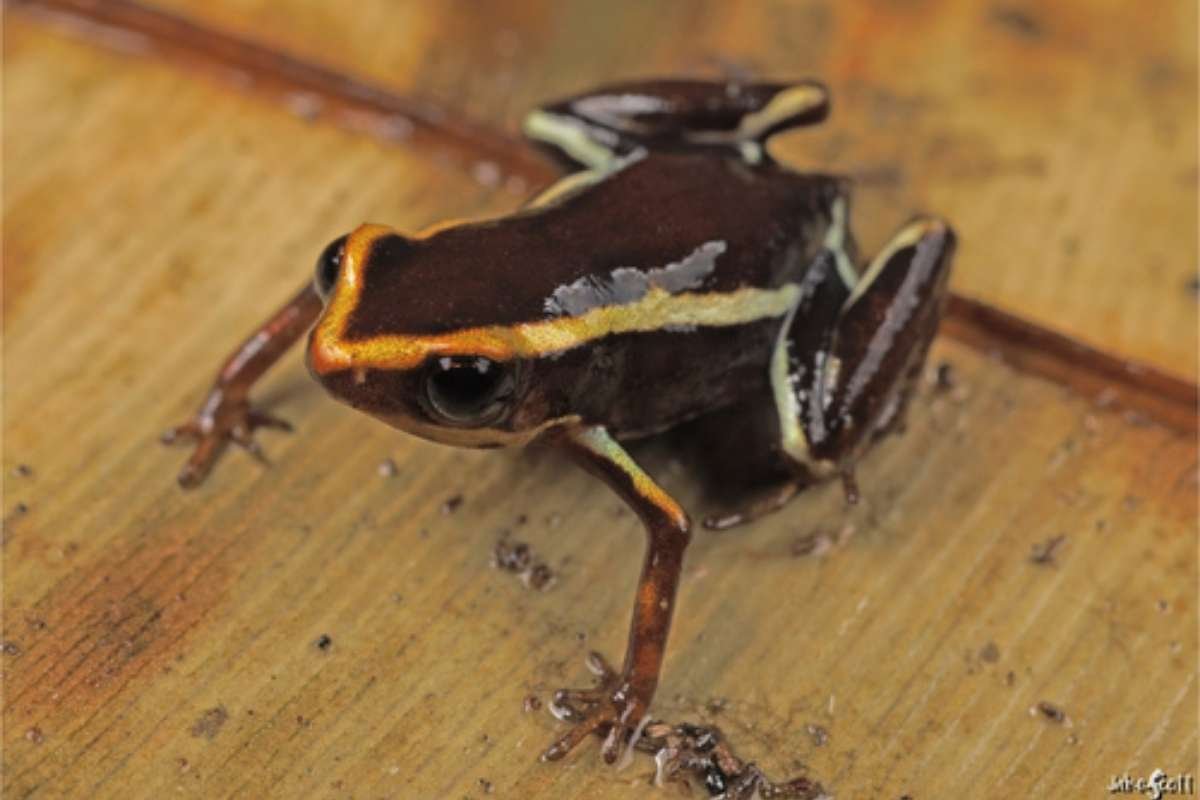
- Scientific Name: Eleutherodactylus iberia
- Native Regions: Monte Iberia, Holguín Province, Cuba
- Size: 10 mm
- Weight: 0.15 – 0.2 grams
- Habitat: Closed rainforests with high humidity.
- Conservation Status: Critically Endangered
This Cuban native is unique because it possesses “alkaloid” toxins on its skin, similar to poison dart frogs. Being one of the smallest amphibians in the world makes you vulnerable, so having a chemical defense is a brilliant evolutionary trade-off for lacking physical strength.
Read Next: Meet the Top 10 Smallest Birds in the World That Do the Biggest Jobs
5. Gardiner’s Seychelles Frog
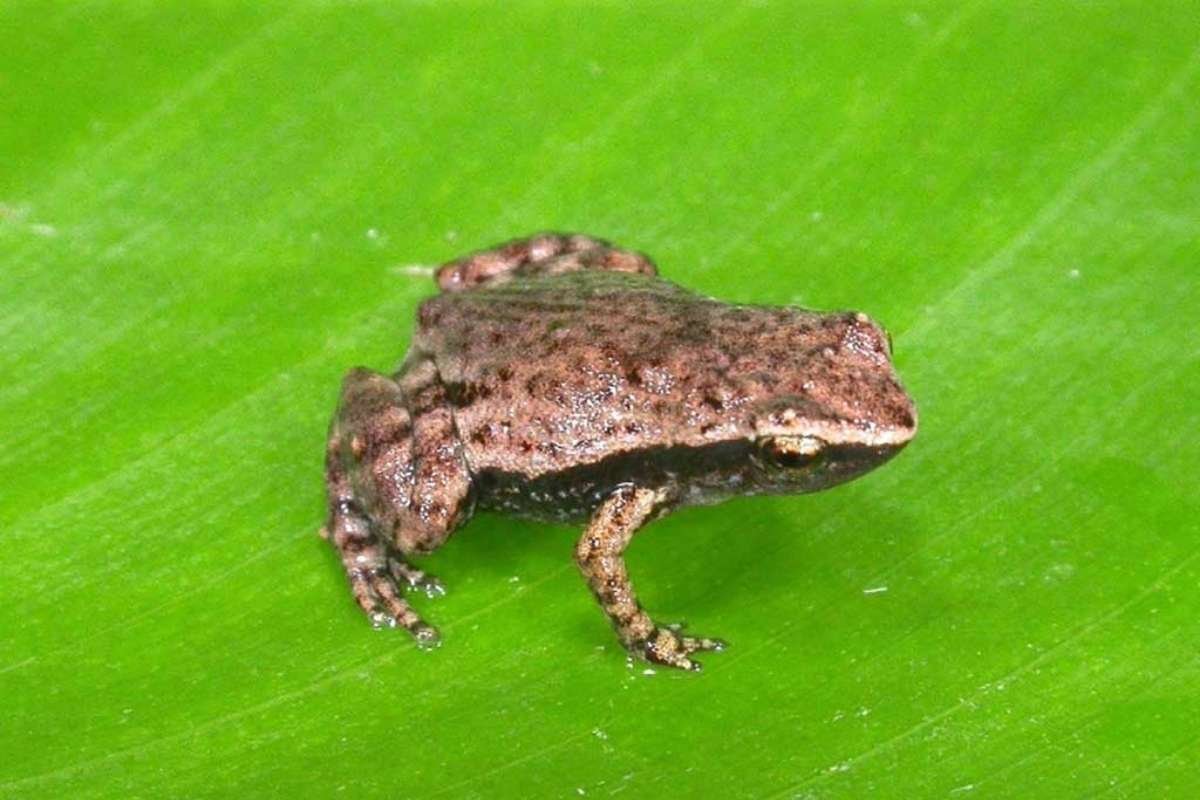
- Scientific Name: Sechellophryne gardineri
- Native Regions: Mahé and Silhouette Islands, Seychelles
- Size: 11 mm (Males average 8 mm)
- Weight: 0.2 grams
- Habitat: Mid-to-high altitude rocky rainforests.
- Conservation Status: Endangered
Part of a genus cheekily named Mini by scientists (alongside Mini scule and Mini ature), this frog lives in the leaf litter of Madagascar. It has evolved a highly reduced skeleton, which is a common trait among these miniature species to save on energy and space.
6. Matang Narrow-Mouthed Frog
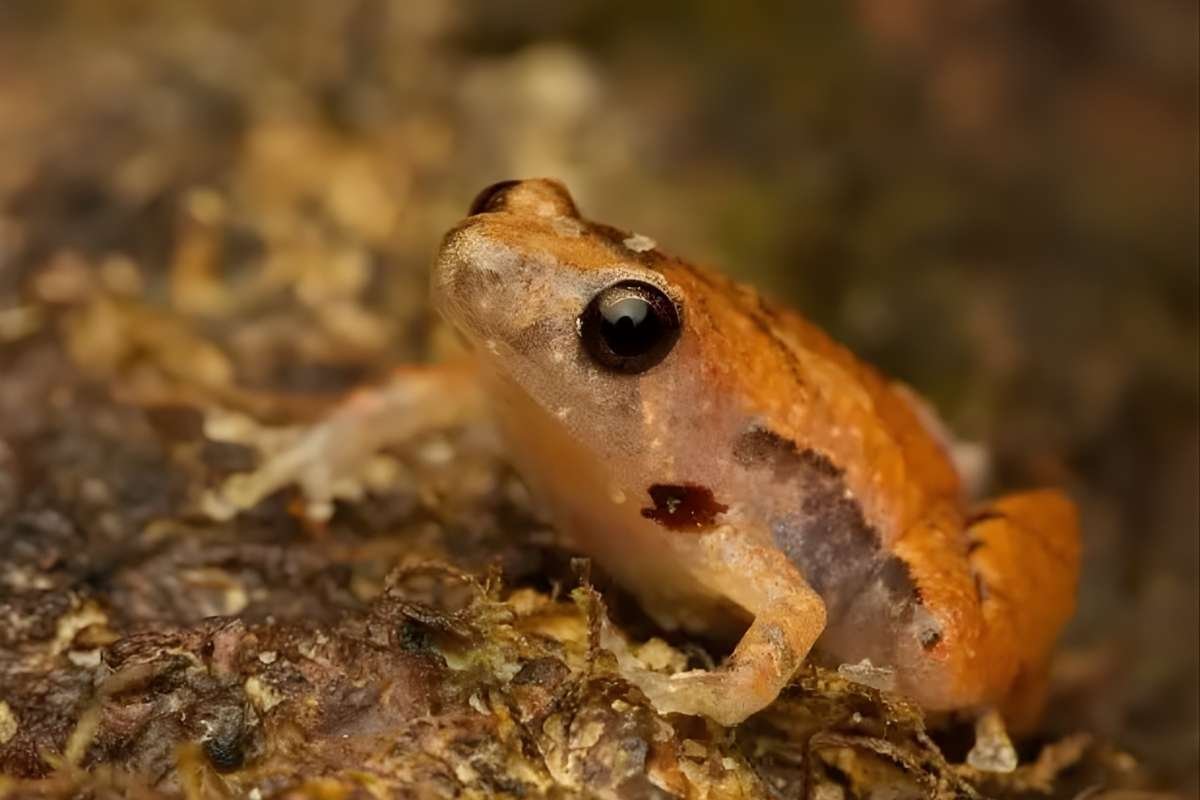
- Scientific Name: Microhyla nepenthicola
- Native Regions: Sarawak, Borneo (Malaysia)
- Size: Males 10.6 – 12.8 mm
- Weight: 0.2 grams
- Habitat: Forest floor near pitcher plants (Nepenthes ampullaria).
- Conservation Status: Least Concern
This species has a fascinating relationship with the carnivorous Pitcher Plant. It lays its eggs in the water trapped inside the plant’s “pitcher.” The tadpoles grow up in this protected, watery home, safe from the many predators found on the open forest floor.
7. Madagascar Pygmy Frog
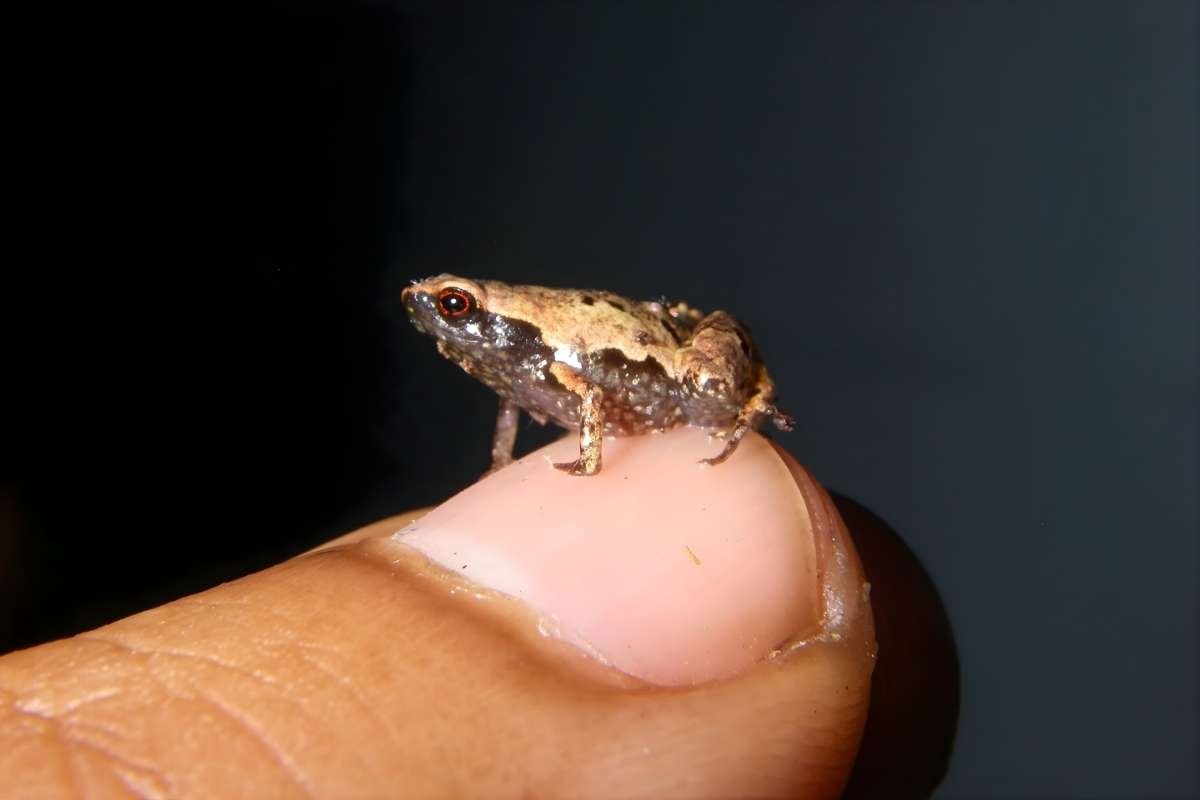
- Scientific Name: Stumpffia pygmaea
- Native Regions: Nosy Be and Nosy Komba, Madagascar
- Size: 10 – 12.5 mm
- Weight: < 0.2 grams
- Habitat: Lowland rainforests and plantations.
- Conservation Status: Endangered
This frog is a biological mystery. It doesn’t have an eardrum or a middle ear, yet it can still hear other frogs calling. Scientists discovered that it uses its mouth cavity as a resonance chamber to transmit sound to its inner ear, proving that being the smallest amphibians in the world (or close to it) requires creative engineering.
8. Yellow-striped Dwarf Frog
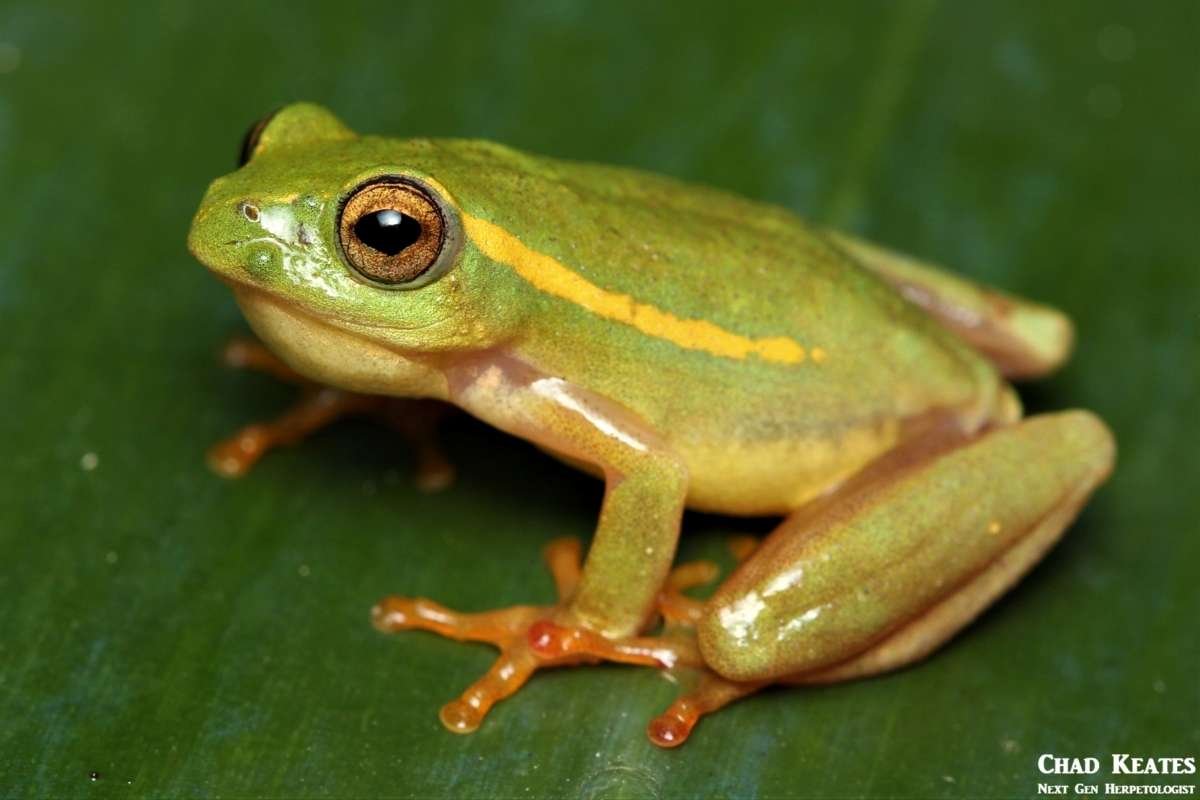
- Scientific Name: Eleutherodactylus limbatus
- Native Regions: Throughout Cuba
- Size: 11.7 – 11.8 mm
- Weight: 0.25 grams
- Habitat: Mesic forests and pinewoods.
- Conservation Status: Vulnerable
Unlike many other tiny frogs that hide in the shadows, this Cuban species is active during the day. Its yellow stripes help break up its outline against the sun-dappled leaves, making it nearly invisible to birds and lizards looking for a snack.
9. Mini Mum
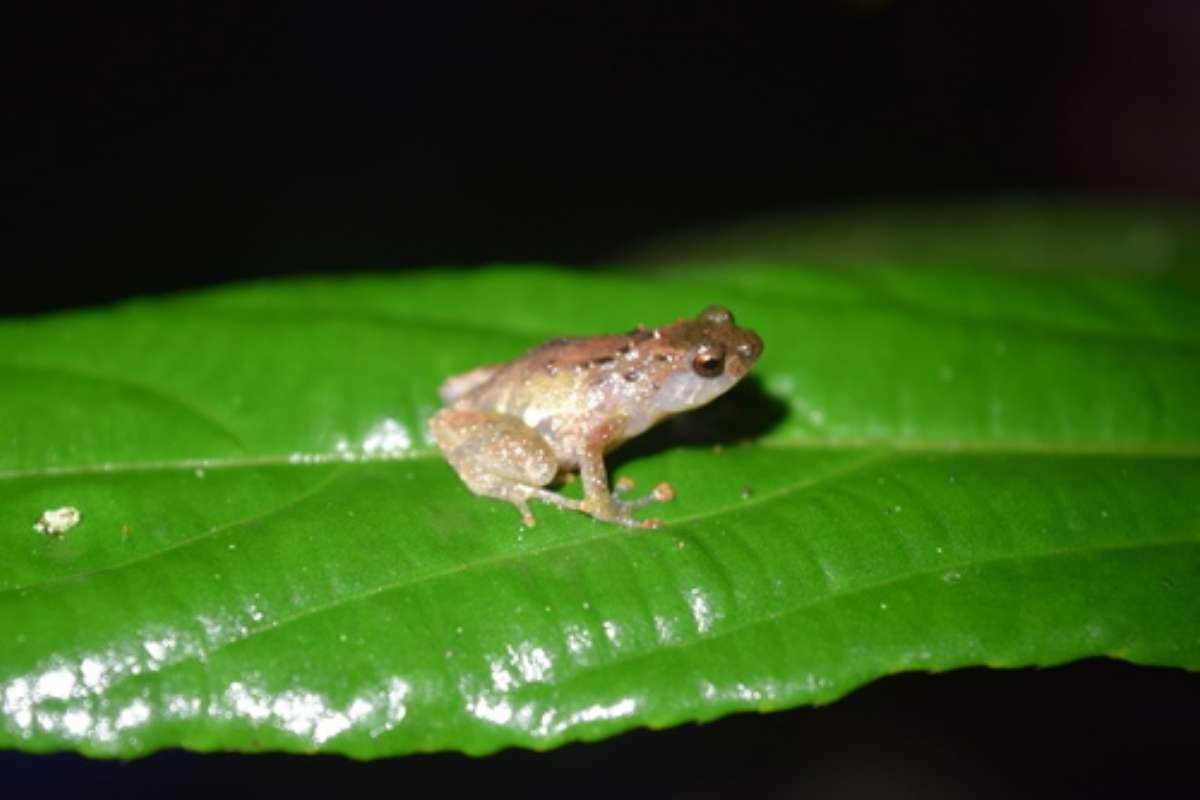
- Scientific Name: Mini mum
- Native Regions: Manombo Special Reserve, Madagascar
- Size: 8 – 11.5 mm
- Weight: 0.15 grams
- Habitat: Lowland rainforest leaf litter.
- Conservation Status: Critically Endangered
Found on the islands off Madagascar, this frog is a “terrestrial” breeder. Instead of swimming in a pond, the males create a foam nest in the moist soil. This allows them to reproduce without ever needing a large body of standing water, which could be dangerous for such a small creature.
10. Arboreal Minute Salamander
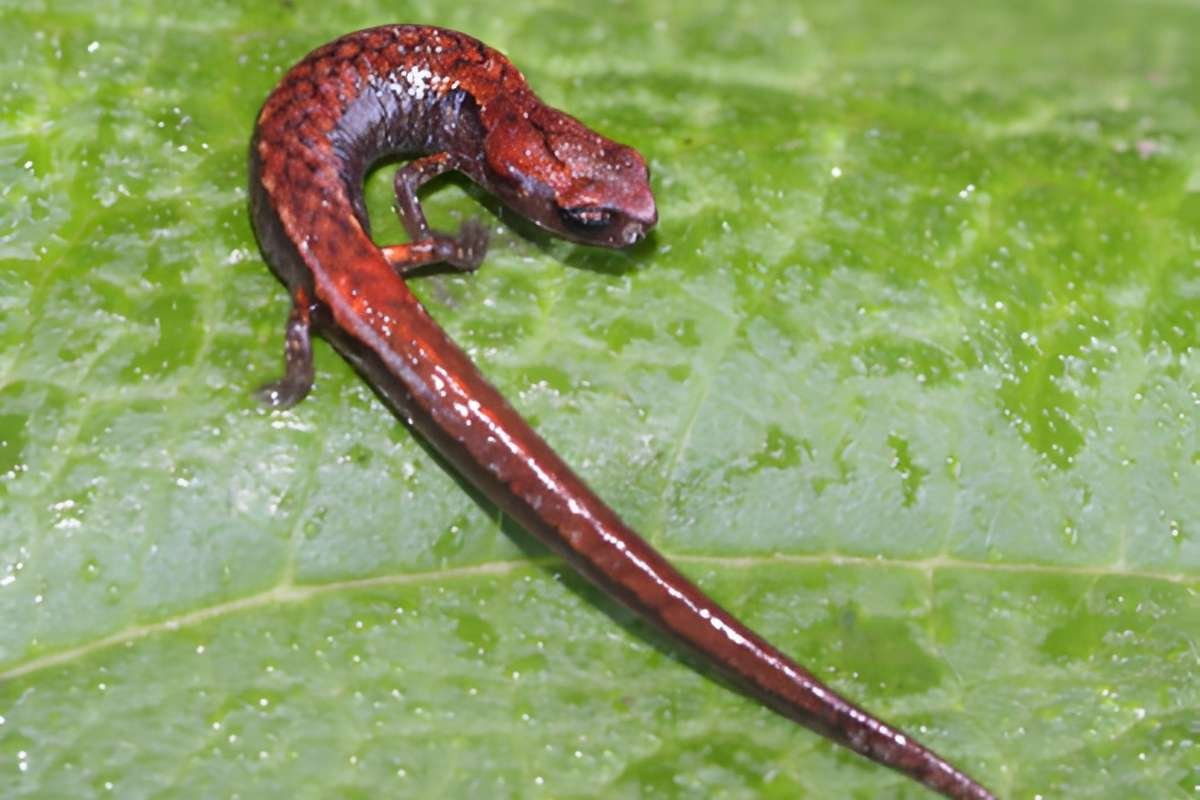
- Scientific Name: Thorius arboreus
- Native Regions: Sierra Juárez, Oaxaca, México
- Size: 15 – 20 mm (Total length)
- Weight: 0.2 – 0.3 grams
- Habitat: Cloud forests, specifically inside bromeliads.
- Conservation Status: Critically Endangered
As the only salamander on this list, this species represents the absolute limit of how small a tailed amphibian can get. It lives inside bromeliads (plants that grow on trees) in Mexico. Its tiny size allows it to slip into the narrowest gaps between leaves to find moisture and microscopic insects.
Read Next: The Science of Small: What the 15 World’s Smallest Animals Teach Us About Evolution
Regional Highlight of Tiny Amphibians:
The tiniest vertebrates on the planet are not evenly distributed; instead, they are concentrated in particular biological “powerhouses” where evolution has pushed the boundaries of body size.
- Papua New Guinea: The Miniature Frog Zone Papua New Guinea is a primary hub for the smallest amphibians in the world. Largely due to its vast, undisturbed tropical rainforests. The thick, humid leaf-litter ecosystems act as a protective “micro-climate.” This allows tiny frogs to skip the pond stage and hatch directly from eggs into miniature adults.
- Brazil’s Atlantic Forest: This region is a global hotspot for micro-amphibians. It includes the recently crowned record-holder, the Brazilian Flea Toad. Research here is booming. Scientists frequently describe new species that have remained hidden for centuries. Due to their secretive nature.
- Islands & Endemism: Seychelles & Madagascar Isolation on islands like the Seychelles and Madagascar often leads to “insular miniaturization.” Here, the smallest amphibians in the world face intense pressure from habitat loss and climate change, as they often live on single mountain peaks or small forest patches.
- Broadening the Map: discoveries in Mexico’s cloud forests and India’s Western Ghats (home to the “starry dwarf frog”). They continue to expand our understanding of these tiny creatures across the globe.
Why Size Matters? Evolution, Ecology & Conservation
One extreme evolutionary tactic is miniaturization. The smallest amphibians in the world live in “micro-niches” that are inaccessible to larger predators. They undergo paedomorphosis, which is the retention of larval characteristics into adulthood. However, they are very vulnerable to dehydration due to their high surface-area-to-volume ratio.
Based on an ecological perspective, they are essential for controlling insect populations in leaf-litter food webs. Their conservation is a global priority because many of them are endemic to single mountainsides, and habitat loss and climate change pose an existential threat.
Conclusion
Nature’s most intricate engineering doesn’t need a big canvas. It is shown by the smallest amphibians in the World. These small vertebrates play essential ecological roles that maintain the health of our rainforests. Spanning from the earless marvels of the Seychelles to the poison-protected frogs of Cuba. However, they are “canaries in the coal mine” for climate change. Because of their dependence on particular microhabitats. We preserve the amazing biodiversity of our planet’s hidden corners by preserving these tiny wonders. Even though they could fit on a fingernail. The tiniest amphibians have a profound impact on our understanding of life.
FAQ:
1. Why are most of the smallest amphibians frogs rather than salamanders or caecilians?
Frogs dominate the list of the smallest amphibians in the world. Because they evolved specialized adaptations for miniaturization. Such as simplified skeletal structures and direct development (skipping the tadpole stage). Salamanders and caecilians generally require larger body sizes for respiration and reproduction. This limits how small they can evolve.
2. Are new tiny amphibian species still being discovered?
Absolutely. Advances in DNA analysis, acoustic monitoring, and rainforest exploration continue to reveal new species. Scientists believe many more of the smallest amphibians in the world remain undiscovered, especially in remote tropical regions.
3. Why are the smallest amphibians important to science?
The smallest amphibians are crucial for understanding:
Evolutionary limits of vertebrate size
Miniaturization biology
Ecosystem health indicators
Climate sensitivity in micro-habitats
Their presence often signals a healthy, undisturbed ecosystem, making them valuable to conservation science.