
Every day, millions of healthcare decisions are made about what treatment a patient needs, how insurance claims are processed, or even how hospitals manage their resources. Behind all of this is medical coding, the process of translating medical information into standard codes that everyone in the healthcare system can understand. And it’s more important than you might think: coding errors cost the U.S. healthcare system over $25 billion every year.
As healthcare becomes more digital, the demand for skilled medical coders is skyrocketing. The global medical coding market is expected to reach $51.4 billion by 2030, growing at nearly 10% a year. That means more opportunities than ever for people who have the right skills.
This is where online medical coding training courses make a real difference. They allow you to learn at your own pace, gain industry-recognized certifications, and step into a career that is both in demand and rewarding, all from home. Whether you’re a student exploring career options, a professional looking to switch fields, or someone interested in healthcare, these courses can open doors to a stable and exciting future.
By the time you finish reading this article, you’ll understand why online medical coding training programs are more than simply courses; they’re a route to a safe and rewarding job.
What is Medical Coding and Why is It so Important?
Medical coding might sound like a behind-the-scenes job, but it’s actually the backbone of modern healthcare. Simply put, medical coders take patient records, treatments, and diagnoses and convert them into standardized codes that doctors, insurance companies, and hospitals can understand. These codes ensure that billing is accurate, treatments are tracked correctly, and healthcare data is organized for research and policy decisions.
Think about it this way: every prescription, lab test, or surgical procedure has a code attached to it. If even one code is wrong, it can lead to denied insurance claims, delayed treatments, or compliance issues. In a world where precision matters, coders are the unsung heroes keeping the system running smoothly.
The importance of medical coding goes beyond numbers and paperwork. Accurate coding improves patient care, streamlines hospital operations, and even helps shape healthcare policies. That’s why skilled coders are in high demand, and why learning this skill through online medical coding training programs is such a smart career move.
Why Choose Online Medical Coding Training Courses?
The healthcare industry is evolving faster than ever, and accurate medical coding is at the heart of this transformation. Consider this:
- The U.S. is expected to face a shortage of over 100,000 skilled medical coders by 2030.
- Globally, the medical coding market is projected to reach $51.46 billion, growing at nearly 10% annually.
- Students completing online coding programs are 30–40% more likely to land entry-level positions faster due to hands-on practice and simulations.
Online medical coding training programs give you a front-row seat to this booming field. Here’s why they stand out:
| Learn at Your Own Pace | Balance studies with work, family, or other commitments. |
| Industry-Recognized Certifications | Prepare for exams like CPC, CCA, and CCS that employers trust worldwide. |
| Practical Experience | Real-world case studies and coding exercises give you hands-on skills before entering the workforce. |
| Cost-Effective & Accessible | High-quality education from anywhere without the expense of traditional programs. |
| Global Opportunities | Many online certifications are recognized internationally, opening doors beyond your local job market. |
To put it briefly, online medical coding training programs are more than just courses; they’re a quick route to a lucrative, future-proof profession in healthcare, equipping you with the knowledge, reputation, and self-assurance you need to succeed.
Who Should Enroll in Online Medical Coding Training Courses?
Medical coding is a career option available to anyone who is prepared to make a future in a highly sought-after industry; it is not limited to healthcare professionals. Learners from all backgrounds can acquire the necessary skills through online medical coding lessons. Who stands to gain the most is as follows:
| Recent Graduates | Students from life sciences, nursing, or allied healthcare fields can kickstart a career with minimal investment in time or money. |
| Working Professionals Seeking a Career Change | Those in administrative, finance, or unrelated fields can transition into healthcare without returning to full-time school. |
| Healthcare Staff Looking to Upskill | Nurses, medical assistants, and billing staff can enhance their career prospects and increase their earning potential. |
| Stay-at-Home Professionals or Remote Workers | Flexible online courses make it possible to earn certifications and enter a stable, well-paying industry without relocating. |
| International Learners | Many courses are recognized globally, opening doors for remote or overseas employment in the growing medical coding market. |
In short, online medical coding training programs are designed for anyone who wants a future-proof career, whether you’re starting out, switching fields, or enhancing your healthcare skills.
Top 5 Certifications That Matter After Online Medical Coding Training Courses
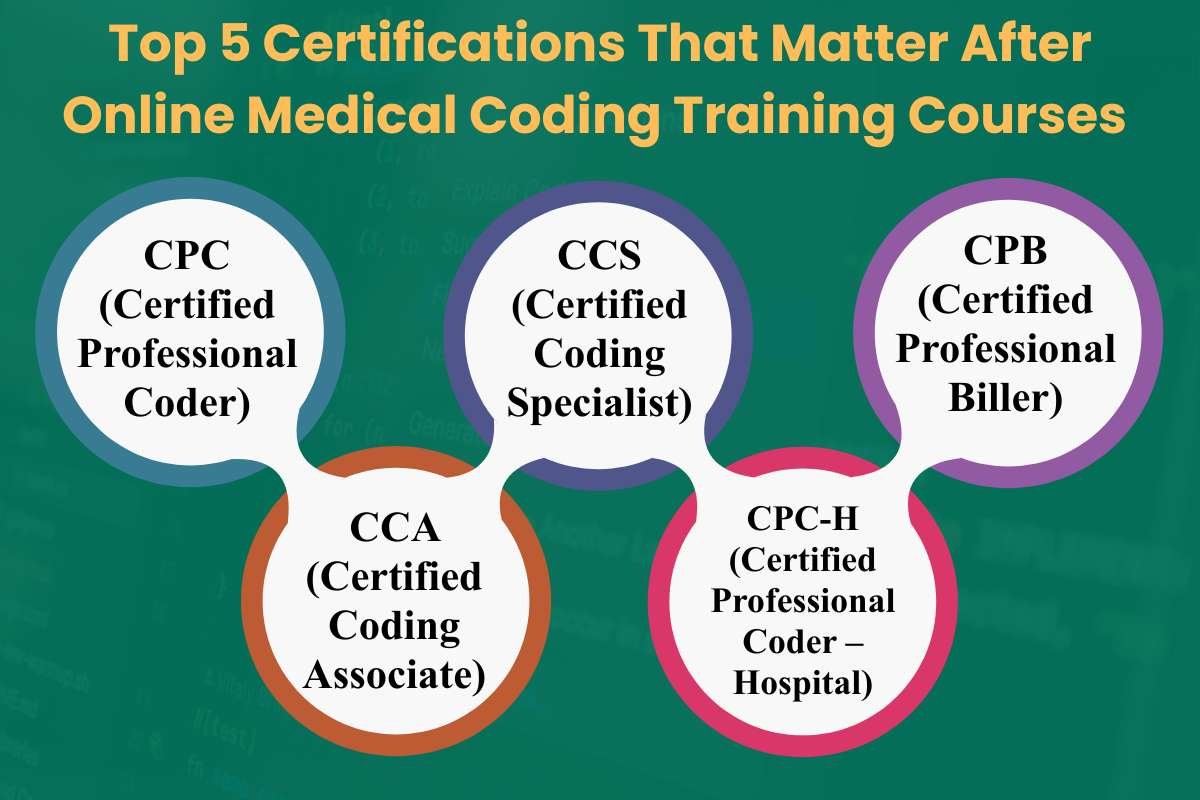
Your employment chances might be greatly enhanced by earning a recognized certification after completing online medical coding training classes. The most significant certifications are summarized as follows:
1. CPC (Certified Professional Coder)
| Average Salary Impact* | +20–30% |
| Focus Area | Outpatient & physician office coding |
| Key Benefit | Globally recognized, boosts job opportunities |
| Ideal For | Beginners & office coders |
The CPC certification is often considered the gold standard for building credibility in medical coding careers worldwide. It demonstrates your ability to interpret clinical documentation accurately while adhering to strict compliance and reimbursement guidelines. Employers value CPC-certified professionals for their reduced error rates and stronger audit readiness. This certification also provides long-term flexibility, allowing coders to transition across specialties such as orthopedics, cardiology, and dermatology. Over time, CPC holders often move into auditing, compliance, or training roles within healthcare organizations.
2. CCA (Certified Coding Associate)
| Average Salary Impact* | +15–25% |
| Focus Area | Inpatient & outpatient coding basics |
| Key Benefit | Validates foundational skills for hospitals |
| Ideal For | Entry-level coders |
The CCA certification plays a crucial role for learners completing online medical coding training courses and entering real-world healthcare settings. It sharpens practical decision-making skills that help new coders adapt quickly to hospital documentation standards. Employers often view this credential as evidence of hands-on readiness rather than purely academic knowledge. The certification also builds confidence in handling multidisciplinary medical records involving diagnostics, labs, and physician notes. For many professionals, CCA becomes a strategic foundation for advancing into higher-level certifications and specialized coding roles.
3. CCS (Certified Coding Specialist)
| Average Salary Impact* | +25–35% |
| Focus Area | Inpatient hospital coding |
| Key Benefit | Advanced expertise opens senior hospital roles |
| Ideal For | Experienced coders |
The CCS certification is highly respected for validating deep analytical and decision-making skills in complex clinical scenarios. It reflects mastery over medical terminology, disease processes, and advanced reimbursement structures. Certified professionals are often entrusted with high-value cases where accuracy directly impacts hospital revenue. The credential also signals leadership potential, as CCS holders frequently mentor junior coders and assist in compliance reviews. Long-term, this certification can open doors to roles in health information management and clinical documentation improvement.
4. CPC-H (Certified Professional Coder – Hospital)
| Average Salary Impact* | +20–30% |
| Focus Area | Hospital coding & billing |
| Key Benefit | Prepares for inpatient roles, enhances career growth |
| Ideal For | Hospital-focused coders |
The CPC-H certification is especially valuable for professionals aiming to specialize after online medical coding training courses with a hospital-focused career path. It demonstrates advanced competence in managing complex inpatient documentation across departments. Certified professionals are better prepared to handle evolving payer regulations and compliance-driven coding environments. This credential supports long-term career stability, as hospital coding roles remain in consistent demand across healthcare systems. Many CPC-H holders eventually progress into supervisory, auditing, or revenue integrity positions.
5. CPB (Certified Professional Biller)
| Average Salary Impact* | +15–25% |
| Focus Area | Medical billing |
| Key Benefit | Combines billing & coding expertise |
| Ideal For | Coders aiming for billing roles |
The CPB certification focuses on the financial lifecycle of healthcare services beyond just coding accuracy. It equips professionals with insight into payer policies, claim follow-ups, and denial management strategies. This credential is especially valuable in improving cash flow and reducing revenue leakage for healthcare providers. CPB-certified professionals often act as a crucial link between clinical teams and insurance companies. With experience, this certification can lead to leadership roles in revenue cycle management or healthcare finance operations.
Why do certifications matter?
- They validate your skills for employers and make your resume stand out.
- Certified coders are often prioritized for promotions and higher-paying positions.
- Many certifications are recognized internationally, opening doors for global opportunities.
Read Next: How to Become a Medical Coder: Step-by-Step Guide
What You’ll Learn in Online Medical Coding Training Courses?
One of the biggest advantages of online medical coding training programs is that they teach exactly what the healthcare industry needs today. These programs are designed to give you both the technical knowledge and practical skills to succeed. Here’s a breakdown of what you can expect to learn:
| Medical Terminology & Anatomy | Understand the language of healthcare, including body systems, diseases, procedures, and medications. |
| ICD-10-CM, CPT, and HCPCS Coding | Master the essential coding systems used worldwide for diagnoses, treatments, and billing. |
| Healthcare Documentation & Compliance | Learn how to accurately read and interpret medical records while adhering to legal and ethical standards. |
| Insurance Claims & Billing Workflow | Get hands-on experience with the process of submitting claims, coding for reimbursements, and avoiding denials. |
| Auditing & Quality Control | Understand how to check coding accuracy, identify errors, and ensure compliance with regulations. |
| Software Tools & Technologies | Gain proficiency in popular coding and billing software used in hospitals and insurance companies. |
By the end of these courses, you’ll have the confidence, knowledge, and practical experience to step directly into a medical coding role and start contributing from day one.
Key Skills You Gain from Online Medical Coding Training Courses
Completing online medical coding training programs doesn’t just give you certifications; it equips you with a set of highly valuable skills that employers are actively seeking. These skills ensure you can work efficiently, accurately, and confidently in the healthcare field:
- Analytical & Attention-to-Detail Skills: Medical coding requires precision; even a single mistake can delay claims or affect patient care.
- Understanding of Healthcare Regulations: Learn HIPAA, CMS guidelines, and other compliance standards that protect patient data and ensure legal accuracy.
- Technical Coding Proficiency: Master ICD-10, CPT, and HCPCS codes, as well as coding software and billing systems used in hospitals and clinics.
- Problem-Solving Abilities: Quickly interpret complex medical records, resolve coding discrepancies, and handle insurance queries.
- Communication Skills: Collaborate effectively with healthcare professionals, insurance staff, and administrative teams.
Why these skills matter:
- Coders with strong analytical and compliance skills are in high demand, and certified professionals earn 20–30% higher salaries on average.
- Employers prioritize coders who can combine accuracy with efficiency, reducing costly errors and speeding up claim approvals.
- These skills are transferable, meaning you can grow into roles like coding auditor, medical billing specialist, or healthcare data analyst.
By developing these abilities through online medical coding training programs, you’re not just learning codes but also creating a toolkit that will help you land a variety of in-demand positions in the healthcare industry.
Career Opportunities After Completing Online Medical Coding Training Courses
Completing online medical coding training programs opens the door to several high‑demand and stable careers in healthcare. According to current job market data, employment in medical coding and related health information roles is growing faster than average compared to other occupations, making it a promising choice for career seekers.
Here’s a breakdown of the most popular career paths after online medical coding training, along with real salary ranges based on industry data:
- Medical Coder: Translate clinical records into universal codes used for billing and reporting.
- Salary Range: ~$50,000–$65,000/year (median), average salary: $51,563.
- Medical Billing Specialist: Handle claims submission, patient billing, and reimbursement follow‑ups.
- Salary Range: ~$40,000–$60,000/year, depending on experience and location.
- Coding Auditor: Review coding accuracy and compliance to prevent errors and financial loss.
- Salary Range: ~$55,000–$75,000/year (specialized roles often pay more).
- Healthcare Data Analyst: Use coding and clinical data to optimize processes and support decision‑making.
- Salary Range: $65,000–$85,000/year with analytics skills and experience.
- Compliance Specialist: Ensure coding and billing practices meet legal and ethical standards.
- Salary Range: ~$50,000–$70,000/year (varies by employer and region).
Why are these careers promising right now?
- Steady demand: Medical coding jobs continue to grow as healthcare expands and more data needs to be processed accurately. U.S. government projections show job growth above the average for all occupations.
- Good earning potential: Certified coders, especially those with advanced credentials, often earn higher salaries than those without certification.
- Remote and flexible work: A growing number of coding roles are fully remote or hybrid, offering work‑life balance and geographic flexibility.
All things considered, the healthcare industry’s reliance on accurate data, electronic health records (EHRs), and compliance standards guarantees that competent coders continue to be vital components of the system, making this one of the most reliable and future-proof career paths following completion of high-quality online medical coding instruction programs.
How to Choose the Right Online Medical Coding Training Courses?

Your success in passing certification exams and developing a legitimate career can be greatly impacted by your choice of online medical coding training programs. With so many possibilities, knowing what to look for will help you invest in training that companies trust and avoid time-wasting or low-value programs.
Here’s a step‑by‑step guide to help you make an informed decision:
1. Check for Accreditation & Recognition
Accreditation is one of the most important indicators of course quality. Accredited programs are reviewed by recognized bodies and meet industry standards, which employers value when hiring. Look for courses aligned with organizations like AAPC (American Academy of Professional Coders) or AHIMA (American Health Information Management Association). They are widely respected in the industry.
Accreditation also improves your chances of successfully preparing for certification exams and makes your skills more credible to hiring managers.
2. Dive Deep into the Course Curriculum
A strong online course should cover the core topics that reflect real job requirements:
- ICD‑10‑CM, CPT, and HCPCS coding systems
- Medical terminology and anatomy
- Compliance standards (HIPAA, billing ethics)
- Reimbursement workflows
- Practice exercises and case simulations
A comprehensive curriculum ensures you’re not just memorizing codes, but understanding how to use them accurately, a skill employers value highly.
3. Ensure Certification Preparation
Some courses are simply introductory and don’t fully prepare you for professional certification exams like CPC, CCA, or CCS. Choose programs that explicitly prepare you with practice tests, mock exams, and exam‑focused lessons that boost your confidence and pass rates.
4. Look at Instructor Experience & Support
Experienced instructors with real‑world medical coding backgrounds bring valuable insights you won’t find in basic scripts. Courses that provide mentorship, Q&A sessions, or instructor support help you understand complex topics and stay motivated.
5. Consider Career Services & Outcomes
High‑quality programs often offer career support, such as resume building, interview preparation, or job placement assistance. These services are especially valuable if you’re entering the field for the first time and want help transitioning to work.
Online Medical Coding Training Courses vs Offline Programs
When it comes to learning medical coding, both online and offline programs have their advantages, but in today’s fast-paced world, online courses are increasingly becoming the preferred choice. Here’s a detailed comparison to help you understand the differences:
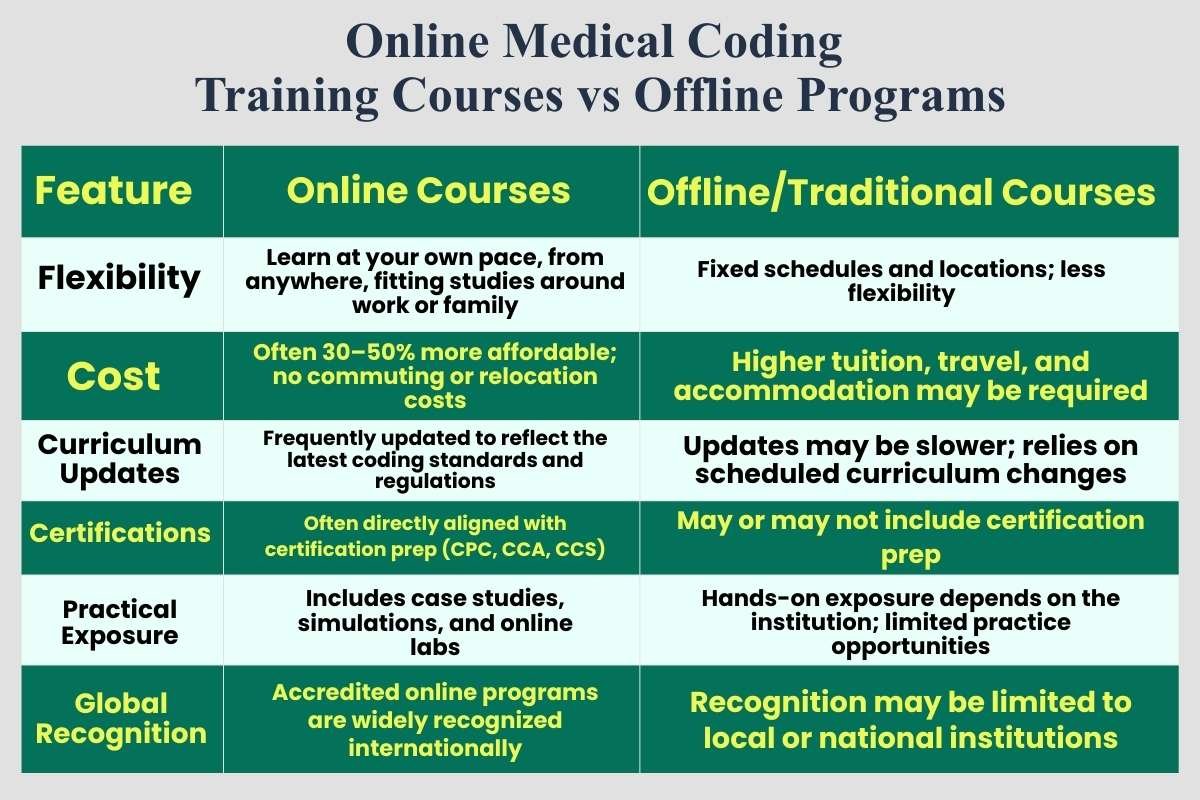
| Feature | Online Courses | Offline/Traditional Courses |
| Flexibility | Learn at your own pace, from anywhere, fitting studies around work or family | Fixed schedules and locations; less flexibility |
| Cost | Often 30–50% more affordable; no commuting or relocation costs | Higher tuition, travel, and accommodation may be required |
| Curriculum Updates | Frequently updated to reflect the latest coding standards and regulations | Updates may be slower; relies on scheduled curriculum changes |
| Certifications | Often directly aligned with certification prep (CPC, CCA, CCS) | May or may not include certification prep |
| Practical Exposure | Includes case studies, simulations, and online labs | Hands-on exposure depends on the institution; limited practice opportunities |
| Global Recognition | Accredited online programs are widely recognized internationally | Recognition may be limited to local or national institutions |
To put it briefly, online medical coding training programs are more effective and future-focused for anyone wishing to begin or grow a career in medical coding since they provide flexibility, cost, and real-world preparation.
Common Myths About Online Medical Coding Training Courses

Even while online medical coding classes are becoming more and more popular, many people still have false beliefs about what these programs can provide. Let’s clarify a few of the most popular myths:
Myth 1: Online courses aren’t recognized by employers
Reality: Accredited online programs from organizations like AAPC or AHIMA are widely accepted in the industry. Employers value certification and practical skills over the mode of learning.
Myth 2: Medical coding is only for healthcare professionals
Reality: Anyone with an interest in healthcare and data accuracy can learn coding. Many coders come from backgrounds in administration, IT, or even finance. Skills and certifications matter more than prior healthcare experience.
Myth 3: It’s hard to find a job after online training
Reality: The U.S. The Bureau of Labor Statistics projects a 7% growth in medical coding and health information jobs between 2024 and 2034, which is faster than average. Certified online graduates are often in high demand.
Myth 4: Online learning doesn’t provide practical experience
Reality: Most reputable online courses now include simulated coding labs, case studies, and exam prep, giving students hands-on experience just like traditional classrooms.
Myth 5: Only younger students benefit from coding courses
Reality: Coding is suitable for anyone looking for a stable career, whether you’re a recent graduate, a career shifter, or a working professional looking for upskilling.
By understanding these myths and facts, you can make an informed decision and realize that online medical coding training courses offer a credible, effective, and flexible path to a high-demand career.
Is Medical Coding a Future-Proof Career?
In a world where healthcare is becoming increasingly digital, medical coding is one of the most stable and future-proof careers you can pursue. Here’s why this field continues to grow and thrive:
- Rising demand for healthcare services: The global healthcare industry is expanding rapidly, and hospitals, clinics, and insurance companies need skilled coders to manage patient data efficiently. The global medical coding market is expected to reach $51.4 billion by 2030, growing at a CAGR of 10.22% annually.
- Shortage of trained professionals: In the U.S., the demand for medical coders is outpacing supply. According to AAPC, there is an expected shortage of over 100,000 certified coders by 2030, creating significant job opportunities for trained professionals.
- Integration with technology: Electronic Health Records (EHRs), telehealth, and AI-powered billing systems are making coding more critical than ever. Skilled coders who can adapt to technology are highly valued and less likely to face job automation.
In short, medical coding is more than a job; it’s a career with stability, growth, and adaptability. By completing online medical coding training courses, you’re investing in a skill set that will remain in demand for decades to come.
Read Next: Understanding Medical Billing and Coding: A Comprehensive Guide
Conclusion
The demand for qualified medical coders is higher than ever due to the expansion of the healthcare sector. You may learn at your own pace, obtain internationally recognized qualifications, and confidently enter a solid and future-proof job with online medical coding instruction.
From mastering real-world coding and billing processes to preparing for CPC, CCA, or CCS exams, these courses give you the skills and credibility employers are looking for. The myths about online learning, lack of recognition, or practical exposure are long gone. Accredited programs now combine flexibility, quality curriculum, and career support, ensuring you’re ready for success.
If you’re ready to invest in a career that offers growth, security, and global opportunities, online medical coding training courses are your gateway to a thriving, rewarding future in healthcare.