What truly defines the most rare flowers in the World? It’s a mix of scarcity, specific needs, and vulnerability. A plant earns this title if its population is severely limited. And it is restricted to a single valley or requires an uncommon pollinator. They bloom once every few years or even decades. For example, the magnificent, night-blooming Kadupul flower.
Factors such as habitat loss, climate change, and deforestation in endangered ecosystems. This creates an immediate threat to these delicate treasures. An estimated 36.5% of all global land plant species are categorized as “highly rare.” The existence of the most rare flowers in the world serves as evidence of nature’s durability. It is an important reminder of its fragility. Get ready to learn about the hidden lives of these vanishing botanical marvels.
What Makes a Flower Rare?
The most rare flowers in the world stand out due to scientific traits like endemism. Where species occur in only one geographic location. Alongside infrequent blooming and pollination hurdles. They are tied to specific pollinators or climates.
- Scientific Classification of Rarity
- Endemism confines plants to unique habitats, reducing populations. Low blooming frequency, such as once every few years, limits reproduction. It can be seen in jade vine or chocolate cosmos. Pollination challenges arise from specialized insects or environmental mismatches. While dependency on precise climates hampers wide survival.
- Environmental & Human Factors
- Habitat destruction from urbanization and agriculture decimates ranges. Illegal collection for trade depletes stocks. Climate change alters suitable conditions, and limited reproduction cycles intensify declines.
- Expert Insights
- Botanists highlight genetic diversity loss in small populations in ecological studies. The IUCN Red List assesses rarity via population decline, range size, and extinction risk. This is classifying species as Vulnerable or Endangered.
Here are the Top 30 Most Rare Flowers in the World That You Must See Once:
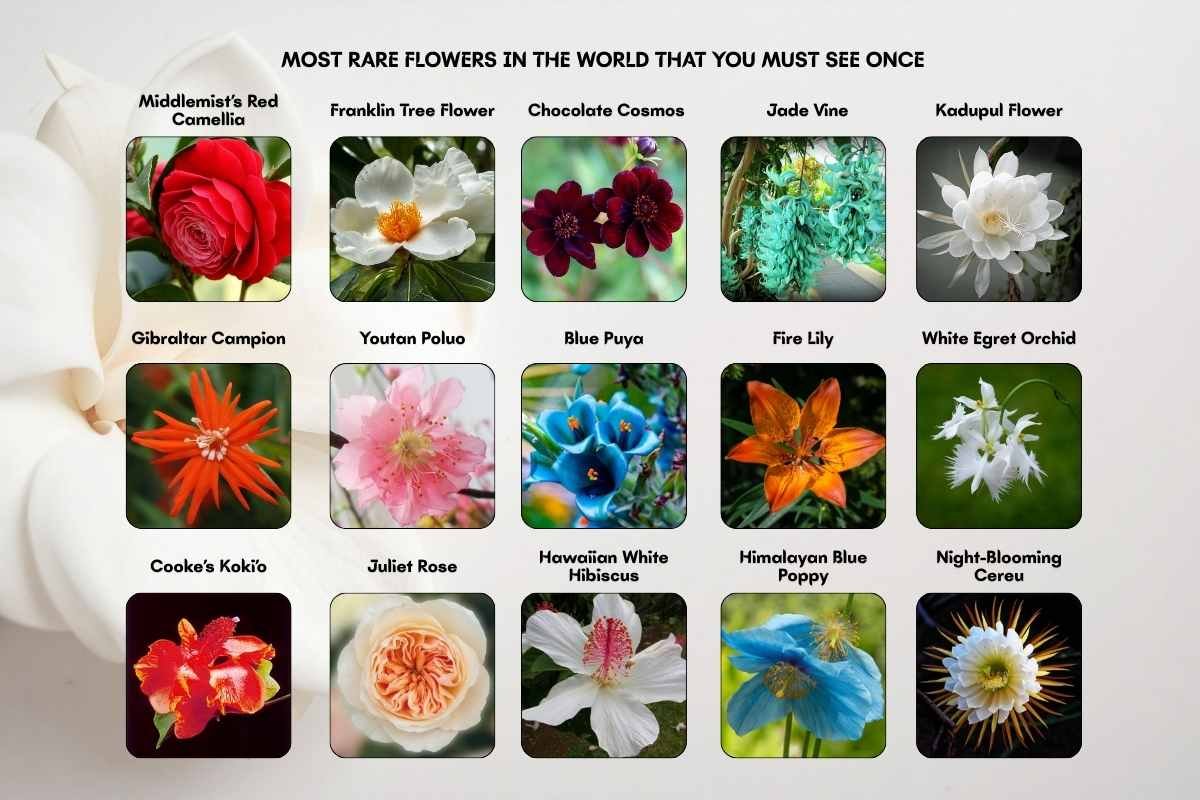
Below is a detailed look at the most rare flowers in the world. It includes where they grow. With the climate zones they depend on. And the fragile ecosystems that keep them alive.
| Flower Name | Main Location (Where it’s Found) | Simple Habitat Description |
| 1. Middlemist’s Red Camellia | UK and New Zealand (Only two plants are known) | Gardens and historically moist forests |
| 2. Ghost Orchid | Florida (USA) and Cuba | Dark, watery swamps and humid forests |
| 3. Franklin Tree Flower | Southeastern USA (Extinct in the wild) | Historically found along riverbanks |
| 4. Chocolate Cosmos | Mexico (Extinct in the wild) | Historically found in pine and oak forests |
| 5. Corpse Flower | Sumatra, Indonesia | Hot, tropical rainforests |
| 6. Rafflesia arnoldii | Sumatra and Borneo, Indonesia | Tropical rainforests (grow on vines) |
| 7. Jade Vine | Philippines | Wet, tropical river valleys |
| 8. Kadupul Flower | Sri Lanka | Tropical forests (grow on other trees) |
| 9. Gibraltar Campion | Gibraltar (Europe) | Rocky sea cliffs and mountainsides |
| 10. Parrot’s Beak | Canary Islands (Spain) | Dry, steep coastal cliffs |
| 11. Rothschild’s Slipper Orchid | Borneo, Malaysia | Cool, humid mountain rainforests |
| 12. Lady’s Slipper Orchid | Europe and Asia | Moist, shaded woodlands |
| 13. Hawaiian Cabbage / ʻŌlulu | Hawaiʻi (Kauaʻi) | Steep sea cliffs and rocky ledges (Extinct in the wild) |
| 14. Youtan Poluo | Found on metal or statues (Mythical/Unverified) | N/A (Often indoors or on surfaces) |
| 15. Attenborough’s Pitcher Plant | Palawan, Philippines | Wet, high-altitude mountain peaks |
| 16. Black Bat Flower | Southeast Asia | Shaded, dense tropical forests |
| 17. Blue Puya | Chile and Argentina | High, dry mountain slopes (Andes) |
| 18. Flame Lily | Tropical Africa and Asia | Grasslands and jungle edges |
| 19. Fire Lily | South Africa | Coastal brush, areas that burn often |
| 20. White Egret Orchid | Japan, Korea, China | Wet mountain meadows and marshes |
| 21. Cooke’s Koki’o | Molokaʻi, Hawaiʻi (USA) | Dry, warm Hawaiian forests |
| 22. Arizona Agave | Arizona (USA) | Desert, dry grasslands, and hillsides |
| 23. Shenzhen Nongke Orchid | China (Created by humans) | Controlled lab environment (Not natural) |
| 24. Juliet Rose | United Kingdom (Created by humans) | Gardens and greenhouses |
| 25. Assam Catkin Yew | Northeast India (Himalayas) | Humid, shady forests near streams |
| 26. Hawaiian White Hibiscus | Hawaiʻi (USA) | Moist, sheltered valleys and forests |
| 27. Western Underground Orchid | Western Australia | Completely underground in dry mallee scrub |
| 28. Himalayan Blue Poppy | Himalayas (China, Nepal) | Cold, moist, high mountain fields |
| 29. Hawaiian Silversword | Hawaiʻi (USA) | High-altitude volcanic slopes (alpine desert) |
| 30. Night-Blooming Cereus | USA Southwest and Mexico | Dry desert scrub and open fields |
1. Middlemist’s Red Camellia
- Scientific Name: Camellia japonica ‘Middlemist’s Red.’
- Appearance: Features large, deep rose-pink flowers that resemble a classic rose, but with the texture of a camellia.
- Blooming Behavior: Blooms in late winter to early spring.
- Why it’s Rare: It is arguably the rarest flower in the world, as only two known specimens exist: one in a garden in New Zealand and one in a greenhouse in Chiswick, UK. It is extinct in its native China.
- IUCN Status: Not officially listed (as it is a cultivar), but its wild equivalent is considered extinct.
This is arguably the rarest ornamental flower globally. Only two known plants survive today, one in New Zealand and one in the UK. It is extinct in its native China. It features large, beautiful, deep rose-pink flowers. This cultivar represents one of the Most Rare Flowers in the World.
2. Ghost Orchid
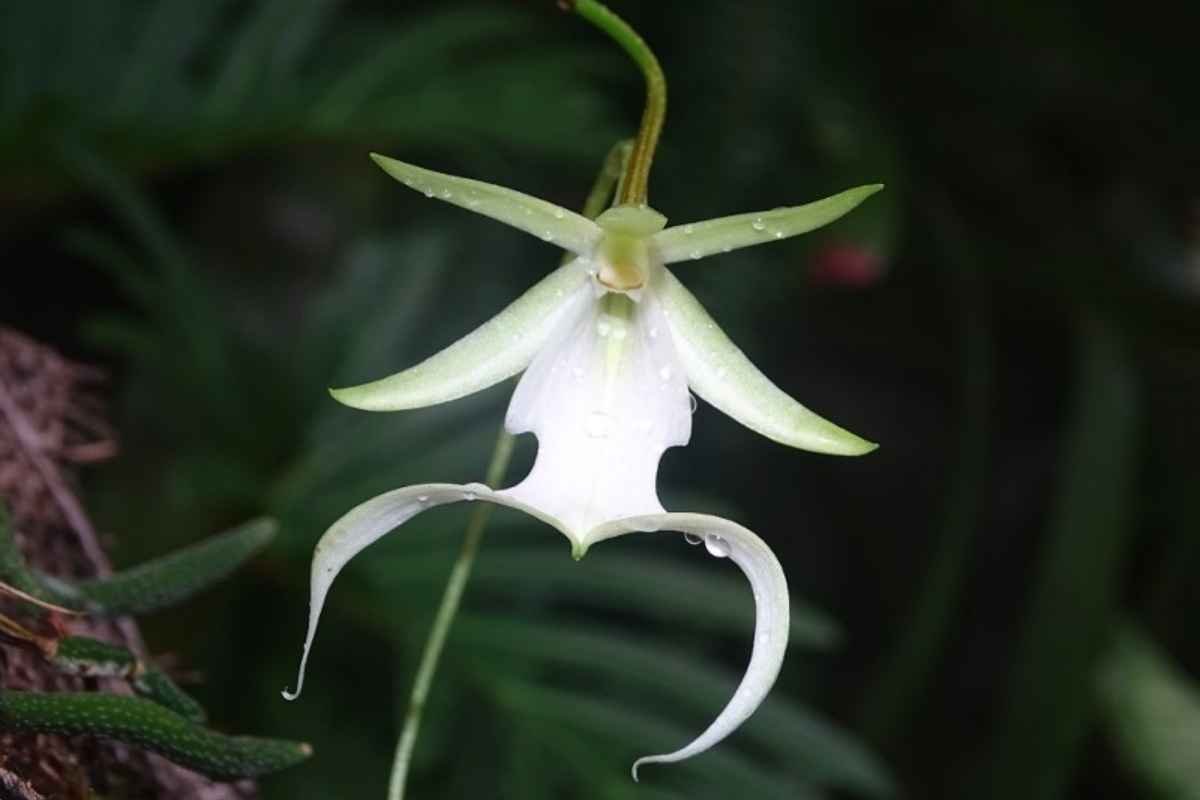
- Scientific Name: Dendrophylax lindenii
- Appearance: This leafless orchid has thick green roots that blend into the bark of its host tree, giving the illusion that the plant is floating. Its white, moth-like flowers feature long, twisted lower sepals.
- Blooming Behavior: Blooms sporadically between June and August.
- Why it’s Rare: It is critically dependent on its specific habitat (humid, deep cypress swamps) and a single, specific pollinator, the giant sphinx moth (Cocytius antaeus). Its seeds also require a specific mycorrhizal fungus to germinate.
- IUCN Status: Not assessed globally, but Critically Imperiled in Florida.
It is a leafless orchid, often appearing to float magically in the air within swampy forests of Florida and Cuba. It relies entirely on a single species of giant sphinx moth for pollination. Its seeds must bond with a specific fungus to germinate. Habitat loss makes this one of the Most Rare Flowers in the World.
3. Franklin Tree Flower
- Scientific Name: Franklinia alatamaha
- Appearance: A deciduous small tree with attractive dark green leaves that turn brilliant red-orange in autumn. The flowers are white, cup-shaped, and resemble camellias with a central cluster of yellow stamens.
- Blooming Behavior: Blooms late in the season, typically in summer and early autumn.
- Why it’s Rare: It has been extinct in the wild since the early 1800s. All existing trees today are descendants of specimens collected in 1777 by the botanist John Bartram and his son, William.
- IUCN Status: Extinct in the Wild (EW).
This small tree has been extinct in the wild in the Southeastern USA since the early 1800s. All specimens alive today are descendants of seeds collected by the Bartrams in the 18th century. It produces cup-shaped white flowers with a prominent yellow center.
4. Chocolate Cosmos
- Scientific Name: Cosmos atrosanguineus
- Appearance: Features deep burgundy to brownish-red petals. It is famous for emitting a soft, dark cocoa or vanilla scent when in bloom.
- Blooming Behavior: Blooms from mid-summer until the first frost.
- Why it’s Rare: It has been extinct in the wild for over a century. The single clone surviving in cultivation is sterile and propagated only through root division, meaning it produces no viable seeds.
- IUCN Status: Extinct in the Wild (EW).
This species is extinct in the wild, surviving only as a sterile single clone cultivated through cuttings. It is famous for its dark burgundy color and a distinct, pleasant scent of vanilla or cocoa. It has not set viable seeds in its native Mexico for over a century.
5. Corpse Flower
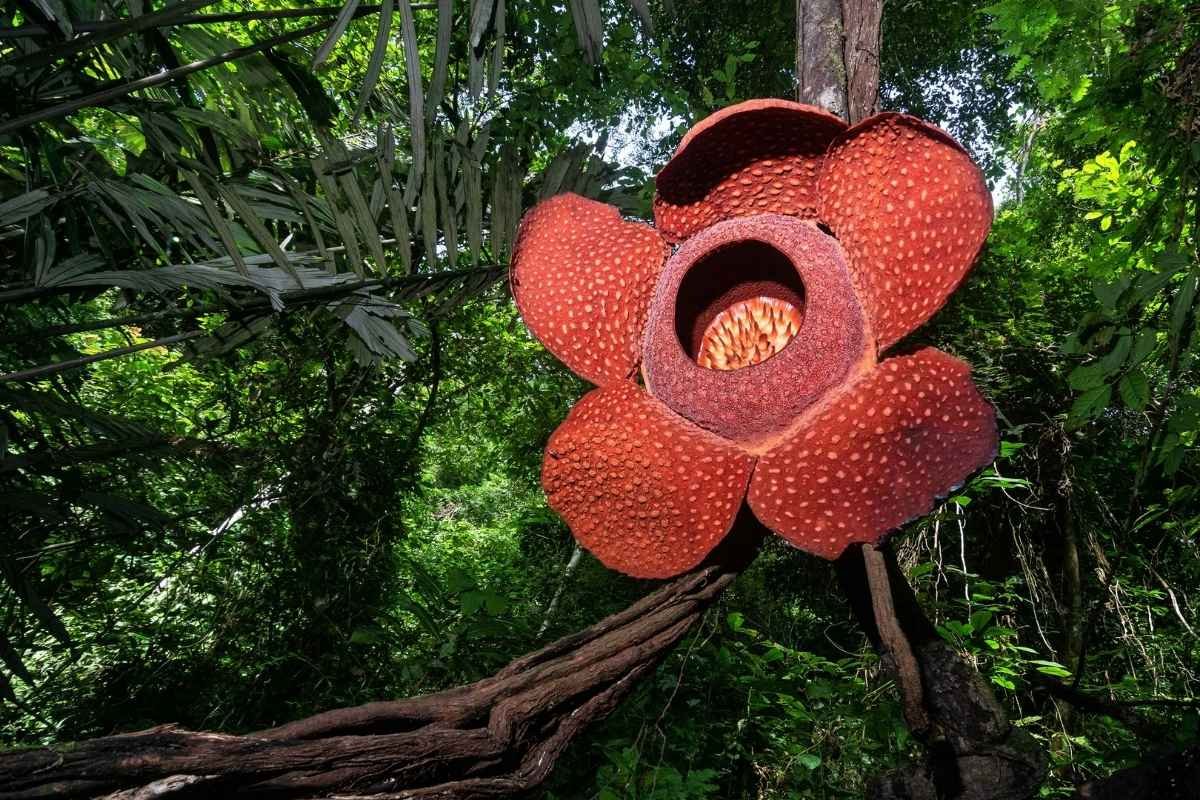
- Scientific Name: Amorphophallus titanum
- Appearance: It is not a single flower, but a massive inflorescence (cluster of flowers) called a titan arum. It can reach over 10 feet tall. It is deep red inside and releases a powerful smell of rotting flesh to attract pollinators (carrion beetles and flies).
- Blooming Behavior: Blooms unpredictably and infrequently, typically only once every few years, with the bloom lasting just 24–48 hours.
- Why it’s Rare: Its blooming is incredibly rare, and its native habitat (rainforests of Sumatra) is rapidly being destroyed.
- IUCN Status: Endangered (EN).
Known for producing the largest unbranched inflorescence in the world, which can exceed 10 feet tall. It blooms unpredictably, often only once every few years, for a fleeting 24–48 hours. It emits a powerful stench of rotting flesh to attract carrion pollinators in the rainforests of Sumatra. This is one of the Most Rare Flowers in the World.
6. Rafflesia arnoldii (Stinking Corpse Lily)
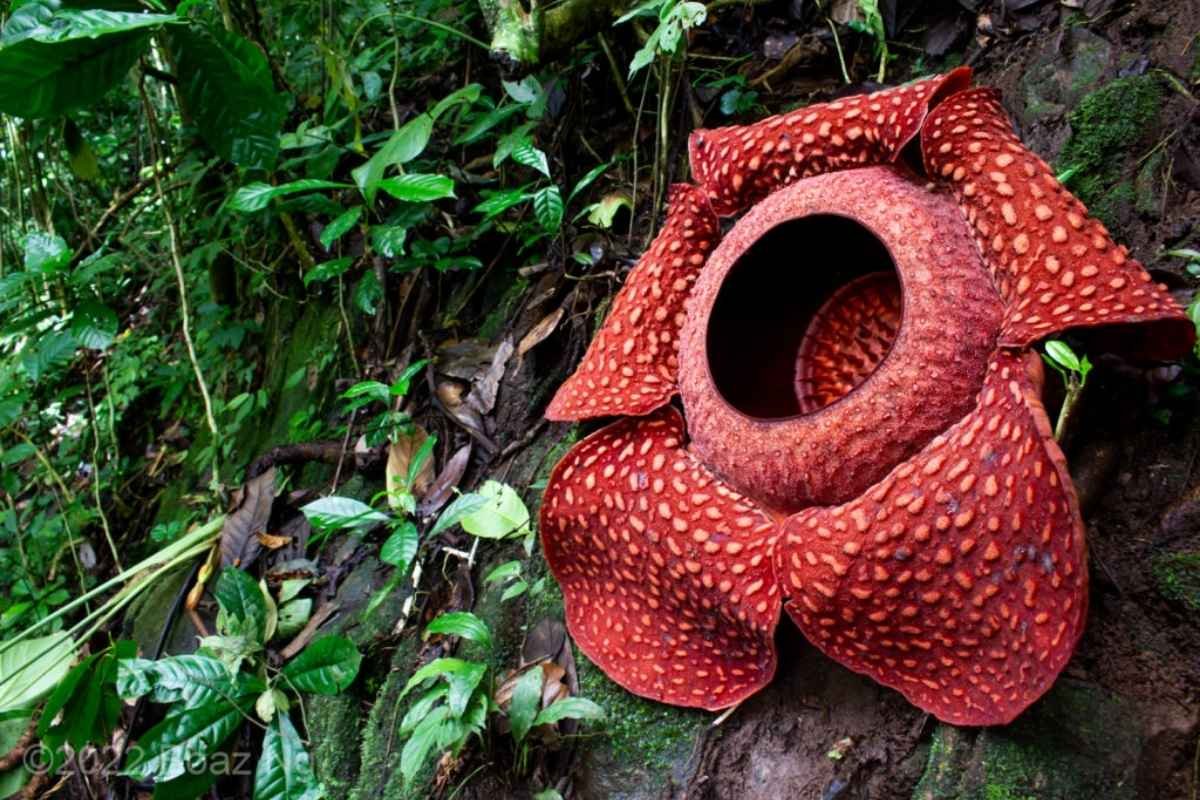
- Scientific Name: Rafflesia arnoldii
- Appearance: Produces the largest individual flower in the world, growing up to 3 feet in diameter and weighing up to 24 pounds. It is entirely parasitic, having no leaves, stems, or true roots. It is reddish-brown and also emits a stench of rotting meat.
- Blooming Behavior: Flowers open for only about 5–7 days.
- Why it’s Rare: It is entirely parasitic on only one genus of vine (Tetrastigma), and its specific rainforest habitat is under constant threat.
- IUCN Status: Not officially assessed, but often considered Critically Endangered.
This plant produces the world’s largest single flower, which can measure three feet across and weigh 24 pounds. It is a parasitic plant, having no visible leaves, stems, or roots. It depends entirely on one specific vine (Tetrastigma) for nutrients in the Bornean and Sumatran rainforests.
7. Jade Vine
- Scientific Name: Strongylodon macrobotrys
- Appearance: A spectacular woody vine that produces hanging clusters (racemes) of luminous, claw-shaped flowers. The color ranges from a light, vibrant jade green to turquoise blue.
- Blooming Behavior: Blooms during the dry season, typically spring/summer.
- Why it’s Rare: It is native only to the Philippines and is severely threatened by the destruction of its tropical rainforest habitat. It is pollinated by bats in the wild.
- IUCN Status: Endangered (EN).
Its flowers hang in spectacular, claw-shaped clusters of a unique, luminous jade-green or turquoise color. It is native only to the Philippines, where it is endangered due to severe deforestation. Its specific pollinator in the wild is thought to be a bat.
8. Kadupul Flower (Queen of the Night)
- Scientific Name: Epiphyllum oxypetalum
- Appearance: A species of cactus with large, white, highly fragrant flowers.
- Blooming Behavior: Blooms exclusively at night (only for a few hours) and withers before dawn. It rarely flowers.
- Why it’s Rare: While the plant itself is cultivated globally, its bloom is extremely rare and fleeting, especially in its native Sri Lankan habitat, leading to its local reverence as an almost mythical flower.
- IUCN Status: Not assessed, but locally protected in Sri Lanka.
Often called the “Queen of the Night,” it is a cactus that produces large, highly fragrant white flowers. The flower is famous for its rarity because it blooms only at night and withers before dawn, making its sighting a rare event. It is native to Sri Lanka and parts of South America.
9. Gibraltar Campion
- Scientific Name: Silene tomentosa
- Appearance: Features clusters of delicate, pale pink or white five-petalled flowers.
- Blooming Behavior: Flowers typically bloom in the summer.
- Why it’s Rare: It is endemic to the Rock of Gibraltar. It was thought to be extinct by 1992, but was rediscovered by a hiker in 1994, with only a few plants surviving on inaccessible cliffs.
- IUCN Status: Critically Endangered (CR).
This flower was declared extinct in 1992 but was dramatically rediscovered in 1994 by a park ranger. Only a handful of plants survive on the inaccessible cliff faces of the Rock of Gibraltar. Active conservation efforts are vital to protect this member of the Most Rare Flowers in the World.
10. Parrot’s Beak
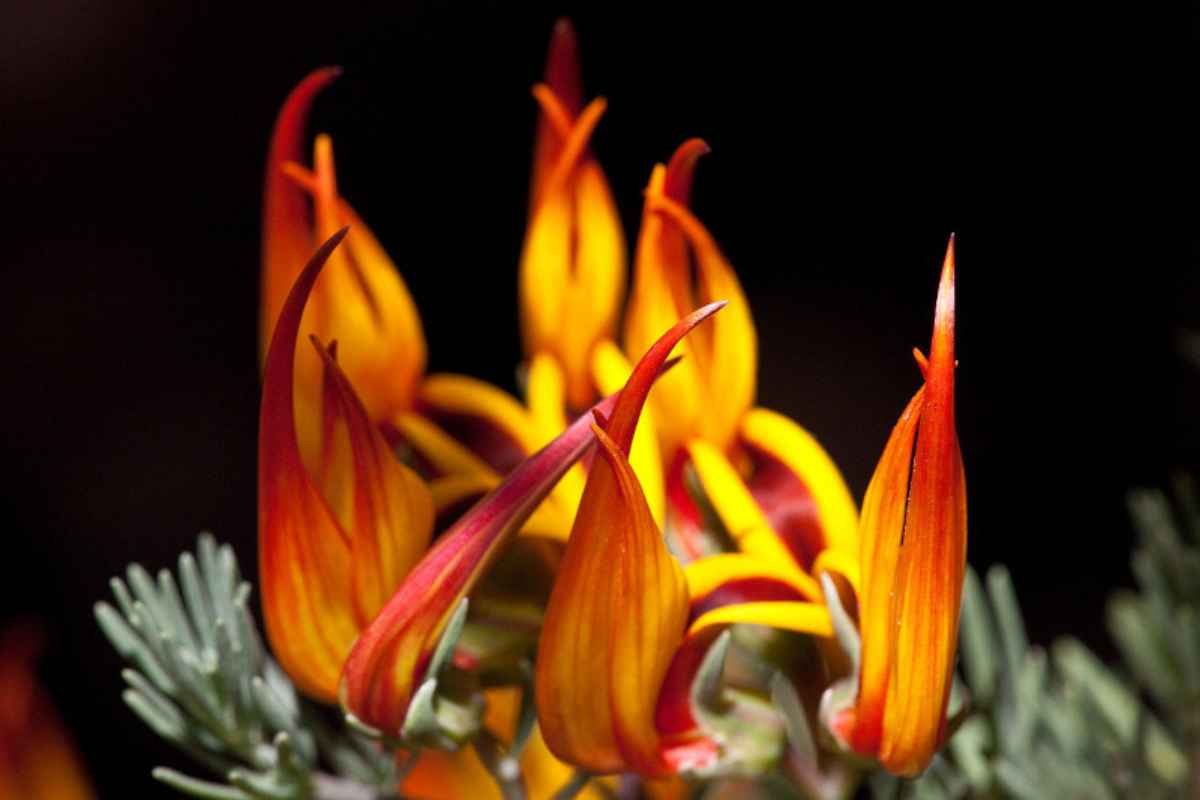
- Scientific Name: Lotus berthelotii
- Appearance: Named for its unique, claw-like, intensely colored flowers that resemble a parrot’s beak. The colors range from deep orange-red to scarlet.
- Blooming Behavior: Flowers usually appear in late spring and summer.
- Why it’s Rare: It is critically endangered and possibly extinct in its native habitat of the Canary Islands. It is believed to have originally been pollinated by sunbirds, which are now absent or very scarce in its range, leading to a major pollination deficit.
- IUCN Status: Critically Endangered (CR).
Its curved, intense orange-red flowers strongly resemble a parrot’s beak or claw. It is native to the Canary Islands, where it is considered critically endangered and possibly extinct in the wild. Lack of its original sunbird pollinator is a key threat.
11. Rothschild’s Slipper Orchid
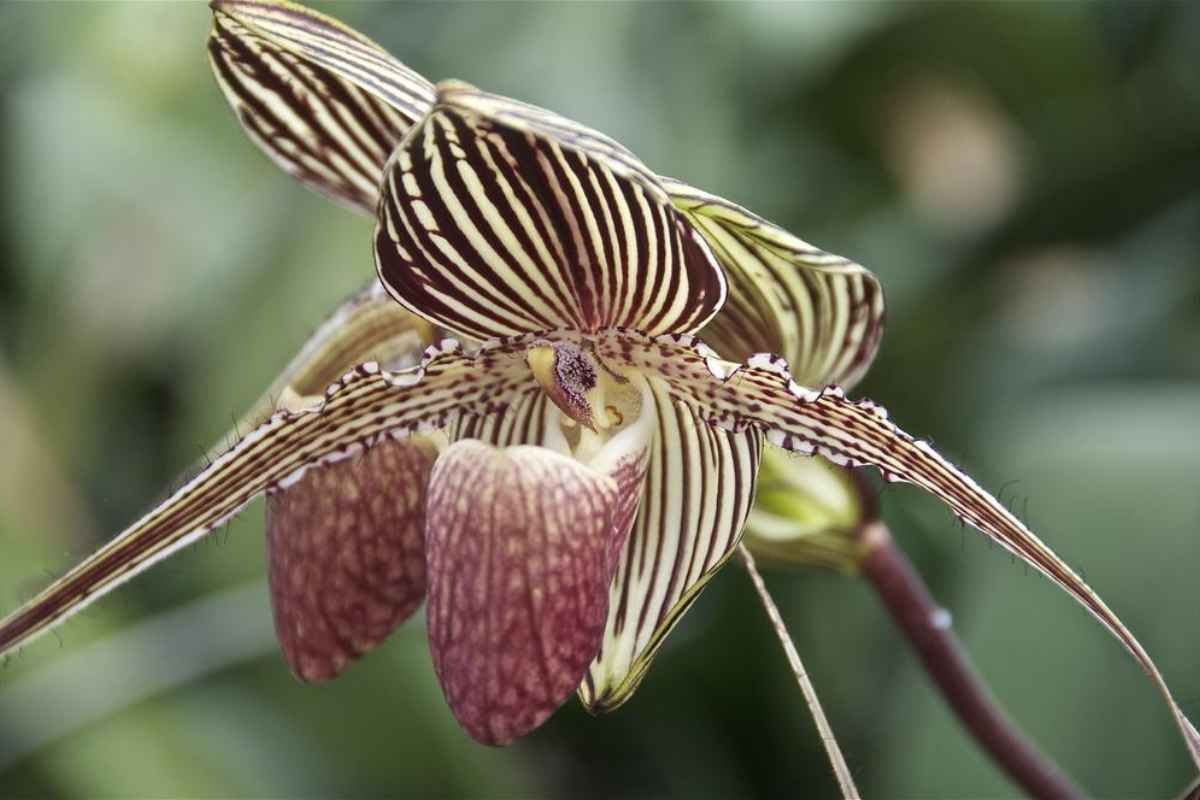
- Scientific Name: Paphiopedilum rothschildianum
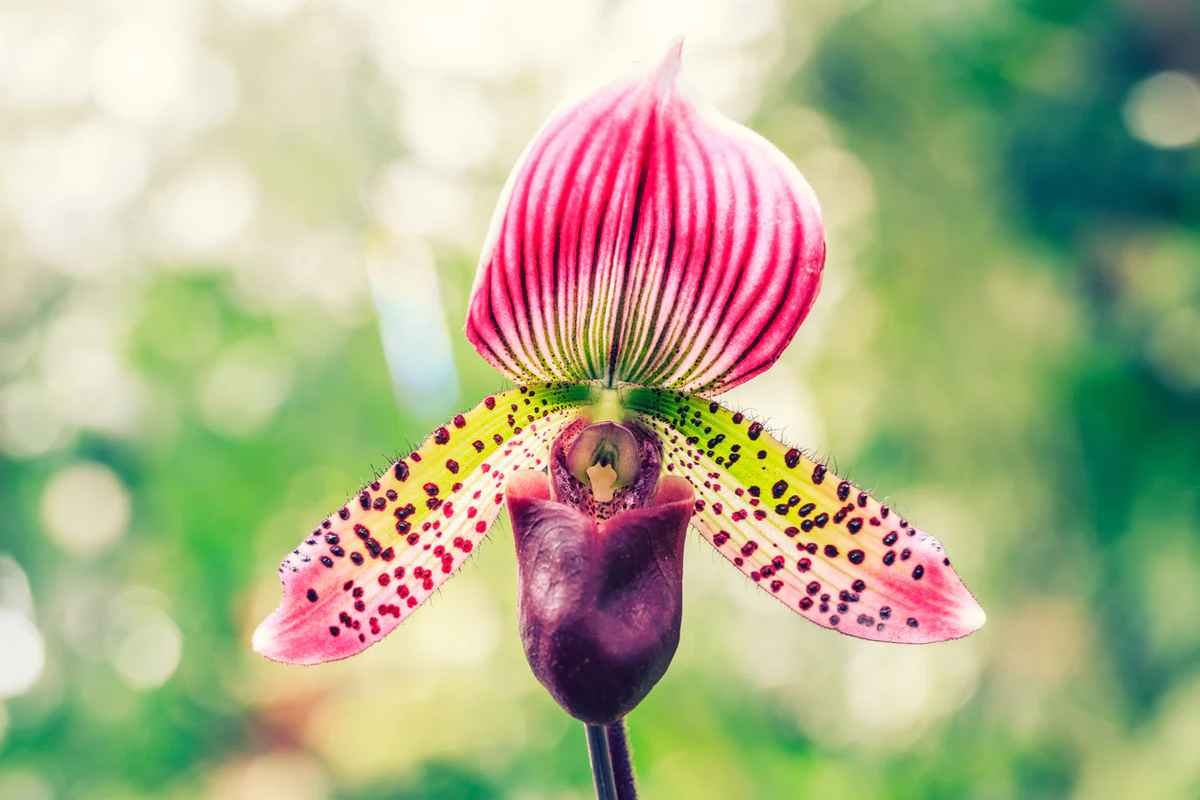
- Appearance: This is a spectacular orchid, featuring long, horizontal petals that can reach up to 10 inches wide, giving it a mustache-like appearance. The pouch (slipper) is yellow-green, and the petals are striped with maroon.
- Blooming Behavior: Flowers usually appear on a single stem, typically in spring or early summer.
- Why it’s Rare: It is restricted to a very small area on Mount Kinabalu in Borneo, Malaysia. Its beauty made it a prime target for illegal collectors, driving it to the brink of extinction in the wild.
- IUCN Status: Endangered (EN).
This is a highly valued and extremely expensive orchid, known for its long, horizontal, striped petals that stretch out like a mustache. It is endemic to a small area of Mount Kinabalu in Borneo. Its rarity is largely due to rampant, illegal poaching by collectors.
12. Yellow and Purple Lady’s Slipper
- Scientific Name: Cypripedium calceolus (Yellow Lady’s Slipper is C. parviflorum in North America, often confused with the European C. calceolus)
- Appearance: Features a dramatic, pouch-like lower petal (the “slipper”) that is usually bright yellow. The sepals and other petals are typically brown or maroon and twisted.
- Blooming Behavior: Blooms in late spring to early summer.
- Why it’s Rare: In much of Europe and the UK, it is critically rare (sometimes only one known plant remains). It is highly vulnerable to habitat destruction and requires a specific soil composition and mycorrhizal fungus for germination.
- IUCN Status: C. calceolus is Least Concern (LC) globally due to wide distribution in Asia, but it is Critically Endangered/Protected in many European countries.
This orchid is highly protected across Europe due to its scarcity, surviving in only a handful of specific sites in the UK. It requires a specific mycorrhizal fungus in the soil to grow. It’s dramatic, pouch-like yellow petal traps insects for pollination.
13. Hawaiian Cabbage / ʻŌlulu
- Scientific Name: Brighamia insignis
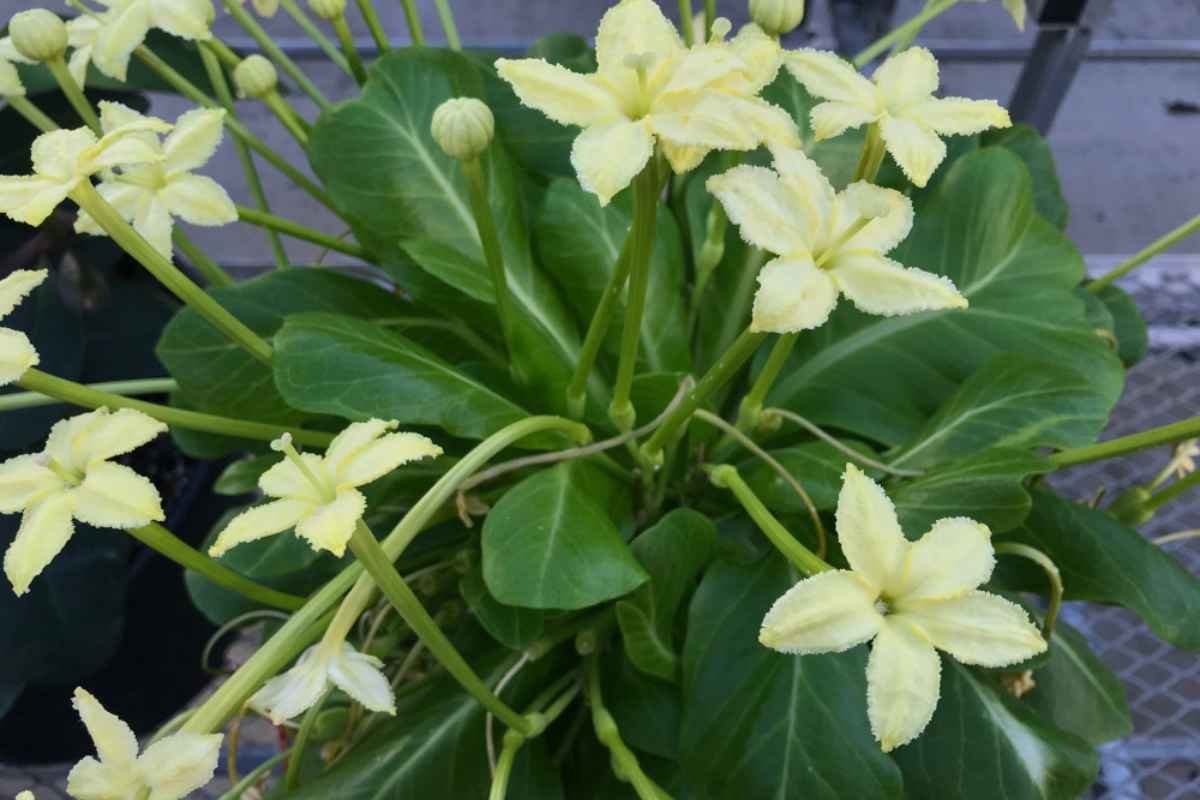
- Appearance: This plant resembles a small palm tree with a thick, succulent stem (caudex) and a dense rosette of shiny green leaves at the top, hence the common name “Hawaiian Cabbage.” It produces clusters of pale yellow-cream, trumpet-shaped flowers.
- Blooming Behavior: Flowers typically bloom in the fall.
- Why it’s Rare: It is critically rare, primarily due to its extreme habitat specialization on steep, inaccessible sea cliffs, making hand-pollination difficult. Its natural pollinator, a specific species of hawk moth with a long proboscis, is thought to be extinct, necessitating dangerous human-assisted pollination by botanists rappelling down cliffs.
- IUCN Status: Critically Endangered (CR).
This plant is endemic to the steep, rocky sea cliffs of Kauaʻi and Niʻihau in Hawaiʻi. Its survival is endangered because its natural hawk moth pollinator is believed to be extinct. Botanists must rappel down cliffs to hand-pollinate the remaining plants. This is one of the Most Rare Flowers in the World.
14. Youtan Poluo
- Scientific Name: N/A (Likely a fungus or insect egg cluster)
- Appearance: Extremely minute, white, filamentous or thread-like objects, described as delicate, tiny white flowers. Said to be only about 1mm in diameter.
- Blooming Behavior: Mythologically, it is said to bloom once every 3,000 years.
- Why it’s Rare: Its extreme rarity is mythical and symbolic in Buddhist texts, signifying the arrival of a Buddha. Scientifically, most experts believe sightings are actually a type of slime mold, fungus, or the eggs of a lacewing insect. It is “rare” because of its spiritual significance, not its botany.
- IUCN Status: Not applicable (Not a scientifically classified plant species).
This is a mythological flower, said to bloom once every 3,000 years in Buddhist tradition. Scientifically, the tiny, minute white objects often cited as this flower are most likely the eggs of a lacewing insect or a type of fungus. Its rarity is symbolic, not botanical.
15. Attenborough’s Pitcher Plant
- Scientific Name: Nepenthes attenboroughii
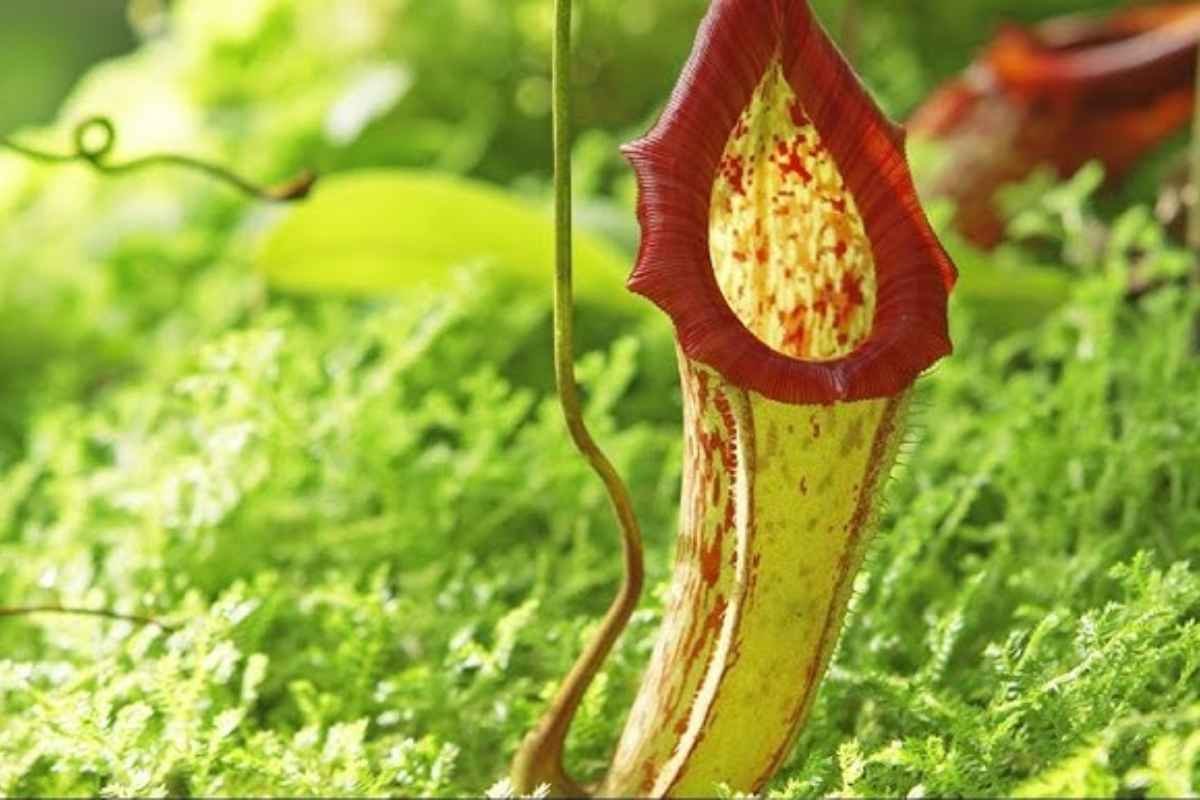
- Appearance: A giant, carnivorous pitcher plant. The pitchers are bell-shaped and enormous, reaching up to 1.5 meters (4.9 ft) tall and 30 cm (11.8 in) in diameter, capable of trapping rodents and insects.
- Blooming Behavior: Produces small flowers on a tall spike; separate male and female plants are required for seeds.
- Why it’s Rare: It is restricted to the summit and upper slopes of Mount Victoria on the island of Palawan in the Philippines. Its tiny, isolated population is severely threatened by illegal plant poaching and habitat disruption.
- IUCN Status: Critically Endangered (CR).
A giant carnivorous plant that produces huge pitchers capable of trapping insects and even small rodents. It is endemic to the summit region of Mount Victoria in the Philippines. Its tiny, isolated population is threatened by illegal poaching.
Read Next: The 10 Most Expensive Flowers in the World, And Why They Cost More Than Gold
16. Black Bat Flower
- Scientific Name: Tacca chantrieri
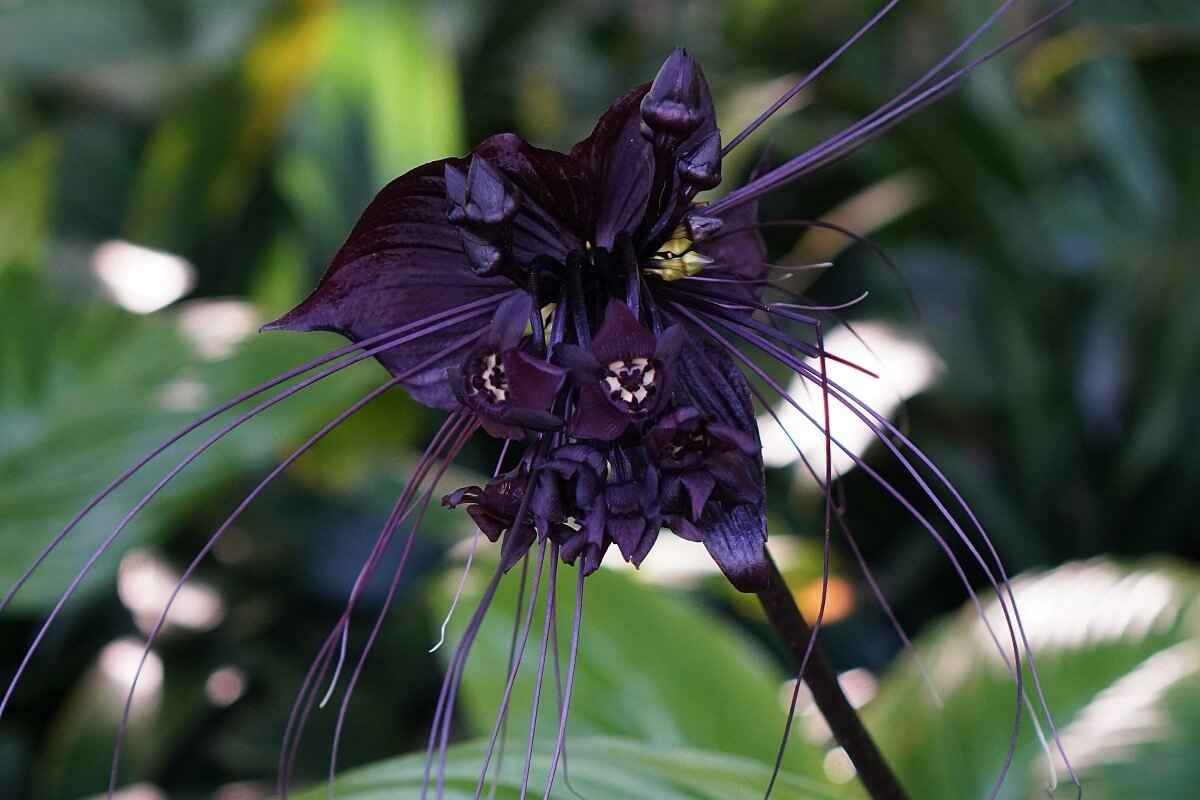
- Appearance: Known for its highly unusual, dark purple to nearly black, bat-shaped flowers that can span up to 12 inches wide. It features long, whisker-like bracts that trail downward.
- Blooming Behavior: Blooms over a long period, usually from late spring through fall.
- Why it’s Rare: While widely cultivated, the wild populations in Southeast Asia are threatened by habitat destruction and over-harvesting for use in traditional medicine.
- IUCN Status: Not officially assessed, but protected in some regions (like China) due to collection pressure.
This species is instantly recognizable by its bizarre, nearly black, bat-shaped flowers that have long, dark, whisker-like bracts. While cultivated, wild populations in Southeast Asia are threatened by over-harvesting and habitat loss.
17. Blue Puya
- Scientific Name: Puya alpestris
- Appearance: A giant terrestrial bromeliad that produces a towering, dramatic spike of flowers. The individual flowers are a stunning metallic, sapphire-blue to turquoise-green with bright orange pollen.
- Blooming Behavior: Monocarpic. It blooms once after many years and then dies.
- Why it’s Rare: It is native to the high, arid Andes Mountains in Chile and Argentina and is very slow-growing. Habitat loss due to livestock grazing and changes in high-altitude climate threaten its survival.
- IUCN Status: Not officially assessed, but considered rare and vulnerable.
This plant is a giant bromeliad native to the high-altitude Andes Mountains of Chile and Argentina. It produces a massive flower spike of stunning, metallic sapphire-blue to turquoise flowers with bright orange anthers. It is one of the Most Rare Flowers in the World.
18. Flame Lily
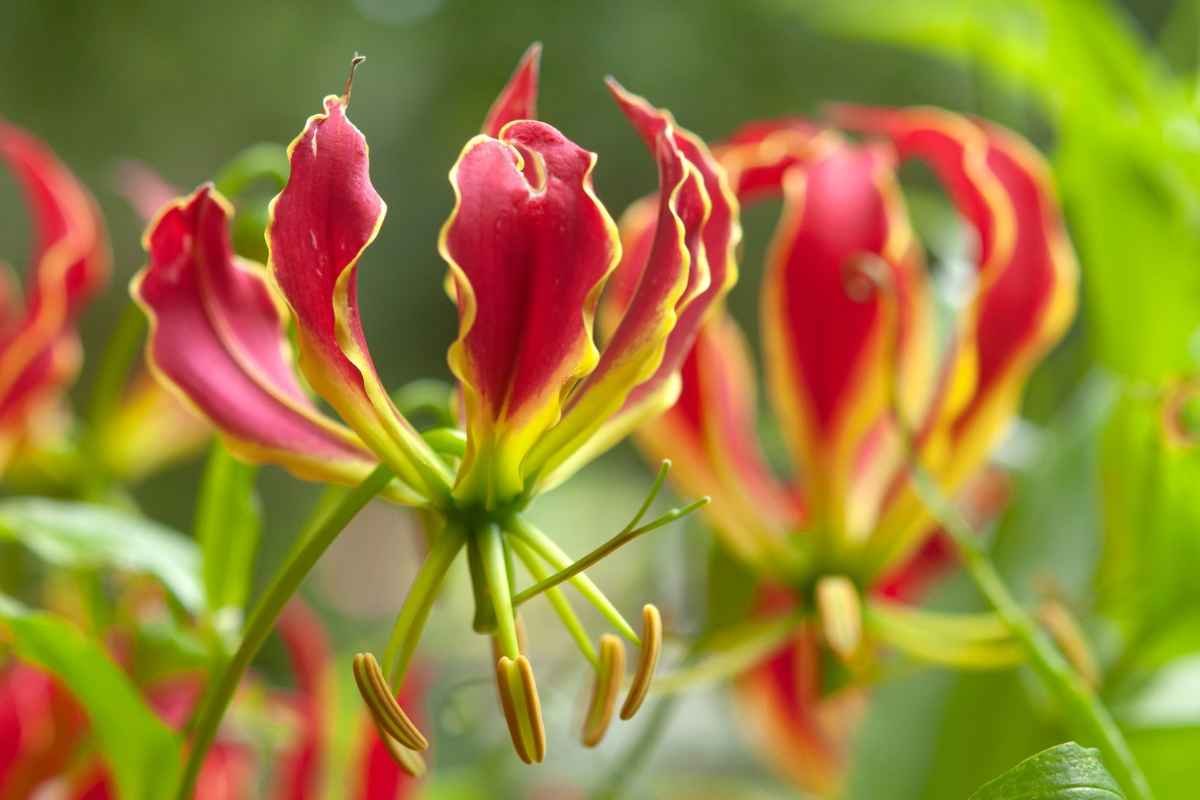
- Scientific Name: Gloriosa superba
- Appearance: A spectacular climbing lily with bright red and yellow, highly reflexed (bent backward) petals, giving it a flame-like or wavy appearance.
- Blooming Behavior: Flowers profusely during the rainy season.
- Why it’s Rare: The roots (tubers) and leaves are highly poisonous but are widely harvested for use in traditional medicine, leading to severe over-collection in the wild.
- IUCN Status: Least Concern (LC) globally due to wide distribution, but Critically Endangered in local areas due to harvesting pressure.
A striking climbing plant with unique, wavy petals of fiery red and yellow. It is widespread but often locally endangered due to extreme harvesting pressure. The tubers are collected in large quantities for traditional medicine despite being highly poisonous.
19. Koki’o (Hawaiian Tree Cotton)
- Scientific Name: Kokia cookei
- Appearance: A small Hawaiian tree that produces large, striking, crumpled red to orange-red hibiscus-like flowers.
- Blooming Behavior: Flowers in the winter.
- Why it’s Rare: It has been extinct in the wild since the 1860s. All current living specimens are derived from a single branch grafted onto a closely related species, representing an extreme genetic bottleneck.
- IUCN Status: Extinct in the Wild (EW).
This South African lily is well-known for being pyrophytic, meaning it is one of the first plants to sprout and flower after a wildfire. Its specific, localized populations in coastal scrub are increasingly lost to urban development and alien plant invasion.
20. White Egret Orchid
- Scientific Name: Habenaria radiata
- Appearance: This terrestrial orchid produces delicate white flowers that uncannily resemble a white egret in flight, with feathery fringes along the lip petals.
- Blooming Behavior: Flowers in summer.
- Why it’s Rare: It is critically threatened by the drainage and development of its wetland and marsh habitat in China, Japan, and Korea.
- IUCN Status: Not assessed, but widely considered critically Endangered across much of its native range
This magnificent orchid’s flower perfectly mimics a white egret in flight, complete with feathery fringes. It is critically endangered in its native Japan, Korea, and China due to the drainage and loss of its natural wetland and marsh habitat, solidifying its place among the Most Rare Flowers in the World.
21. Cooke’s Koki’o
- Scientific Name: Kokia cookei
- Appearance: A small, red-flowered tree with large, stunning hibiscus-like blossoms that are crinkled and orange-red.
- Blooming Behavior: Flowers primarily during the winter months.
- Why it’s Rare: Considered one of the rarest plants globally. It has been Extinct in the Wild (EW) since 1918. All living plants today (approximately 23) exist as grafts from a single surviving branch onto a related species, resulting in an extreme genetic bottleneck.
- IUCN Status: Extinct in the Wild (EW).
This Hawaiian tree is one of the rarest trees on Earth, surviving only through cultivated grafts. It has been Extinct in the Wild (EW) since 1918. All living specimens originate from a single surviving branch and feature beautiful, large red hibiscus flowers.
22. Arizona Agave
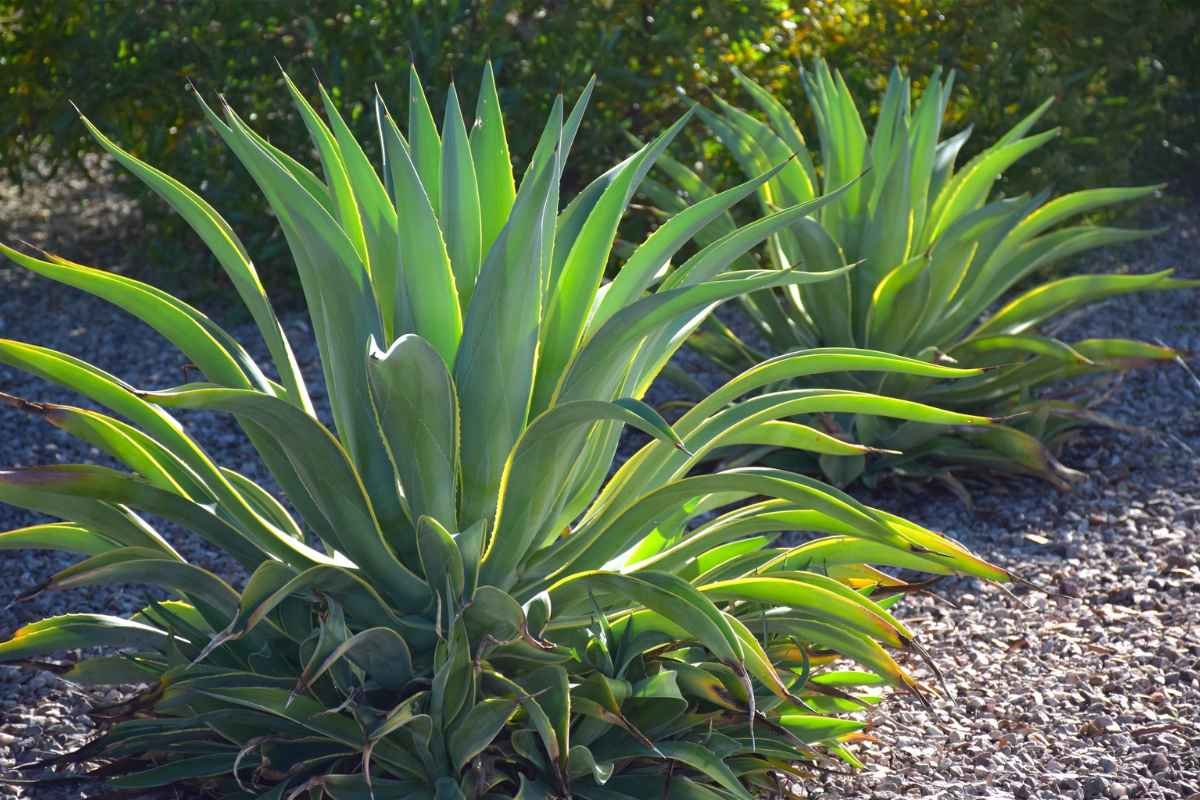
- Scientific Name: Agave arizonica
- Appearance: A small, compact agave with blue-green, spine-edged leaves. After many years, it sends up a tall spike of yellow flowers.
- Blooming Behavior: Monocarpic. It flowers only once after several decades, then dies.
- Why it’s Rare: It is an extremely restricted endemic species, found only in two small mountain ranges in Arizona. Its rarity is compounded by hybridization with other agave species.
- IUCN Status: Endangered (EN).
This agave is endemic to just two small mountain ranges in central Arizona, making its distribution severely restricted. It flowers once in its life after several decades, producing a tall spike of yellow flowers, and then dies. Conservation efforts focus on managing hybridization. This is one of the Most Rare Flowers in the World.
23. Shenzhen Nongke Orchid
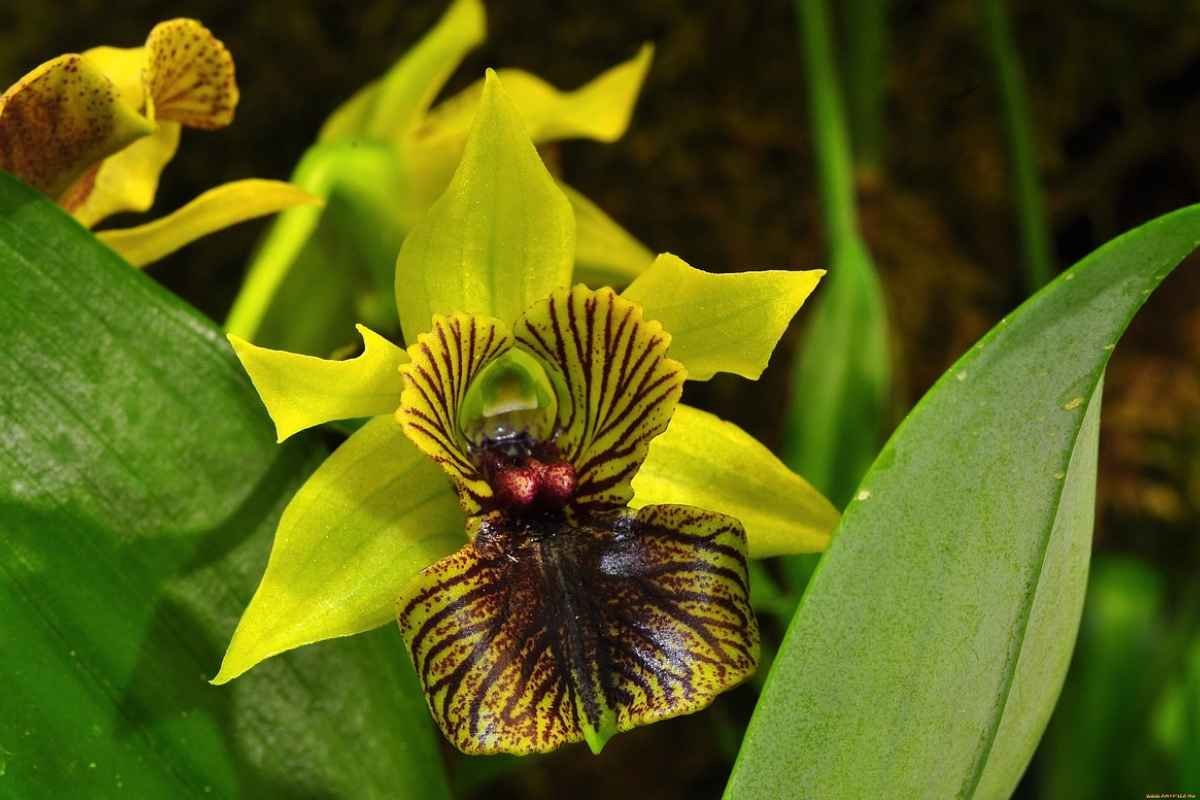
- Scientific Name: N/A (Artificial Cultivar)
- Appearance: A highly complex and delicate orchid, known for its intricate flowers with light purple or yellow-green coloring and complex patterns.
- Blooming Behavior: Blooms only every 4–5 years, and the bloom period is short.
- Why it’s Rare: It is completely man-made, developed through eight years of agricultural research at the Shenzhen Nongke University in China. Its rarity is defined by its uniqueness and its historic cost, selling for the equivalent of $200,000 in 2005, making it the most expensive flower ever sold at the time.
- IUCN Status: Not applicable (Man-made hybrid).
This unique orchid is not natural; it was entirely man-made by agricultural researchers in China. It is famous for its immense price, setting records at auction. It requires 4–5 years to bloom, making its appearance a rare and scheduled event.
24. Juliet Rose
- Scientific Name: Rosa ‘Ausgold’ (Trade name: Juliet Rose)
- Appearance: A distinctive English shrub rose with large, deeply cupped, full-petalled flowers. The color is a unique, warm apricot or peach shade.
- Blooming Behavior: Blooms in flushes from late spring through fall.
- Why it’s Rare: Its rarity is artificial. It was created by famous rose breeder David Austin and took 15 years and £3 million to develop. Its high price and exclusive use in the cut-flower market (especially for luxury weddings) define its scarcity and luxury status.
- IUCN Status: Not applicable (Man-made hybrid).
This luxurious rose, known for its deep apricot, cup-shaped flowers, was developed over 15 years by David Austin. Its rarity is artificial, driven by its exclusivity and high price in the cut-flower trade. It is one of the most famous and expensive roses ever created.
25. Assam Catkin Yew
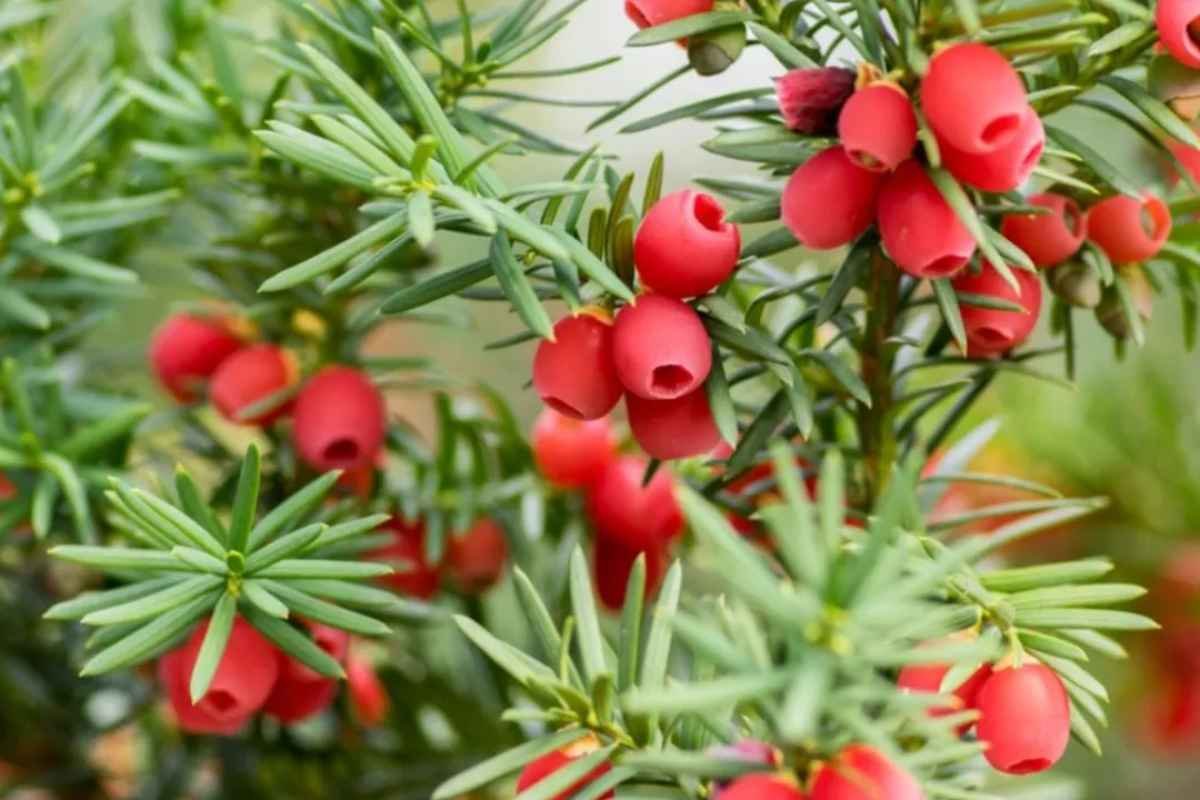
- Scientific Name: Amentotaxus assamica
- Appearance: A rare conifer tree with needle-like leaves (foliage), distinguished by its unique, dangling, catkin-like cones.
- Blooming Behavior: Dioecious (male and female flowers on separate plants). Pollinated by wind.
- Why it’s Rare: It is restricted to a very small area in the subtropical forests of Northeast India. It is highly vulnerable to deforestation, logging, and habitat degradation for agriculture.
- IUCN Status: Endangered (EN).
A rare conifer endemic to the subtropical forests of the Himalayas in Northeast India. Its limited population is threatened by illegal logging and habitat degradation. It has unusual drooping male cones (catkins). Protecting the habitat of the Most Rare Flowers in the World is crucial.
26. Hawaiian White Hibiscus
- Scientific Name: Hibiscus arnottianus subsp. immaculatus
- Appearance: A small tree producing large, pure white, highly fragrant hibiscus flowers that often turn pink as they age.
- Blooming Behavior: Flowers throughout the year, but heaviest in winter.
- Why it’s Rare: It is considered the rarest of all native Hawaiian Hibiscus species, existing in only four known wild populations on the island of Molokaʻi. It is threatened by feral goats, pigs, and invasive plants.
- IUCN Status: Endangered (EN) (U.S. Federal Status).
This is one of the most endangered hibiscus species native to Hawaiʻi, found in only a few remote valleys on Molokaʻi. The large white flowers are fragrant and turn pink as they age. Its survival is constantly threatened by feral animals.
27. Western Underground Orchid
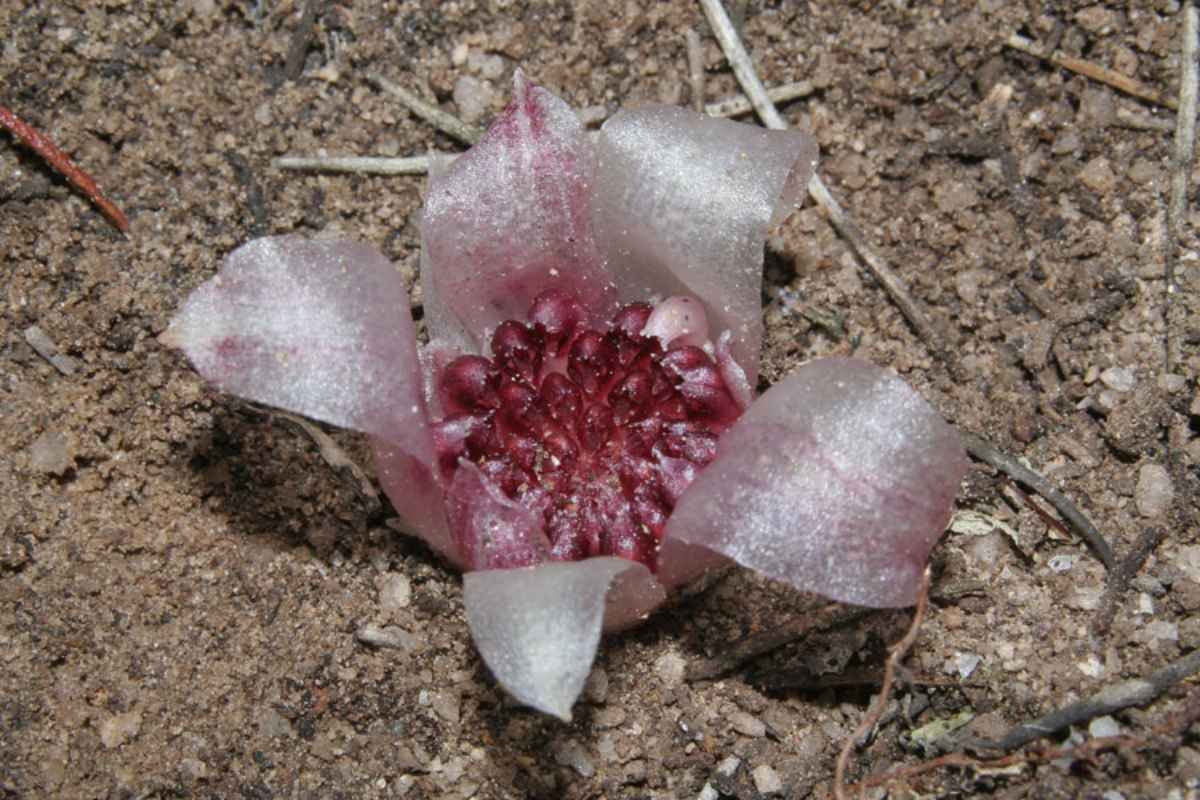
- Scientific Name: Rhizanthella gardneri
- Appearance: Unlike nearly all other plants, this orchid produces no leaves or green parts and lives its entire life completely underground. The flowers are small, reddish-cream, and clustered into an inflorescence (flower head) about 2 inches in diameter, resembling a small mushroom cap.
- Blooming Behavior: Flowers from May to July, but remains below the surface. Its scent, described as yeasty, is believed to attract its subterranean pollinators.
- Why it’s Rare: It is entirely non-photosynthetic (it cannot make its own food) and is obligately dependent on a specific fungus (Rhizoctonia) that is attached to the roots of a specific host shrub (Melaleuca uncinata). The destruction of its dry mallee scrub habitat and the complex symbiotic relationship make it extremely difficult to locate and protect.
- IUCN Status: Endangered (EN).
This is one of the most bizarre and Most Rare Flowers in the World, as it spends its entire life cycle underground in Western Australia. It has no green leaves and relies entirely on a specific fungus for nutrition. Its rarity is compounded by the difficulty of locating and studying it.
28. Himalayan Blue Poppy
- Scientific Name: Meconopsis betonicifolia (or other rare Meconopsis species like M. bhutanica)
- Appearance: Famous for the ethereal, vibrant, and sky-blue to mauve petals, often with a contrasting golden-yellow center.
- Blooming Behavior: Blooms in the summer in high-altitude meadows.
- Why it’s Rare: It is difficult to grow and maintain outside its native high-altitude habitat. Wild populations are increasingly threatened by over-collection for ornamental and medicinal purposes.
- IUCN Status: Varies by species. M. bhutanica is listed as Critically Endangered (CR).
Coveted for its stunning, ethereal, sky-blue color, this poppy is difficult to cultivate outside its cold, high-altitude native environment. Wild populations face threats from over-collection and climate change in the Himalayan regions.
29. Hawaiian Silversword
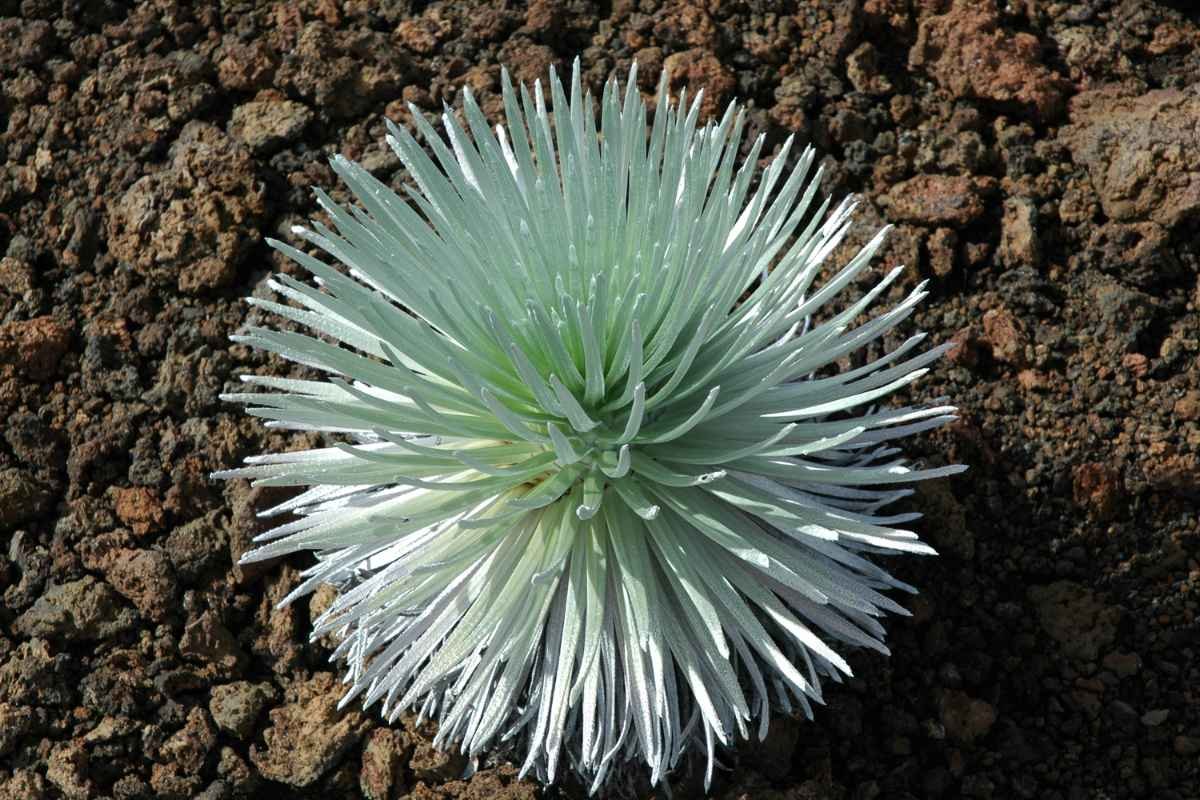
- Scientific Name: Argyroxiphium sandwicense
- Appearance: A rosette of stiff, dagger-like leaves covered in shimmering, silvery hairs. When it blooms (after decades), it sends up a dramatic spike covered in hundreds of dark reddish-purple flower heads.
- Blooming Behavior: Monocarpic. It blooms only once after 10–50 years and then dies.
- Why it’s Rare: It grows only on the high-altitude, barren volcanic slopes of Haleakalā volcano in Hawaiʻi and is sensitive to human disturbance and climate change.
- IUCN Status: Endangered (EN).
This plant grows only on the high-altitude volcanic slopes of Haleakalā in Hawaiʻi. It is famous for its rosette of dagger-like leaves covered in shimmering silver hairs. It blooms spectacularly only once after decades and then dies.
30. Night-Blooming Cereus
- Scientific Name: Peniocereus greggii
- Appearance: A spindly, inconspicuous desert cactus that looks like dry sticks for most of the year. It produces a massive, fragrant, pure white flower up to 8 inches wide.
- Blooming Behavior: Blooms for a single night in the summer, with the flower closing and dying by sunrise.
- Why it’s Rare: Its extreme nocturnal blooming behavior makes the flower itself rarely seen by humans, and its habitat in the arid Southwest is fragile.
- IUCN Status: Least Concern (LC), but locally rare and protected due to its unique ecology.
This desert cactus is inconspicuous, resembling a few dry sticks for most of the year. Its flower is rarely seen because it blooms for a single summer night before wilting at sunrise. It is widespread but locally rare throughout the arid US Southwest and Mexico. This is one of the Most Rare Flowers in the World.
Conservation and Scientific Importance:
Many of the Most Rare Flowers in the World are critically endangered. Conservation science plays a major role in their survival.
| Flower Name | Main Danger (Threats) | How We Save It (Conservation Method) | Who is Helping (Organizations) |
| 1. Middlemist’s Red Camellia | Extinct in the wild. | Growing it safely in gardens and greenhouses. | Kew Gardens (UK) and local botanic groups. |
| 2. Ghost Orchid | Poachers and swamps are being drained. | Protecting its swamp habitat and growing new plants in labs. | U.S. Fish & Wildlife Service, National Park Service. |
| 3. Franklin Tree Flower | Extinct in the wild for 200 years. | Keeping trees alive in gardens and maintaining seed banks. | USDA, U.S. Botanic Garden. |
| 4. Chocolate Cosmos | Extinct in the wild, plants can’t make seeds. | Keeping the one surviving plant clone alive by careful cuttings. | Botanical Gardens worldwide. |
| 5. Corpse Flower | The rainforests where it lives are being cut down. | Protecting its Sumatra habitat and growing it in many major gardens. | Botanical Gardens Conservation Int’l (BGCI). |
| 6. Rafflesia arnoldii | Logging destroys the specific vine it must live in. | Protecting the rainforest and involving local people in tourism. | Indonesian Government Agencies. |
| 7. Jade Vine | Philippine rainforests are being destroyed. | Protecting its specific habitat and growing new plants from cuttings. | Philippines Department of Environment. |
| 8. Kadupul Flower | Habitat fragmentation (less of its natural forest). | Local protection, as it is widely grown elsewhere. | Local Sri Lankan protection groups. |
| 9. Gibraltar Campion | Thought extinct, lives only on a few cliffs. | Growing it in greenhouses and replanting it on the protected cliffs. | Gibraltar Botanic Gardens. |
| 10. Parrot’s Beak | Extinct in the wild, lost its natural pollinator bird. | Growing it in gardens and helping it reproduce manually. | Canary Islands Botanic Gardens. |
| 11. Rothschild’s Slipper Orchid | Illegal poachers steal it from the mountain. | Growing huge numbers in labs to make the wild ones less valuable. | Sarawak Forestry (Malaysia), CITES. |
| 12. Lady’s Slipper Orchid | Poaching and destruction of the forest floors. | Legal protection and careful management of its woodland homes. | Natural England, U.S. Forest Service. |
| 13. Hawaiian Cabbage (B. insignis) | Its pollinator moth is extinct; grazing animals eat it. | Botanists climb cliffs to pollinate it by hand, building fences. | Center for Plant Conservation, USFWS. |
| 14. Youtan Poluo | Not a real plant. | N/A | N/A |
| 15. Attenborough’s Pitcher Plant | Poachers steal it from mountain peaks. | Protecting its remote mountain habitat and enforcing strict laws against stealing. | IUCN Carnivorous Plant Group. |
| 16. Black Bat Flower | Wild plants are taken for medicine. | Encouraging people to grow it in farms instead of taking it from the wild. | N/A (Focus on commercial growth). |
| 17. Blue Puya | Goats and cattle eat it on mountain slopes. | Fencing off areas and collecting seeds for safety. | Chilean National Forest Corporation. |
| 18. Flame Lily | People dig up the roots for traditional medicine. | Setting up sustainable harvesting rules to protect wild stocks. | Local Forestry Departments in Africa/Asia. |
| 19. Fire Lily | Coastal building destroys its land; invasive plants choke it. | Removing invasive plants and restoring its fire-prone coastal habitat. | South African National Biodiversity Institute. |
| 20. White Egret Orchid | Marshes and wetlands are being drained for development. | Protecting the wetlands and growing new plants in safe nurseries. | Local Environmental Agencies (East Asia). |
| 21. Cooke’s Koki’o | Extinct in the wild, only one type survives. | Grafting the single remaining type onto related plants to save it. | Center for Plant Conservation, Arboretums. |
| 22. Arizona Agave | Lives only in two small mountain areas. | Protecting its small patches of desert habitat and guarding the seeds. | USFWS, Bat Conservation groups. |
| 23. Shenzhen Nongke Orchid | Not a natural plant (created in a lab). | N/A | Shenzhen Nongke University. |
| 24. Juliet Rose | Not a natural plant (commercial creation). | N/A | David Austin Roses Ltd. |
| 25. Assam Catkin Yew | Illegal logging is cutting down its forest habitat. | Protecting its forest home and collecting seeds for future use. | Indian Forest Service. |
| 26. Hawaiian White Hibiscus | Feral pigs and goats eat it. | Building strong fences to keep out grazing animals and replanting new stock. | Hawaiʻi DLNR, USFWS. |
| 27. Western Underground Orchid | Relies on one specific fungus and a specific host shrub. | Protecting the host shrub habitat where the fungus grows. | Australian Government, Australian Orchid Foundation. |
| 28. Himalayan Blue Poppy | People collect it too often; the climate is changing. | Giving it legal protection and storing its seeds in seed banks. | Royal Botanic Garden Edinburgh (RBGE). |
| 29. Hawaiian Silversword | Introduced animals eat it; very limited genetic base. | Building fences in the volcano habitat and manually crossing plants. | Haleakalā National Park Service. |
| 30. Night-Blooming Cereus | Desert land is being developed. | Protecting its land in desert preserves and parks. | Local land management groups. |
Scientific Breakthroughs for Rare Flowers:
Modern science is fighting plant extinction with powerful techniques. These breakthroughs offer hope for the Most Rare Flowers in the World:
- Cloning Rare Orchid Species: Using tissue culture (micropropagation) to rapidly grow thousands of genetically identical copies from tiny pieces of stem or seed.
- Cryopreservation: Storing seeds, pollen, or embryonic material in liquid nitrogen (at -196 ° C for centuries, creating a genetic backup.
- Botanical DNA Mapping: Sequencing the genomes of rare plants to understand their specific environmental needs and the genetic diversity required for long-term survival.
Why These Flowers Matter in Today’s World?
Saving the Most Rare Flowers in the World is vital for our planet. They safeguard genetic diversity, offering untapped potential for new medicines and pharmaceuticals. It is a crucial benefit to humanity. Ecologically, they maintain biodiversity balance, supporting unique pollinators and fragile ecosystems.
Governments and botanical institutions track these species through global programs like the IUCN Red List and conservation networks, ensuring their protection. These stunning rarities also fuel sustainable ecotourism and research, justifying ongoing preservation efforts.
Conclusion
The Most Rare Flowers in the World reminds us just how fragile and extraordinary nature can be. These flowers show that rarity is frequently a tale of survival against all odds. Whether they are concealed on isolated cliffs, buried underground, or blooming for just one night. It is more important than ever to preserve these botanical treasures. As habitat loss and climate change worsen. By understanding their origins, limitations, and astonishing adaptations. We can appreciate their beauty and recognize our responsibility to ensure these wonders continue to exist for generations to come.
FAQ:
1. Are any of these rare flowers extinct in the wild?
Yes. The Franklin Tree, Flower, and Chocolate Cosmos are officially extinct in the wild. They survive only through cultivation in botanical gardens and conservation centers, supported by seed banking and cloning efforts.
2. How do scientists protect these rare species?
Researchers use cloning, micropropagation, cryopreservation, habitat restoration, and DNA mapping to preserve species. Organizations like Kew Gardens, IUCN, WWF, and national botanical institutions lead global conservation programs.
3. Why are some rare flowers so expensive?
Flowers like the Juliet Rose or Shenzhen Nongke Orchid are costly because they took years of genetic research, controlled breeding, and experimental cultivation to create. Their scarcity, labor-intensive production, and auction exclusivity drive prices into the thousands or even millions.