
You’ve probably walked past those glossy, caramel-colored fruits at your grocery store and wondered: Are Medjool dates actually that good for you? The short answer is yes, and the science backs it up hard.
Medjool dates have quietly become one of the most nutrient-dense whole foods on the planet, eaten for centuries across the Middle East. Because of the benefits of medjool dates, they are now making waves in sports nutrition, clean eating, and even prenatal health circles.
Here’s the thing most people miss. These aren’t just “natural candy.” A single pitted Medjool date delivers 167 mg of potassium, 1.6 grams of fiber, and a lineup of antioxidants that rival blueberries. That’s serious nutrition packed into roughly 66 calories. Whether you want to ditch refined sugar, fuel a workout, or support your heart, Medjool dates offer a compelling case. Let’s break them down one by one with real data, no fluff.
What makes medjool dates nutritionally exceptional?
Before diving into specific benefits, you need to understand what you’re actually eating. Medjool dates come from the Phoenix dactylifera date palm, originally native to Morocco and now widely grown in California’s Coachella Valley, the Middle East, and South Asia. Unlike most dried fruits, Medjool dates are sold and eaten fresh.
Per 100g serving (about 4–5 dates), the USDA reports the following nutritional profile:
| Nutrient | Amount per 100g | % Daily Value |
| Calories | 277 kcal | — |
| Carbohydrates | 75 g | 27% |
| Dietary Fiber | 7 g | 25% |
| Natural Sugars | 66 g | — |
| Potassium | 696 mg | 15% |
| Copper | 0.36 mg | 40% |
| Magnesium | 54 mg | 13% |
| Vitamin B6 | 0.25 mg | 15% |
| Manganese | 0.30 mg | 13% |
| Iron | 0.90 mg | 5% |
That 40% daily copper in one serving is genuinely impressive. Copper supports red blood cell formation and iron absorption (two things most people never think to track). The combo of potassium, magnesium, and B6 also makes Medjool dates stand apart from other fruit snacks.
Are the benefits of medjool dates actually backed by science?
Yes, and the research pool keeps growing. Healthline’s medically reviewed guide, updated in June 2025, notes that Medjool dates contain three major antioxidant classes: carotenoids, flavonoids, and phenolic acids. Each plays a distinct role in fighting oxidative stress, the root driver behind aging, cardiovascular disease, and neurodegeneration.
A 2024 systematic review found that regular date consumption may lower total cholesterol and triglycerides while improving HDL (good) cholesterol levels. A follow-up study in 2025 confirmed the total cholesterol reduction. Results on LDL vary across studies, so more research is ongoing, but the cardiovascular direction is positive.
Researchers at the NIH found that Medjool date seeds contain up to 13.7 mg GAE/100g of polyphenols, placing them firmly among the highest-antioxidant dried fruits tested (above figs and plums in polyphenol concentration). That antioxidant density is the foundation for most of what follows.
7 core benefits of medjool dates you should know about
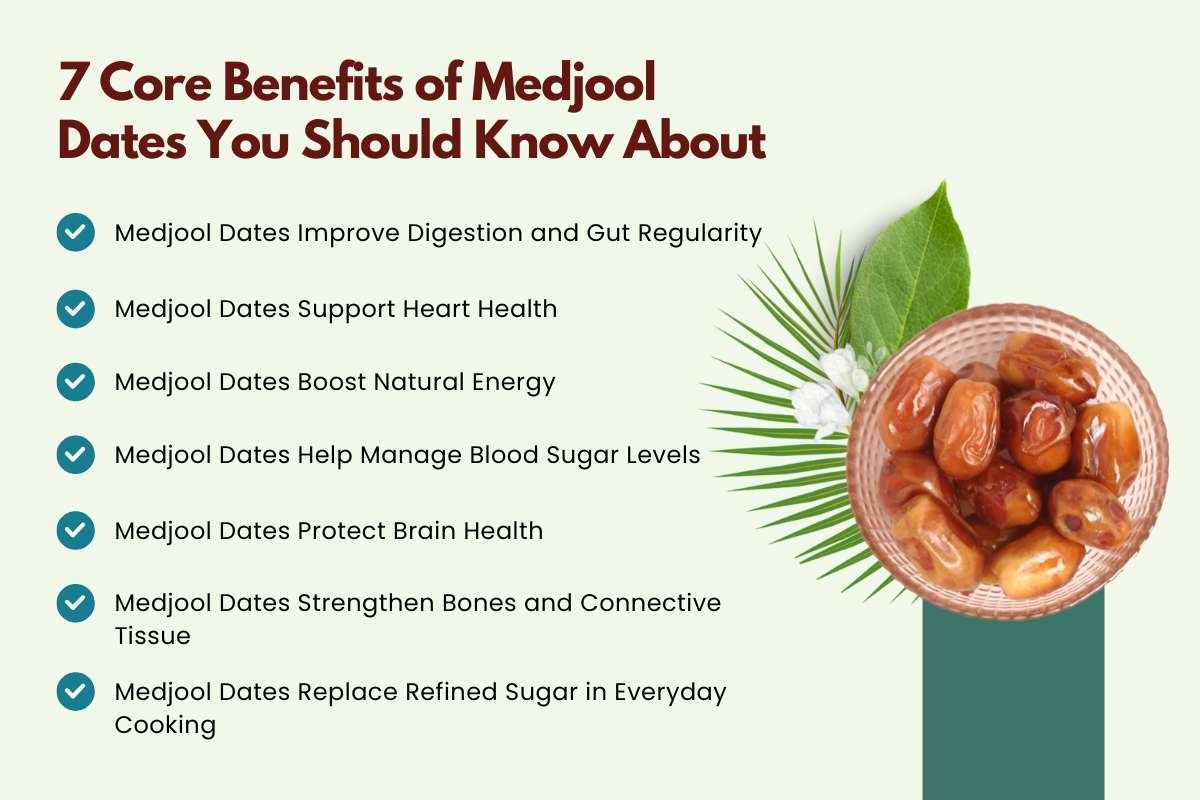
Benefit #1: Medjool dates improve digestion and gut regularity
They genuinely do. Fiber is the engine behind healthy gut function, and Medjool dates deliver about 7 grams per 100g (roughly 25% of your daily target in one snack). The fiber is predominantly insoluble, which bulks up stool and keeps bowel movements regular.
In a 3-week clinical study, 21 participants ate 7 dates (50g) daily. Their bowel movement frequency improved significantly compared to periods when they skipped dates entirely. The soluble fiber fraction also acts as a prebiotic, feeding beneficial gut bacteria and supporting a healthier microbiome. If you deal with occasional constipation, two to three Medjool dates daily is one of the simplest dietary upgrades you can make.
Benefit #2: Medjool dates support heart health
The answer is a cautious yes, and the mechanisms are well understood. Potassium is the star here. One 100g serving provides about 15% of your daily potassium needs, which directly supports blood pressure regulation and muscle function, including the heart. Gram for gram, Medjool dates actually contain more potassium than bananas.
The antioxidants, specifically carotenoids and phenolic acids, help prevent LDL cholesterol from oxidizing. Oxidized LDL is what actually builds plaques in arteries, so stopping that process upstream matters. The 2024 cholesterol study showing improved HDL and lower triglycerides adds further weight to the cardiovascular argument. Magnesium also contributes: it relaxes blood vessel walls and supports a steady heart rhythm. When it comes to the benefits of medjool dates for heart patients, it is important to know.
Benefit #3: Medjool dates boost natural energy
Think of each date as a precision fuel packet. The carbohydrates in Medjool dates are almost entirely natural sugars, which your body converts to ATP (cellular energy) quickly and efficiently. That’s why endurance athletes have snacked on dates for generations.
But here’s what separates them from a candy bar: the fiber slows glucose absorption, preventing the sharp crash that comes after refined sugar. One Medjool date provides over 1.5g of fiber that moderates how fast the 16g of natural sugar enters your bloodstream. The potassium further helps prevent muscle cramps during physical exertion. Two dates, 30 minutes before a workout, is a simple and clean pre-training strategy.
Benefit #4: Medjool dates help manage blood sugar levels
This surprises most people. Despite being 66% sugar by weight, Medjool dates have a glycemic index (GI) of approximately 40–55, which sits firmly in the low-to-moderate range. A clinical trial specifically measuring the GI of Medjool dates landed at around 55 (lower than white bread, white rice, or most energy bars).
A small study in people with type 2 diabetes found no significant blood sugar spike even after consuming 7–10 dates in one sitting. The fiber and phenolic compounds appear to improve insulin sensitivity, blunting the glycemic response you’d expect from high-sugar food. That said, portion control still matters: two to four dates per sitting is the evidence-based sweet spot.
Benefit #5: Medjool dates protect brain health
The benefits of medjool dates also include protection of brain health. Emerging research points in a fascinating direction. The flavonoids in Medjool dates cross the blood-brain barrier and reduce neuroinflammation, a key driver behind Alzheimer’s disease and cognitive decline. Animal studies have shown that mice fed date-mixed diets showed significantly better memory, learning ability, and reduced anxiety compared to control groups.
Dates have also been studied for their potential to reduce the activity of amyloid beta proteins, the molecules that form the brain plaques associated with Alzheimer’s. Vitamin B6 in Medjool dates supports neurotransmitter production, the chemical signaling that underlies mood, focus, and memory. Human trials are still catching up, but the mechanistic case for regular date consumption supporting long-term brain health is genuinely compelling.
Benefit #6: Medjool dates strengthen bones and connective tissue
Often overlooked, the mineral profile of Medjool directly supports skeletal health. Copper (40% DV per 100g), magnesium (13% DV), and manganese (13% DV) all contribute to bone formation and density. Copper specifically helps the body synthesize collagen, the structural protein in bones and connective tissue.
Magnesium plays a dual role: it aids calcium absorption and regulates the hormones that govern bone remodeling. For people at risk of osteoporosis or those who don’t consume enough dairy, adding Medjool dates as a mineral-dense snack is a practical, tasty intervention. The calcium content per date is modest (15mg), but the co-nutrients that help your body use calcium are abundant.
Benefit #7: Medjool dates replace refined sugar in everyday cooking
Absolutely, and this is where the benefits of Medjool dates become most practical for everyday eating. Blend pitted dates with a small amount of water, and you get date paste, a 1:1 substitute for refined sugar in baking, sauces, smoothies, and energy balls. The swap brings fiber, minerals, and antioxidants into recipes that would otherwise deliver nothing but empty calories.
Date paste works in everything from oatmeal cookies to homemade barbecue sauce. Unlike honey or maple syrup, which are liquid and add moisture unpredictably, date paste behaves more like brown sugar in texture-sensitive recipes. One cup of date paste delivers roughly the same sweetness as one cup of granulated sugar but with dramatically better nutritional credentials.
Medjool dates vs. Other natural sweeteners: how do they compare?
| Sweetener | GI Score | Fiber per tbsp | Key Minerals | Antioxidants |
| Medjool Date Paste | 40–55 | ~1.5g | Potassium, Copper, Magnesium | High (flavonoids, phenolics) |
| Honey | 58–60 | 0g | Trace | Moderate |
| Maple Syrup | 54–65 | 0g | Manganese | Low |
| Refined White Sugar | 65–68 | 0g | None | None |
| Agave Nectar | 15–30 | 0g | Trace | Low |
Medjool dates win on fiber and micronutrients by a wide margin. The GI advantage over refined sugar is real, and the antioxidant payload is something no other common sweetener comes close to matching.
A bonus benefit: medjool dates in late pregnancy
Among the benefits of medjool dates, this is worth flagging separately because it has direct clinical interest. Compounds in Medjool dates may help prepare the cervix for labor and support spontaneous uterine contractions. A clinical trial currently registered on ClinicalTrials.gov (NCT07058792) is actively studying women who eat three Medjool dates daily from 34 weeks of pregnancy through delivery, tracking effects on spontaneous labor onset and labor duration.
Earlier, smaller studies found promising trends in cervical dilation rates among women who consumed dates in their final month of pregnancy. A 2022 review published in the Complementary Medicine Journal of Faculty of Nursing and Midwifery found that dates support contractile and cervical muscle function in late pregnancy. Always consult your OB before making dietary changes during pregnancy.
How many medjool dates should you eat per day?

The research consistently points to 2–4 dates daily as the optimal range for most adults. That delivers roughly 130–270 calories, 3–7g of fiber, and a meaningful dose of potassium and antioxidants without pushing sugar intake to problematic levels.
Athletes or highly active people can lean toward the higher end, especially around training. People managing blood sugar should start with two dates and monitor their individual response. Pair dates with a protein source (almonds, Greek yogurt, or nut butter) to further slow glucose absorption and extend satiety. Store Medjool dates in an airtight container; they keep for weeks at room temperature or months in the fridge.
The bottom line
The evidence is clear and growing. The benefits of Medjool dates are not hype; they’re grounded in USDA nutritional data, 2024–2025 clinical studies, and decades of traditional use backed by modern biochemistry. From the gut to the heart to the brain, these caramel-sweet fruits deliver a nutrient payload that few whole foods can match.
Start simple: swap your afternoon sugar snack for two Medjool dates with a small handful of almonds. Do that consistently for two weeks and notice how your energy levels, digestion, and sugar cravings shift. Then explore using date paste in your baking and smoothies to cut refined sugar entirely.
FAQs
1. Are Medjool dates healthier than regular dates?
Medjool dates are larger and sold fresh, delivering more nutrients per bite than dried varieties. The benefits of medjool dates make them healthier than regular dates.
2. Can eating Medjool dates help with weight loss?
Yes. 7g of fiber per 100g promotes satiety and curbs cravings, but portion control matters. Stick to two to three dates per sitting.
3. Are Medjool dates safe for people with diabetes?
Their low GI (40–55) and fiber make them viable in moderation, but individual responses vary. Always check with your healthcare provider.
4. What do Medjool dates taste like?
Rich, caramel-like, and fudgy (closer to toffee than fruit), making them a natural go-to for satisfying sweet cravings without processed sugar.
5. When is the best time to eat Medjool dates?
Pre-workout for quick energy, mid-afternoon as a stable snack, or after dinner as a clean dessert. Timing helps you get the maximum benefits of medjool dates.
Sources: