Many people picture depression as constant crying. Yet clinical depression often looks like irritability, exhaustion, numbness, or trouble concentrating. The WHO estimates 322 million people live with depression worldwide, and many go unrecognized. Persistent sadness is only one sign. The DSM-5-TR also counts loss of interest as a core symptom, and diagnosis hinges on symptoms lasting at least two weeks and disrupting daily functioning.
This guide explains how clinical depression is medically defined, which subtler symptoms matter, and how it differs from ordinary low mood, so you can spot it sooner.
Table of Contents
What Is Clinical Depression and How Is It Different From Sadness?
Sadness is a normal emotion. It often eases as circumstances change, though it can also arrive without a clear cause. Depressive symptoms, such as low mood, poor sleep, or fatigue, are broader and can appear with stress, grief, or illness.
A major depressive episode is more specific. It means several symptoms are present most of the day, nearly every day, for at least two weeks. Clinical depression is the everyday term for major depressive disorder (MDD).
A clinician assesses duration, severity, distress, and how much daily functioning is affected. Someone with it may not look sad at all. They may seem irritable, numb, exhausted, or simply uninterested in things they once enjoyed. An episode is a period of symptoms, while MDD is the diagnosis made after a clinician considers other explanations.
| Feature | Everyday sadness | Major depressive episode |
| Trigger | Often linked to an identifiable event | May follow a stressor or occur without an obvious trigger |
| Course | Often eases over time or as circumstances change | Symptoms persist for at least two weeks under diagnostic criteria |
| Interest and pleasure | May remain intact | Often substantially reduced |
| Daily functioning | May be temporarily affected | May be significantly impaired |
| Clinical assessment | Depends on the broader context | Needed to assess diagnostic criteria and alternative explanations |
What Are the Symptoms and Diagnostic Criteria for Clinical Depression?

No one has every symptom, and the mix differs from person to person. Because symptoms show up in sleep, thinking, and relationships, it is judged by how it affects daily life, not by mood alone.
Emotional, cognitive, and physical symptoms
- Emotional: persistent low mood, emptiness, hopelessness, irritability, excessive guilt
- Cognitive: poor concentration, indecision, negative thinking, rumination
- Physical and behavioral: fatigue, sleep or appetite changes, slowed or restless movement, withdrawal, loss of interest
Physical symptoms should not be described as proof of depression. They can also occur with other health conditions.
| Area of life | How it may show up |
| Sleep | Insomnia, early waking, or sleeping too much |
| Decision-making | Simple choices feel overwhelming |
| Relationships | Pulling away, irritability, less contact |
| Work | Trouble focusing, missed deadlines |
| Self-care | Skipped meals, neglected hygiene or appointments |
What the DSM-5-TR criteria require
Diagnostic criteria in brief
- Five or more of nine listed symptoms occur within the same two-week window
- Either low mood or a loss of interest or pleasure is among them
- The symptoms mark a clear shift from how the person normally functions
- They cause significant distress or interfere with daily life
- They are not better explained by substance use, a medical condition, or another mood disorder, such as bipolar disorder
Also, add a disclaimer directly below the criteria:
“This summary is intended for educational purposes. Meeting some of these symptoms does not automatically mean someone has MDD. Only a qualified healthcare professional can make a diagnosis after a comprehensive assessment.”
Why symptom counts do not tell the whole story
Depression does not always look visibly severe from the outside. However, the severity and impact on daily life matter as much as the number of symptoms. Screening questionnaires can support an assessment but cannot diagnose on their own. Thoughts of suicide need prompt attention no matter how many symptoms are present. In the US, call or text 988; elsewhere, contact local emergency services.
What Happens in the Brain During Clinical Depression?

Clinical depression is associated with changes across interconnected brain systems, not one single “depression center.” Research links differences in mood regulation, reward, attention, motivation, and cognitive-control circuits to symptoms, but these are associations and patterns, not proof that a particular brain change causes depression in every person.
Brain circuits involved in mood and motivation
Mood relies on networks that work together. Emotion-processing regions such as the amygdala, reward circuits, attention networks, and the prefrontal cortex, which handles cognitive control, all interact. In clinically diagnosed depression, imaging studies often find differences in how these networks communicate. These are associations seen in groups of people. They do not prove what causes depression in any one person.
Neurotransmitters, stress and the body’s response
Serotonin, norepinephrine, and dopamine help brain cells signal each other. But depression is not simply a “chemical imbalance.” Long-term stress can keep the body’s stress-response system active. It may affect mood and thinking. Sleep, circadian rhythms, and inflammation are still being studied, and their roles are not settled.
Neuroplasticity and depression
Neuroplasticity is the brain’s ability to reshape connections with experience. Researchers think changes in this flexibility may relate to symptoms and to how people respond to treatment, though the details are still being worked out.
| Brain process studied | May help explain | Caution |
| Reward processing | Loss of interest or pleasure | Not present in everyone |
| Attention and cognitive control | Poor concentration, rumination | Not one-to-one |
| Stress-response activity | Fatigue, sleep disruption | Still under research |
What Causes Clinical Depression and Who Is at Risk?
There is no single cause of clinical depression. It usually reflects an interaction among biological vulnerability, psychological patterns, and social or environmental pressures. Different factors can contribute to vulnerability, onset, and persistence.
Biological, psychological, and social influences
- Biological: A family history or inherited susceptibility may raise risk, and long-term physical illnesses, chronic pain, some medications, and substance use can also contribute.
- Psychological: Trauma, bereavement, major loss, low self-esteem, self-criticism, and rumination, repeatedly dwelling on problems, can increase vulnerability.
- Social: Social isolation, sleep disruption, financial strain, unemployment, relationship difficulties, and other ongoing pressures may compound risk.
Risk is not destiny
Risk factors do not determine whether someone develops MDD. Some people develop depression without an obvious precipitating event, while others experience major stress or trauma and do not develop the disorder.
Co-occurring conditions
Depression commonly occurs alongside anxiety disorders, PTSD, bipolar disorder, and substance-use disorders. These conditions can overlap in symptoms, complicate assessment, and shape treatment planning; for example, substance use may worsen mood symptoms or require integrated care.
What Are the Types and Specifiers of Clinical Depression?
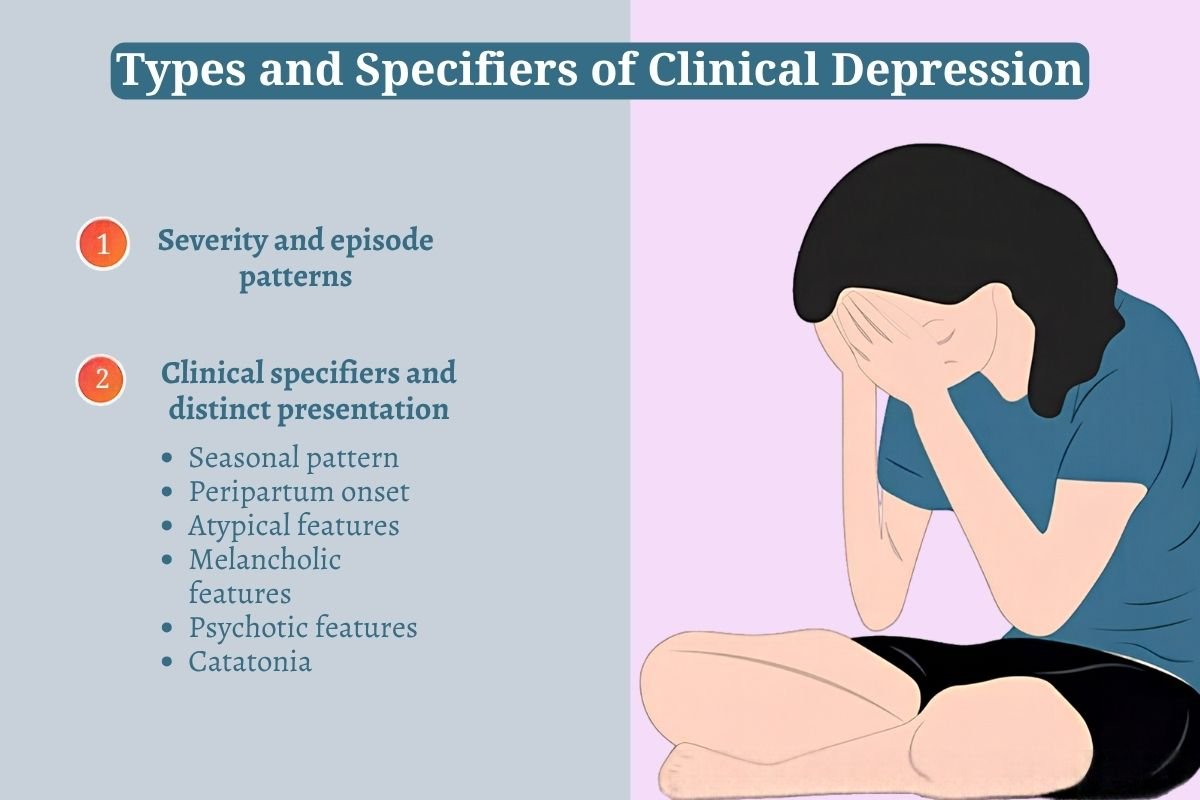
Severity and episode patterns
Clinicians describe depression by how strong it is and how often it returns. Severity is rated mild, moderate, or severe. They are based on the number of symptoms, how intense they are, and how much they affect daily life. A person may have a single episode or recurrent episodes. Between episodes, symptoms can fade partially or fully, which is called partial or full remission.
Clinical specifiers and distinct presentations
Specifiers add detail to a major depressive episode. They describe features of the current picture, not separate illnesses. Examples include:
- Seasonal pattern: episodes recur at a particular time of year
- Peripartum onset: begins during pregnancy or shortly after birth
- Atypical features: mood brightens in response to positive events, often with oversleeping or increased appetite
- Melancholic features: marked loss of pleasure, early waking, and symptoms worse in the morning
- Psychotic features: delusions or hallucinations
- Catatonia: marked changes in movement or responsiveness
Not every depressive condition is a subtype of MDD. It is the common term for MDD, but persistent depressive disorder is a separate diagnosis that involves milder, longer-lasting symptoms. Postpartum depression is usually diagnosed as MDD with peripartum onset. Bipolar depression is a depressive episode within bipolar disorder, and a history of mania or hypomania changes the diagnosis.
Why presentation matters for treatment
| Presentation | Defining clinical feature | Implications for assessment |
| Severe episode | Many intense symptoms, major impairment | Closer monitoring, including suicide risk |
| Recurrent episodes | Repeated episodes over time | Review of past episodes and relapse prevention |
| Psychotic features | Delusions or hallucinations | Prompt specialist assessment |
| Peripartum onset | Onset in pregnancy or after birth | Treatment choices must consider pregnancy and breastfeeding |
| Persistent depressive disorder | Low mood lasting at least two years | Different course and long-term planning |
| Bipolar depression | Depression with past mania or hypomania | Screen for bipolar disorder before treatment |
How Is Clinical Depression Treated in 2026?
Psychotherapy and behavioral interventions
Cognitive behavioral therapy (CBT), interpersonal therapy (IPT), and behavioral activation are well-supported options. Clinicians choose based on severity, patient preference, access, and co-occurring conditions. Milder cases often start with therapy alone.
Antidepressants and medication selection
SSRIs, SNRIs, and other antidepressants are widely used. Treatment of clinical depression is individualized, based on symptoms, past response, side effects, medical history, and interactions. Benefits usually take several weeks, so follow-up and side-effect checks matter. Never stop or change a dose without your prescriber.
What happens when the first treatment does not work?
A poor response calls for a structured review, not a conclusion that depression is untreatable. Clinicians check:
- The diagnosis and treatment goals
- Adherence, dose, duration, and tolerability
- Co-occurring conditions
Next steps may include switching medication, adding therapy, or augmentation. Persistent non-response may warrant specialist assessment for treatment-resistant depression.
Conclusion:
Clinical depression is more than sadness. It is a medical condition marked by symptoms that last at least two weeks and disrupt daily life, often appearing as irritability, exhaustion, or lost interest. Its causes are layered, its presentations vary, and treatment works best when it is monitored and adjusted over time. A poor first response is a reason to reassess, not to give up.
If any of this sounds familiar, consider talking to a doctor or mental health professional. If you have thoughts of suicide, call or text 988 in the US, or contact local emergency services elsewhere.
FAQ:
1. When should someone seek professional help for clinical depression?
Seek professional help when symptoms persist for two weeks, disrupt daily life, or become difficult to manage.
2. Can someone have depression without feeling sad?
Yes. Depression can cause irritability, emotional numbness, fatigue, or loss of interest without persistent sadness.
3. What causes clinical depression?
It can develop through a combination of genetic, biological, psychological, and environmental factors.
4. How is clinical depression diagnosed?
A healthcare professional evaluates symptoms, their duration, functional impact, medical history, and possible alternative explanations.
5. Can clinical depression return after treatment?
Yes, depressive episodes can recur, but ongoing care and relapse-prevention strategies may help reduce the risk.
Links and Sources:
- https://www.nimh.nih.gov/health/publications/depression
- https://www.nhs.uk/mental-health/conditions/depression-in-adults/symptoms
- https://my.clevelandclinic.org/health/diseases/9290-depression
- https://www.ncbi.nlm.nih.gov/books/NBK617010
- https://pmc.ncbi.nlm.nih.gov/articles/PMC2721780
- https://nj.gov/health/integratedhealth/publications-reports/miscl/MH_Fact_Sheets/NIMH_Depression.pdf
- https://www.nimh.nih.gov/health/publications/bipolar-disorder
- https://www.nice.org.uk/guidance/ng222/chapter/Recommendations