Growth is often seen as progress. In nature, metamorphosis is a rite of passage tadpoles become frogs, larvae become land-dwelling salamanders. But evolution doesn’t reward change for its own sake. It rewards survival.
In rare cases, survival means never growing up at all.
Across three continents and radically different environments, a small group of amphibians has broken one of biology’s most familiar rules. They never lose their larval features. They never trade gills for lungs. They never leave the water. Yet they live full, reproductive, and often remarkably long lives.
These amphibians that never grow up, the axolotl, the mudpuppy, and the olm, are not evolutionary mistakes. They are evolutionary specialists, perfectly tuned to their environments, and among the most scientifically valuable animals on Earth.
The Science of Neoteny: What Does “Never Growing Up” Actually Mean?
To understand these species, we need to understand neoteny.
Neoteny is a form of heterochrony, a change in the timing of developmental events. In neotenic animals, juvenile traits are retained into adulthood. This doesn’t mean development stops; it means it takes a different path.
In most amphibians:
- Thyroid hormones trigger metamorphosis
- Gills are absorbed
- Lungs develop
- The animal transitions to land
In neotenic amphibians:
- Thyroid hormone signaling is reduced or altered
- Larval traits persist
- Sexual maturity occurs without metamorphosis
An adult animal with a juvenile body plan is the end outcome. Some of the most amazing amphibians that never mature are described by this method.
Comparison Table: How Amphibians That Never Grow Up Differ
Despite being amphibians that never mature, axolotls, mudpuppies, and olms have very different habitats and ways of living. A side-by-side comparison demonstrates how neoteny, the same biological characteristic, influences survival in underground caverns, rivers, and canals.
| Feature | Axolotl | Mudpuppy | Olm |
| Scientific Name | Ambystoma mexicanum | Necturus maculosus | Proteus anguinus |
| Native Region | Mexico (Xochimilco) | North America | Europe (Dinaric Alps) |
| Habitat | Freshwater canals | Rivers & lakes | Underground caves |
| Metamorphosis | Rare, induced only | Never | Never |
| Lifespan | 10–15 years | Up to 20 years | Up to 100 years |
| Regeneration | Extremely advanced | Advanced | Moderate |
| Vision | Functional | Functional | Absent |
| Conservation Status | Critically Endangered | Least Concern–Declining | Vulnerable |
The comparison shows that neoteny is a flexible survival strategy, not a limitation. From rapid regeneration to extreme longevity, these amphibians that never grow up prove that staying juvenile can be evolution’s smartest move.
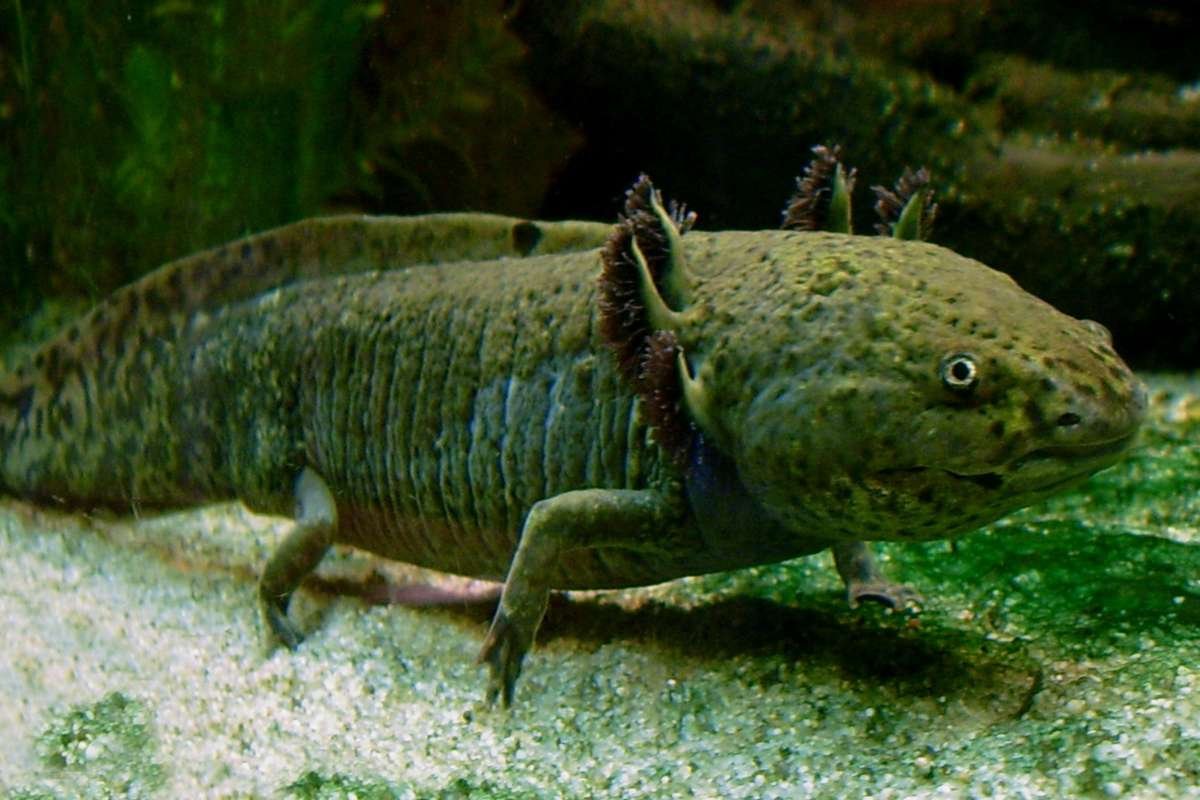
Axolotl (Ambystoma mexicanum): The Regeneration Icon
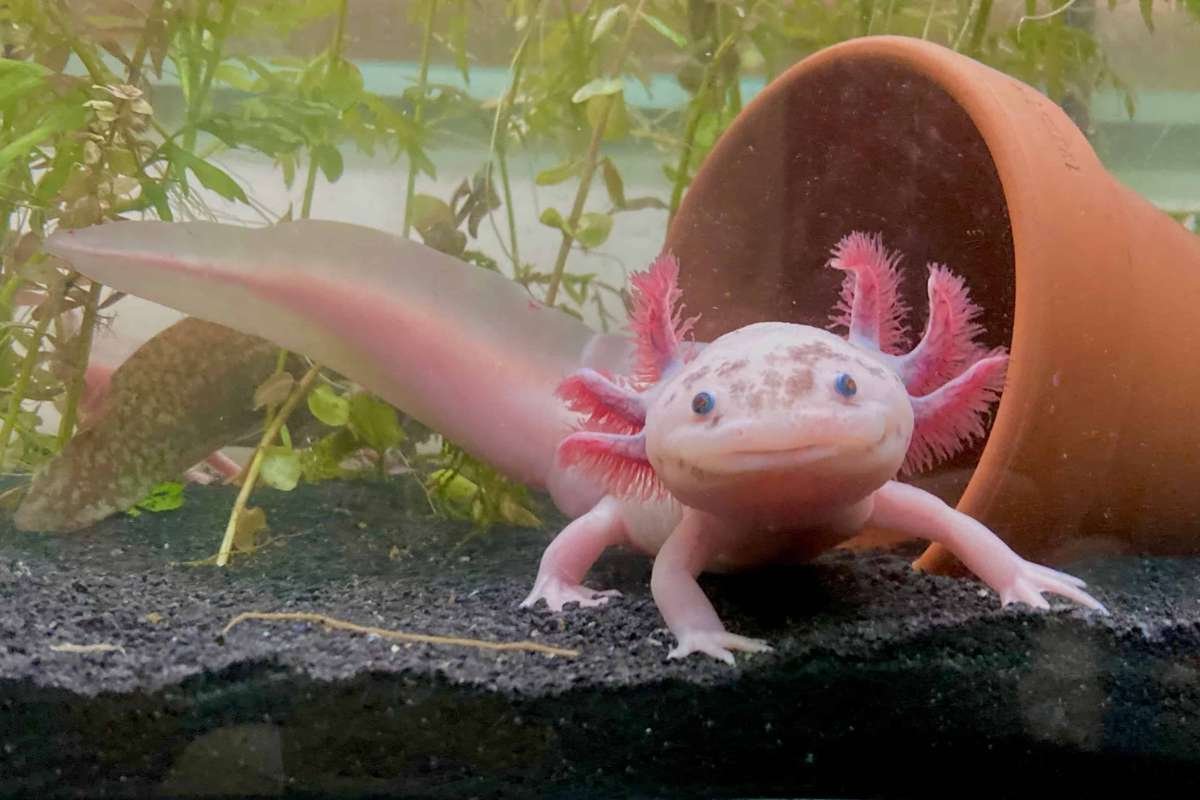
The axolotl looks almost fictional. Floating gently through water, its feathery external gills wave like underwater coral, while its wide head and upturned mouth give it a permanently calm expression.
Native exclusively to the Xochimilco canal system near Mexico City, axolotls are one of the most geographically restricted vertebrates on the planet.
A Life Frozen in Larval Form
Axolotls retain:
- External gills
- Finned tails
- Fully aquatic respiration
Despite this, they reach sexual maturity at around 12–18 months and can live 10–15 years in captivity.
Unlike other salamanders, axolotls do not naturally respond to thyroid hormones that trigger metamorphosis. Scientists can force transformation in labs, but the process drastically reduces lifespan and increases mortality.
Regeneration Beyond Imagination
Axolotls can regenerate:
- Entire limbs
- Spinal cord segments
- Jaw tissue
- Cardiac muscle
- Portions of the brain
What makes this extraordinary is how they regenerate. The regrown tissue is:
- Fully functional
- Scar-free
- Structurally identical to the original
Even after repeated injuries, regeneration remains precise. This places axolotls at the center of regenerative medicine research.
- Genetic Marvel: The axolotl genome contains approximately 32 billion base pairs, making it one of the largest genomes ever sequenced, nearly 10 times larger than the human genome. This genetic complexity is believed to play a role in their regenerative abilities.
- Critically Endangered: Wild axolotl populations have declined by more than 90% since the 1990s due to:
- Urban pollution
- Wetland drainage
- Invasive species such as tilapia and carp
They are listed as Critically Endangered by the IUCN, making them one of the most threatened amphibians that never grow up.
Read Next: Top 8 Most Poisonous Caterpillars in the World: Deadly Species You Must Avoid
Mudpuppy (Necturus maculosus): The Permanent Larva of North America
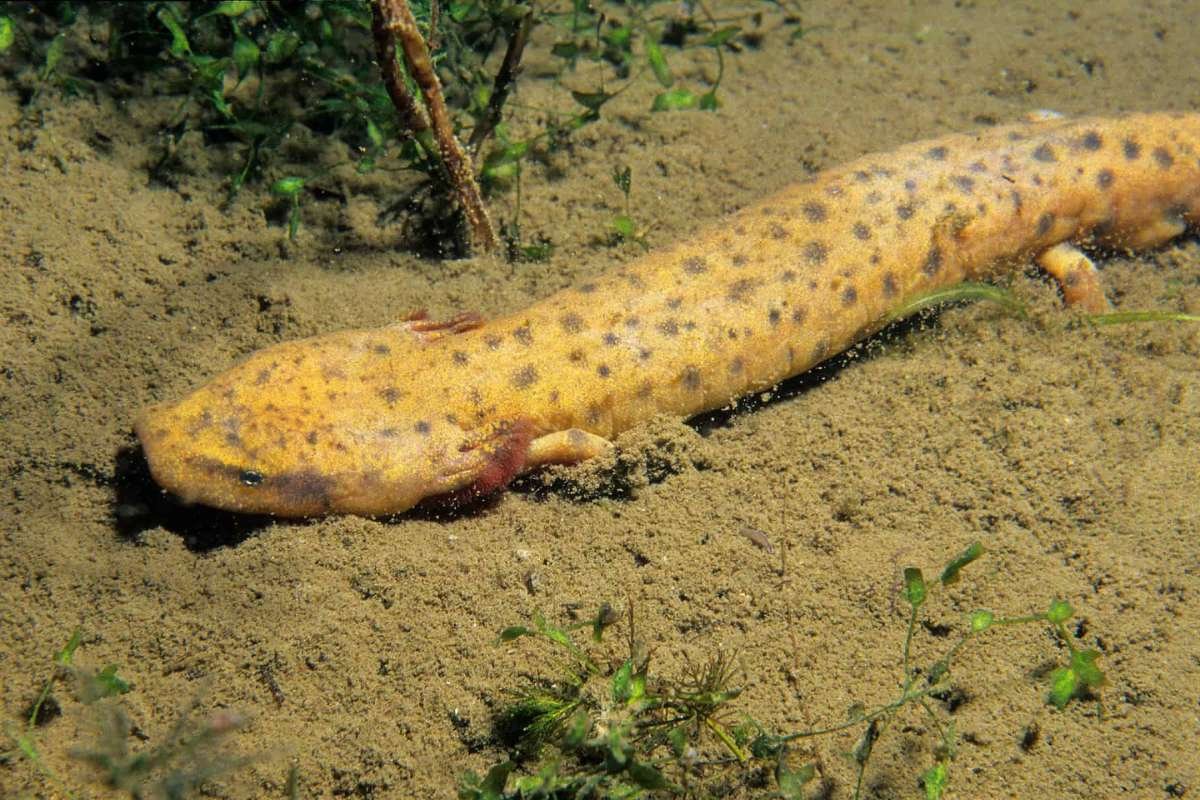
Less famous but equally fascinating, the mudpuppy inhabits freshwater systems across eastern and central North America, from southern Canada to the Gulf Coast.
At first glance, mudpuppies look like oversized larvae, and that’s because they are.
- Obligate Neoteny: Mudpuppies are obligate neotenes, meaning metamorphosis never occurs naturally, not experimentally.
They retain:
- Bushy red external gills
- Laterally compressed tails
- Fully aquatic behavior for life
Adults typically measure 20–49 cm in length and can live up to 20 years, making them among the longest-lived salamanders in North America.
Triple Respiration System
Mudpuppies breathe through:
- External gills
- Skin (cutaneous respiration)
- Primitive lungs
This allows them to survive in cold, low-oxygen water where other amphibians struggle.
Ecological Role
As nocturnal predators, mudpuppies feed on:
- Crayfish
- Aquatic insects
- Snails
- Fish eggs
They help regulate invertebrate populations and contribute to healthy freshwater ecosystems.
Environmental Sentinels
Mudpuppies are highly sensitive to pollution and habitat disruption. Declines in their populations often signal:
- Chemical contamination
- Oxygen depletion
- Ecosystem imbalance
Among amphibians that never grow up, mudpuppies serve as early warning systems for freshwater health.
Olm (Proteus anguinus): The Cave-Dwelling Time Capsule
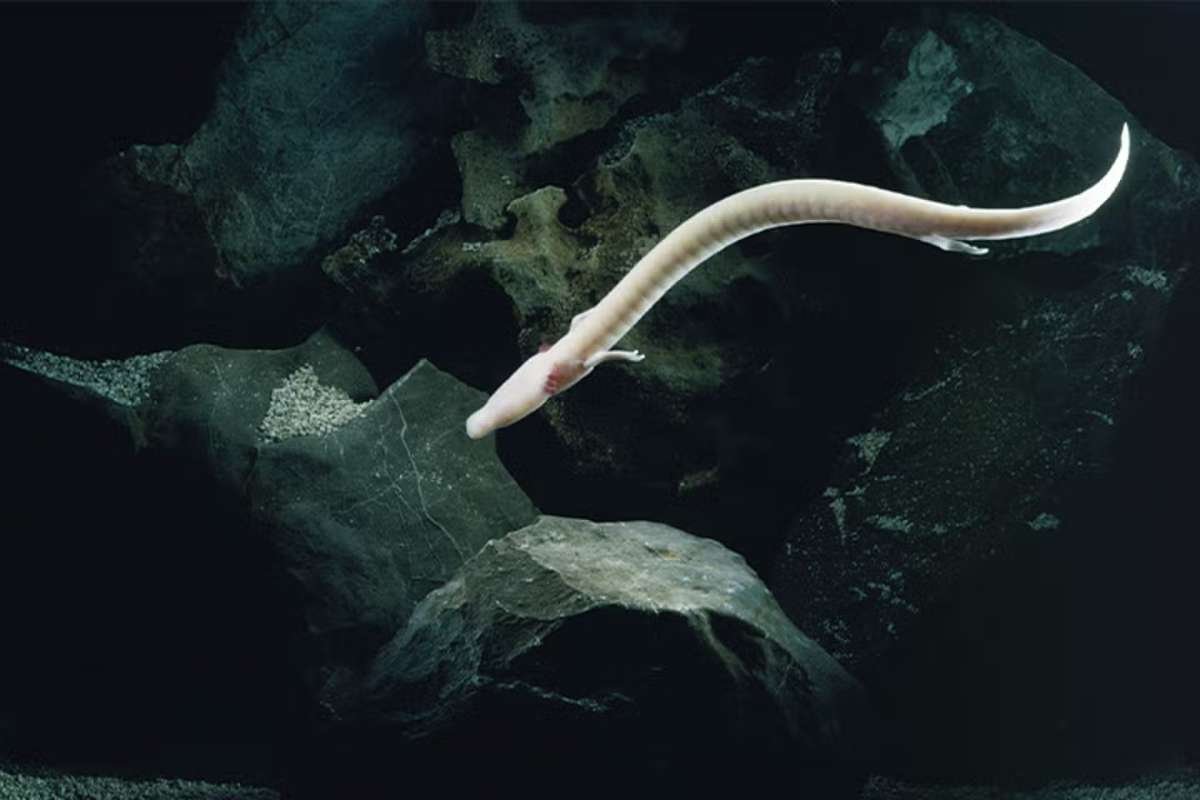
The olm is perhaps the most extreme example of neoteny in the animal kingdom. Native to the subterranean cave systems of the Dinaric Alps in southeastern Europe, olms live in an environment defined by darkness, scarcity, and stability.
Life Without Light
Over evolutionary time, olms lost:
- Functional eyesight
- Skin pigmentation
They retain:
- External gills
- Elongated, eel-like bodies
- Slow, deliberate movement
Instead of sight, olms rely on highly developed senses of smell, vibration, and electrical perception.
Extreme Longevity and Metabolism
Olms are metabolic minimalists:
| Lifespan | up to 100 years |
| Sexual maturity | 15–20 years |
| Feeding frequency | sometimes, once every several years |
| Survival without food | up to 10 years |
No other amphibian matches this combination of longevity and energy efficiency.
Why Neoteny Works Underground?
In nutrient-poor caves, metamorphosis would be energetically expensive with no benefit. Neoteny allows olm to remain perfectly adapted to stable underground conditions.
They are listed as Vulnerable due to groundwater pollution, cave tourism, and climate-driven changes to water systems.
Why Evolution Favors Staying Young?
For these amphibians that never grow up, neoteny offers powerful advantages:
- Elimination of risky habitat transitions
- Stable access to aquatic food sources
- Reduced energy demands
- Reproductive efficiency in consistent environments
However, specialization increases vulnerability. Any disruption to water quality, temperature, or chemistry can be catastrophic.
Why Scientists Are Fascinated?
Neotenic amphibians sit at the center of modern biological research:
- Regenerative medicine
- Stem cell behavior
- Aging and longevity
- Cancer resistance
- Evolutionary development (evo-devo)
Axolotls, in particular, show remarkable resistance to tumor formation despite constant cell regeneration, a paradox that could reshape cancer research.
Read Next: The Science of Small: What the 15 World’s Smallest Animals Teach Us About Evolution
Conservation: Saving More Than Species
Amphibians are declining faster than any other vertebrate group. Over 40% of amphibian species worldwide are threatened.
Protecting amphibians that never grow up means:
- Preserving freshwater ecosystems
- Safeguarding groundwater quality
- Protecting evolutionary knowledge millions of years in the making
Captive breeding programs, habitat restoration, and pollution control are critical—but public awareness is equally important.
Conclusion
Axolotls drifting through Mexican canals.
Mudpuppies lurking beneath icy rivers.
Olms are waiting patiently in eternal darkness.
They never grew up, and evolution never asked them to.
These amphibians that never grow up challenge our ideas of development, maturity, and survival. They remind us that progress isn’t always about transformation. Sometimes, it’s about staying exactly as you are and doing it better than anyone else.