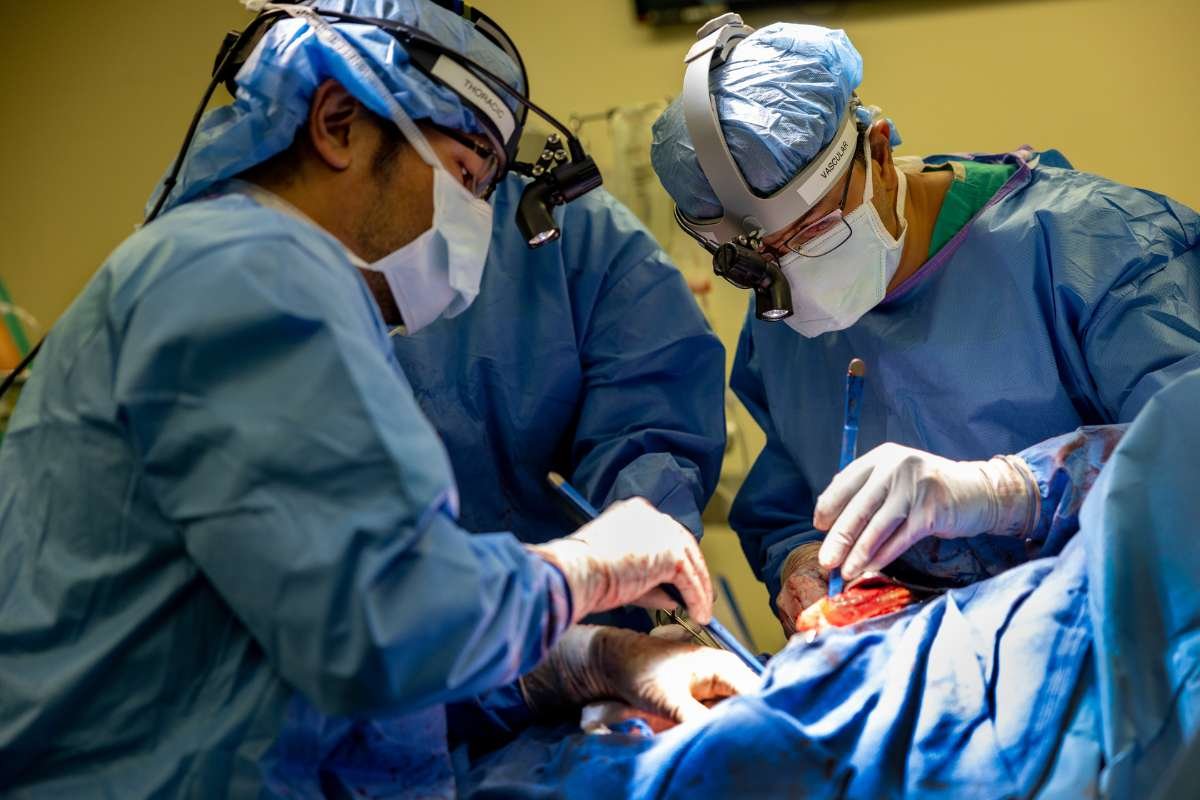
Surgeons at Northwestern University kept a critically ill man alive for forty-eight hours using a custom-built artificial lung system after removing his failed lungs, buying time until a donor transplant became available.
Surgeons have successfully kept a man alive without lungs for two days using an artificial lung system, marking a major step toward temporary organ replacement for patients awaiting transplants.
The patient, a thirty-three-year-old man from St. Louis, survived after doctors removed his irreparably damaged lungs and connected him to a system that oxygenated his blood and maintained normal heart function. Researchers reported the case on Jan. 29 in the journal Med.
The procedure demonstrates that a true artificial lung can sustain life when donor organs are not immediately available, according to the surgical team. Experts say the approach could help patients who would otherwise die while waiting for transplants.
Infections Triggered Rapid Lung Failure
The man became ill in 2023 after contracting influenza B. While hospitalized, he developed a secondary infection with Pseudomonas aeruginosa, a bacterium resistant to multiple antibiotics. The infection spread into his bloodstream, triggering severe immune reactions.
Doctors said the combined infections caused extensive lung damage. Despite aggressive treatment, his condition continued to worsen. Molecular testing showed his lungs would not recover.
“He was not getting better,” said Dr. Ankit Bharat, chief of thoracic surgery at Northwestern University Feinberg School of Medicine. “He was actively dying.”
Ordinarily, patients with active bloodstream infections are not eligible for lung transplants. Surgeons must clear infections first to prevent newly transplanted organs from failing. In this case, doctors faced a dilemma: the patient could not survive with his damaged lungs, but he also could not receive a transplant.
Artificial Lung Replaces Oxygen Function
To solve the problem, Bharat and his colleagues removed the patient’s lungs entirely and connected him to an artificial lung system they had designed. The system used shunts, tubes, and pumps to reroute blood through an oxygenator.
Blood was drawn from the right side of the heart, infused with oxygen, and cleared of carbon dioxide, then returned to the left side of the heart. This allowed the heart to continue pumping blood normally throughout the body.
The patient remained on the system for forty-eight hours. During that time, doctors closely monitored heart function, blood flow, and infection levels.
Previous cases have relied on extracorporeal membrane oxygenation, or ECMO, a machine that oxygenates blood outside the body. However, ECMO does not fully support normal heart circulation and is not considered a true artificial lung, Bharat said.
“This system maintains normal heart function while replacing the lungs,” he said. “That distinction is critical.”
Transplant Follows Rapid Recovery
Doctors initially expected the infection to take weeks to clear. Instead, removing the lungs eliminated the primary source of bacteria, allowing the infection to subside rapidly.
“Once we took out the source of the bacteria, the infection started to get better very rapidly get better,” Bharat said.
As soon as the infection cleared, doctors placed the patient on the transplant list. A donor lung became available immediately, and surgeons performed the transplant without complications.
More than two years later, the patient is doing well, Bharat said. His heart function is normal, and his transplanted lung is healthy.
Researchers say the case provides proof that artificial lungs could serve as a temporary bridge for patients who cannot survive with failing lungs but are not yet eligible for transplant. Larger studies will be needed to determine how long such systems can safely support patients.
“This opens a door we have never been able to walk through before,” Bharat said. “It gives us time where there was none.”